


Lahore Awargi’s summer school confronts urban amnesia by using creative pedagogy to reinstall architectural memory
Text by: Ar. Roha Yousaf (Department of Architecture, University of Engineering and Technology, Lahore)
Lahore, Pakistan – In a city perpetually defined by its chaotic, exhilarating forward momentum, a metropolis where flyovers slice through centuries-old bazaars and glass towers overshadow the delicate brickwork of forgotten empires. History often feels less like a legacy and more like an unwelcome obstruction. For the younger generation navigating Lahore’s unprecedented urban expansion, the city’s profound architectural and cultural past is rapidly becoming an alien concept, irrelevant to the high-speed reality of modern life. It is against this backdrop of accelerating urban alienation that a crucial initiative, Lahore Awargi: Seen and the Unseen, has launched its newest, most ambitious venture: the six-week interdisciplinary summer school, “Illustrating Kipling’s Lahore”, held in the summer of 2025. The program aims to soften the divide between the young and the old, the visible and the forgotten, by re-engineering the way students, particularly those in architecture, art, and the humanities engage with the built environment. The goal is not merely to preserve history, but to make it irresistible, participatory, and emotionally necessary.
Lahore, often called the cultural heart of Pakistan, is undergoing a transformation that is simultaneously magnificent and destructive. Traditions and culture that characterized the layered and multifaceted history of Mughal, Sikh, and colonial influences are steadily being swept away. Enlarged avenues, new concrete structures, and the relentless drive for modern functionality are eroding the physical evidence of this complexity. The practice of celebrating architectural heritage has become a niche pursuit, failing to capture the imagination of a youth oriented toward globalized aesthetics.


For many students today, the academic history of Lahore is delivered through dry texts and fixed academic regimes, fostering passive reception rather than active curiosity. This approach often fails to communicate the lived texture of the past, the stories hidden within the peeling paint, the collaborative spirit embedded in hybrid architectural forms, and the complex negotiations that defined the colonial period. When heritage is presented as a dusty, dead stone, it is avoided; Lahore Awargi seeks to invoke it as a living storyline.
This urgency led Architect and Educator Naveen Zaman to found Lahore Awargi. It is not simply a heritage organization; it is a creative movement. The organization recognized that the only way to safeguard Lahore’s identity was to redefine the city through art, memory, and personalized experience.
“Students are only interested in what they can identify with,” Zaman explains. “If we teach history as a set of static dates, it remains irrelevant. If we teach it as an unfolding drama of creativity, pushing, pulling, and confusion, a story they can step into and help narrate-they transform from bystanders into stewards.”
Rediscovering the Hybridity of the Raj
The centerpiece of this philosophy is the “Illustrating Kipling’s Lahore” summer school. The program delves critically into the late 19th and early 20th centuries, focusing on the interwoven legacies of John Lockwood Kipling (artist, educator, and principal of the Mayo School of Arts) and his Nobel Prize-winning son, Rudyard Kipling. These figures, alongside pivotal local architects and engineers such as Bhai Ram Singh and Sir Ganga Ram, co-created a cityscape defined by its architectural and cultural hybridity.
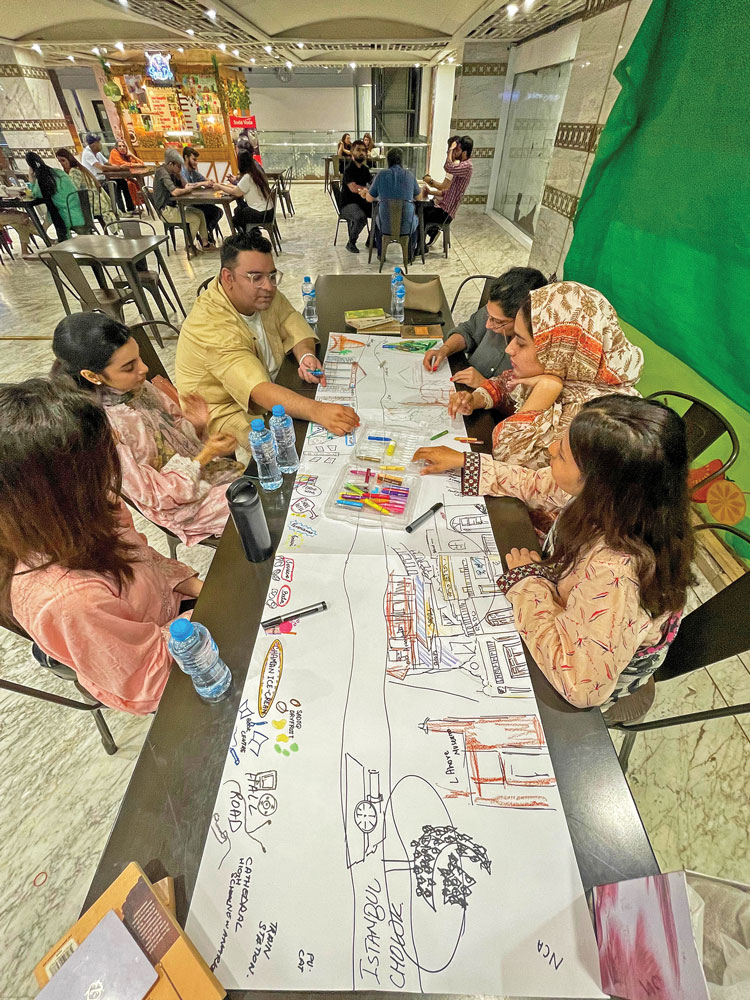
The project is an entry-level, interdisciplinary course designed to reimagine this complex colonial heritage using tools beyond the history book: critical art, visual storytelling, cartography, photo walks, and intensive field visits. It encourages participants to respond critically to the figures who shaped the city’s contemporary identity, not to uncritically consume their legacy.
The selection of Kipling’s Lahore as the thematic core is strategic. It allows participants to engage directly with the colonial archive, the texts and images that framed the city for the British Empire-but immediately challenges the often-Orientalist lens through which it was viewed. The summer school aimed to recognize the local genius and collaborations that formed the unique Indo-Saracenic style, a fusion that speaks volumes about cultural negotiation and agency.


The Six-Week Critical Pedagogy
The course was structured as a comprehensive six-week pedagogy, meticulously combining history, architecture, art, and literature under a critical post-colonial approach. It deliberately moved beyond the model of students as passive receivers, pushing them into advanced activities of narrative reinterpretation and critical documentation.
The journey unfolded across three sequential, two-week modules:
Module I: Lahore and the Footprints of the Raj (Weeks One & Two)
Theme: Cartography and Memory Mapping
The foundational module, “Lahore and the Footprints of the Raj,” introduced participants to colonial Lahore, focusing particularly on the monumental interventions along Mall Road. This road, a regulated promenade lane, embodied imperial aspirations of power and urban order. Students engaged in critical cartography, learning not just what was built, but why it was built where it was, and whose memory was prioritized. They analyzed how imported urban models clashed and merged with vernacular spatial practices.
Module II: Between the Crown and the Lotus (Weeks Three & Four) Theme: Collaborations and Hybridity
The second phase delved into theoretical complexity. Framed by “Between the Crown and the Lotus: Collaborations and Hybridity,” this module exposed participants to critical concepts like Orientalism, hybridity, and enculturation. Architecture was studied not as static structure, but as a vehicle of cultural negotiation.
A central focus was on the revolutionary work of Bhai Ram Singh, the celebrated architect and protégé of John Lockwood Kipling, who skillfully blended local Mughal and Hindu aesthetics with European structural techniques. Similarly, the civic contributions of Sir Ganga Ram were examined. By analyzing structures designed or influenced by these local masters, students could grasp how imperial aesthetics were localized, internalized, and ultimately redefined through South Asian craftsmanship and vision. This module critically dismantled the notion of colonial architecture as a purely European importation.
Module III: Pictured through Prose (Weeks Five & Six)
Theme: Word, Image, and Memory
The final weeks emphasized the narrative construction of Lahore in both literary and visual forms. Entitled “Pictured through Prose: Word, Image, and Memory,” this stage involved close readings of Rudyard Kipling’s seminal novel, Kim, Short stories- Plain tales from the hills, alongside selections from John Lockwood Kipling’s ethnographic and artistic writings.
The crucial exercise here was to examine how the city was inscribed into the colonial imagination and how specific sites were fictionalized, romanticized, or marginalized. Participants then had to produce their own counter-narratives, using advanced writing and visual media to challenge the fixed, imperial perspectives and present a multi-dimensional, lived Lahore.
The Urban Pilgrimage: Embodied Learning
The element that made the experience “addictive” was the integration of embodied learning through urban pilgrimages. Instead of relying solely on artifacts or academic texts, the program mandated a series of meticulously guided site visits designed to bring participants face-to-face with the material fabric of the colonial city, placing the past directly into the present’s lived reality. The itinerary was designed to showcase various methods of heritage experience. The students walked Mall Road, examining collaborative halls such as the Lahore Museum (where John Lockwood Kipling served as curator), the Mayo School of Arts (now the National College of Arts), the Punjab University Old Campus, and the General Post Office. These institutions collectively illustrate the mastery of the Indo-Saracenic style that reflected both imperial aspirations and a profound engagement with vernacular identity. The architecture here tells a story of an educational and civic infrastructure being re-envisioned through a locally informed design idiom.

Visits extended to sites deeply entrenched in Rudyard Kipling’s literary output, including the Zamzama Gun (Kim’s Gun) and the bustling lanes of Anarkali Bazaar, where the novel Kim unfolds along with the area around Wazir Khan Mosque mentioned in the Plain tales from the hills. These explorations underscored the powerful relationship between textual representation and the physical environment, demonstrating how literature and the built landscape co-produce cultural memory. The program strategically moved beyond the strictly colonial sphere to places of deep vernacular continuity. A visit to the Wazir Khan Mosque provided a crucial anchor point in Mughal heritage, emphasizing the depth of tradition that Indo-Saracenic architects sought to integrate. Furthermore, an exploration of the dense, vibrant locality of Gowalmandi, guided by Architect Zubair Yousaf, foregrounded the concepts of hybridity, featuring the unplanned, organic negotiations between layers of history that exist outside formal planning.
Complementary workshops, conducted by Architect Roha Yousaf, introduced the camera not merely as a recording device but as a tool for critical documentation and interpretation. Photography sessions were framed as methodologies for preserving heritage, telling submerged stories, and producing counter-narratives that challenge monolithic views of the city. Visit to Lahore museum and discussion with Ms. Iffat Azeem (Senior Research Officer and formerly an in-charge of the Coins and Manuscripts sections) related to the history of Lahore Museum opened up the new horizons and built critical thinking among students about John Lockwood Kipling’s life.
Identity, Youth, and Memory: The Relevance Today
The decision to return to Kipling’s Lahore must be understood in the larger context of contemporary identity formation. For a generation of Lahoris accustomed to an environment typified by segregated housing, fast infrastructure, and globalized commerce, the colonial urban anatomy often seems functionally irrelevant.
Yet, as the Lahore Awargi summer school demonstrated, these buildings carry crucial accounts of creative compromise, cross-cultural hybridity, and the foundation of modern South Asia. Recognizing these intertwined narratives allows students to grasp the city as an urban palimpsest, a site where multiplicity of historical layers collide, inform, and ultimately determine the present.


This form of recognition fosters cultural rootedness. Heritage ceases to be a relic of nostalgia and becomes an active component of self-definition. By reading Lahore through Kipling’s era, students are compelled to engage critically with the archival material. They are urged to look past the overt imperial narrative, challenge Orientalist constructions, and actively recognize the agency of figures like Bhai Ram Singh and Sir Ganga Ram.
The learning process transforms the student’s relationship with their city as they learn that the past is not a foreign country but a living, breathing component of their daily commute and institutional life. The Indo-Saracenic blend, once perhaps dismissed as “old architecture,” reveals itself as a powerful symbol of early collaboration and cultural self-assertion.
The Ongoing Movement
Lahore Awargi’s summer school is more than an intensive course; it is an intervention designed to combat urban amnesia. By integrating the arts, architecture, literature, and critical theory into a six-week embodied experience, Ar. Naveen Zaman and his collaborators are training a new generation of sophisticated urban analysts, students who understand that saving a city is not just about preserving stones, but about capturing stories. The initiative serves as a powerful model for global cities grappling with rapid, destructive modernization. It argues that history, when taught creatively and critically, does not need to be dull or alien. Instead, it can become an addictive force, transforming passive residents into active, informed stewards of a profoundly complex and endlessly fascinating urban heritage.
As the participants of “Illustrating Kipling’s Lahore” concluded their program, they were equipped not just with historical data, but with a new visual and conceptual toolkit to decipher the city’s unseen narratives. They left with the foundational understanding that the Lahore of Rudyard Kipling is not a museum piece, but a contested, hybrid foundation upon which the identity of the 21st-century Lahori must be built. The movement continues, ensuring that the soul of the city, however fragmented by modernization, will not be entirely swept away.
Summer School
Pedagogy Details:
Ar. Naveen Zaman
Department of Architecture, University of Engineering and Technology, Lahore
The Participants/ students who worked on the Art Illustrations:
Fatima Mubarak Faisal
Amna Adnan
Syeda Hoor Zahra
Aiman Mahmood


