


TEXT BY AR. ASMA QAYOOM
The 3rd International Conference and Panel Discussion on “Navigating the Barriers: Interdisciplinary Value of Artificial Intelligence was held at Dawood University of Engineering and Technology (DUET), Karachi, on December 18-19, 2025. The conference brought together scholars, researchers, industry professionals, and policy-makers across the globe, highlighting the growing interdisciplinary impact of Artificial Intelligence (AI) across architecture, defense, governance, and sustainable development. The event commenced with an inspiring inaugural session, followed by plenary sessions, discussions, and keynote presentations, aiming to explore both the opportunities and challenges of AI in global contexts.
Inaugural Session
The inaugural session commenced at 9:3o am with the recitation from the Holy Quran, followed by the National Anthem. Distinguished international and national speakers, honored guests, and esteemed participants were welcomed.
Engr. Prof. Dr. Atif Jamil, Convener of the Conference and Dean of the Faculty of Information and Computing Sciences, highlighted the central role of Artificial Intelligence in advancing global strategies and innovation. Engr. Prof. Dr. Samreen Hussain (S.I., T.I.), Vice Chancellor of Dawood University of Engineering and Technology, welcomed the guests, dignitaries, keynote speakers, and panelists. She reflected on the significance of the conference theme, “Navigating the Barriers: Interdisciplinary Value of Artificial Intelligence,” situating it as a continuation of Dawood University of Engineering and Technology’s previous two successful international conferences, including “Blurring the Barriers: The Interdisciplinary Value of Architecture” and “Blurring the Barriers: The Interdisciplinary Value of Material Engineering.” Engr. Prof. Dr. Samreen Hussain (S.I., T.I.), emphasized the importance of interdisciplinary engagement in addressing complex contemporary challenges and underscored DUET’s ongoing commitment to fostering research, innovation, and knowledge-sharing across academic, professional, and industrial sectors. She also highlighted the university’s recent achievements, including patents and publications in Nature-affiliated journals, positioning DUET as a leader in AI-driven research and education.
International scholars shared valuable perspectives: Prof. TS. Dr. Mohammad Sanusi Azmi demonstrated AI applications in cultural heritage through digital image verification of the Al-Quran Mushaf and digital Jawi palaeography, while Dr. Haixia Liu highlighted equitable global access to AI, previewing her plenary session on advancing humankind through inclusive AI technologies.
Architecture and Urban Planning Perspectives
Architecture and urban planning perspectives were presented by Ar. Ejaz Ahmed Qadri, Chairman of the Pakistan Council of Architects and Town Planners, emphasizing responsible integration of AI into professional practice and academic curriculum. His presentation stressed ethical oversight, contextual sensitivity, and the balance between technological advancement and human creativity in architectural and urban design.
Mr. Jam Khan Shoro, Minister of Irrigation, Planning and Development, Sindh, shared insights on sustainable planning and governance strategies, highlighting the role of AI in enhancing decision-making for public infrastructure and resource management.
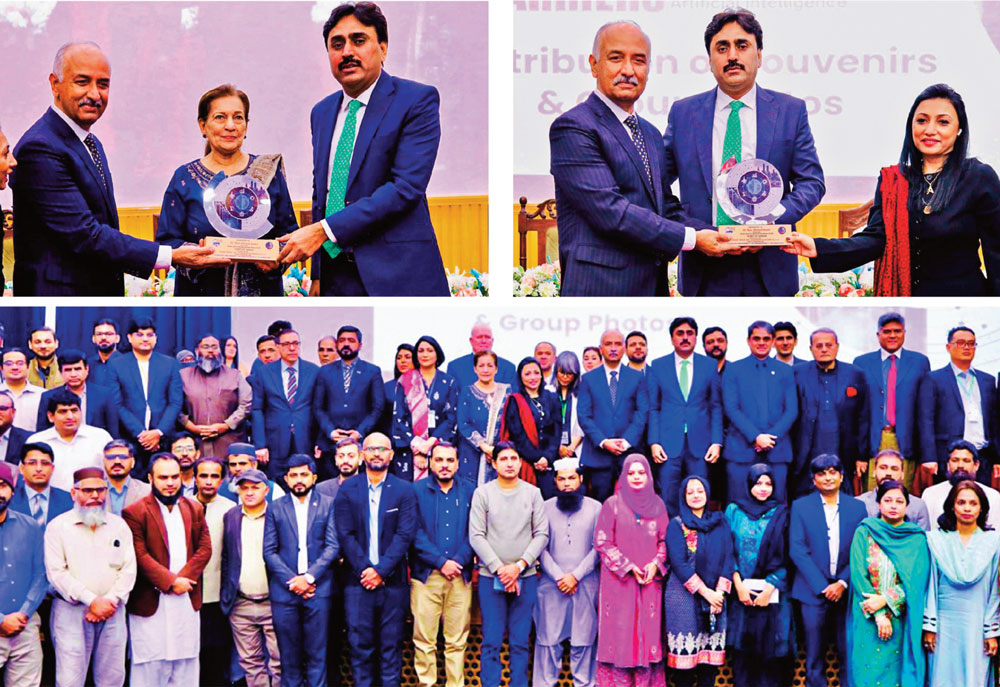
The session concluded with the ceremonial distribution of mementos to distinguished guests, recognizing their academic and professional contributions. Participants then gathered for group photographs, capturing the collaborative spirit and collective commitment to interdisciplinary dialogue and responsible AI adoption.
Plenary Session I: Navigating the Barriers – Interdisciplinary Value of Architecture
The plenary session was chaired by Ar. Ejaz Ahmed Qadri, a veteran architect with over three decades of experience and a leading contributor to Pakistan’s architectural landscape. As founder of Qadri Associates, he is known for balancing innovative design with contextual sensitivity, integrating sustainability, local heritage, and contemporary functionality. His projects harmonize modern engineering with cultural and aesthetic considerations, creating practical and culturally attuned spaces.
As Chairman of the Pakistan Council of Architects and Town Planners (PCATP), Ar. Qadri emphasized interdisciplinary collaboration and the ethical use of emerging technologies like AI to enhance, not replace, human creativity. His leadership highlighted professional accountability, underlining that architectural practice carries social, cultural, and ethical responsibilities alongside design excellence.
The co-chair of the session was Prof. Dr. Yasira Naeem Pasha, a globally recognized academic leader and scholar. Prof. Dr. Yasira Naeem Pasha serves as the Dean of the Faculty of Architecture, Planning, and Civil Engineering at Dawood University of Engineering and Technology (DUET), where she has championed innovation in architectural education and research. Holding a post-doctorate from University College London, she has contributed extensively to interdisciplinary research, bridging architectural theory, design pedagogy, and practical applications.
Prof. Dr. Yasira Naeem Pasha has established international collaborations with institutions in the United Kingdom, Turkey, and Pakistan, highlighting her commitment to integrating global best practices into local contexts. Her research has earned her prestigious recognitions, including the International Research Scholarship from the Higher Education Commission of Pakistan and the Charles Wallace Fellowship from the British Council, reflecting her dedication to advancing knowledge, fostering critical inquiry, and promoting cross-cultural academic exchange.
Beyond the Algorithm – The Human Hands behind Al’s Harms and Possibilities
The conference began on a thought-provoking note with the keynote delivered by Professor Stephen Lyon, inaugural Dean of the Faculty of Arts and Sciences at Aga Khan University, Karachi. As a cultural anthropologist specializing in social organization, conflict, and development, Professor Stephen Lyon provided a human-centered perspective on Artificial Intelligence, emphasizing its societal, ethical, and professional implications.
AI as a Mirror of Human Intention
Professor Stephen Lyon framed AI as a direct reflection of human values, intentions, and cultural contexts, emphasizing that its capabilities are entirely shaped by the data and judgments embedded by humans. He distinguished between existing General AI, used for task-specific problem-solving, and the theoretical concept of Super AI, underscoring the need for foresight and ethical governance in AI development.
The Imperative of Ethical Oversight
A central theme of the keynote was ethical responsibility. Prof. Lyon cautioned that without proper governance, AI could reinforce bias, exacerbate inequalities, and disrupt professional standards. He stressed that AI must not function as an autonomous decision-maker and that human judgment, creativity, and contextual understanding remain essential, particularly in disciplines reliant on intuition and social awareness.
Applications, Limitations, and Human Agency
While acknowledging AI’s potential to enhance productivity, analysis, and optimization, Prof. Lyon highlighted its limitations, noting that AI lacks contextual judgment, cultural sensitivity, and creative intuition. He emphasized that professionals must retain authority over AI-driven outcomes, positioning AI as an enabling tool that augments human intelligence rather than replacing it. He concluded by urging participants to view AI as a reflection of collective human responsibility, with ethical intent and human oversight as non-negotiable principles.Takeaway of the talk:
- AI Reflects Human Intent: AI is shaped by human data, values, and choices, making responsible use and ethical awareness essential.
- Ethical Governance Is Critical: Clear oversight is needed to manage current AI and anticipate future developments while preventing social or professional harm.
- Human Judgment Remains Central: AI should support critical thinking, creativity, and decision-making-not replace human authority.
Prof. Lyon concluded that the future of AI depends on responsible guidance today. His keynote set an ethical and intellectual tone for the conference, emphasizing the balance between technological innovation, human values, and interdisciplinary collaboration.
Generative AI – Your New Design Language
The second keynote of the conference was delivered by Ar. Sobiya Munawar, a renowned AI Generative Design Trainer and Head of Marketing & Strategy at Al-Feroz Pvt Ltd. With over i8 years of experience spanning architecture, media, and corporate strategy, Ar. Sobiya Munawar shared deep insights into how generative artificial intelligence (AI) is transforming architectural and interior design practices. Her session, titled “Generative AI -Your New Design Language,” explored AI not as a creative replacement but as an augmentative partner in the design process, emphasizing both ethical adoption and societal impact.
AI as an Augmentative Tool, Not a Decision-Maker
Ar. Sobiya Munawar challenged the notion of AI as a replacement for human creativity, emphasizing that it functions as an augmentative tool guided by human intent. She noted that AI operates through prompts, making the quality of outcomes dependent on professional judgment, intuition, and critical thinking. While generative AI enables rapid design iterations, visualization of complex spaces, early-stage modeling, and experimentation, she stressed that execution intelligence-such as site understanding, detailing, coordination, and problem-solving-remains inherently human.
Responsible Integration and Ethics
She underscored the need for ethical oversight, cautioning that uncritical reliance on AI may pose professional and societal risks. AI’s predictive capabilities, she argued, must be guided by ethical frameworks and professional accountability to ensure technology strengthens architectural practice rather than undermines it.
Academic and Societal Implications
Addressing education, Ar. Sobiya Munawar advocated for integrating AI into curricula through structured training, ethical guidelines, and innovative assessment methods without compromising core architectural values. She also highlighted AI’s broader societal impact, noting that responsible use can support collaboration, sustainability, and community-focused solutions, while misuse risks reinforcing bias and disrupting social norms.
Takeaway of the Talk
Ar. Sobiya Munawar concluded with a set of actionable insights for both practicing architects and educators:
– Use AI as a supportive tool to enhance creativity, visualization, and iterative design while retaining human decision-making.
– Maintain human judgment and ethics by ensuring contextual awareness, professional accountability, and ethical oversight.
– Integrate AI responsibly in education and practice to prepare for an AI-augmented future without replacing human intelligence.
Her session left the audience with a holistic understanding of AI in architecture: a tool that enhances creative potential, improves efficiency, and informs decision-making, while always remaining tethered to human intelligence, ethical judgment, and professional responsibility.
Panel Discussion:
The panel discussion for the Plenary Session “Navigating the Barriers – Interdisciplinary Value of Architecture” was moderated by Ar. Asma Qayoom, Lecturer at the Department of Architecture and Planning, Dawood University of Engineering and Technology (DUET), Karachi. In her opening remarks, she welcomed the audience and set a reflective tone by situating the session within the broader objectives of the conference. She referenced earlier sessions, particularly Professor Stephen Lyon’s keynote on the human and ethical dimensions of AI and Ar. Sobiya Munawar’s presentation on generative AI as an emerging design language, noting that these perspectives laid a strong foundation for interdisciplinary dialogue. She emphasized that the panel brought together professionals from architecture, engineering, and AI-driven design to explore AI’s evolving role in shaping the built environment.
Ar. Asma Qayoom introduced the panelists, beginning with Ar. Syed Arif Shah, Architect, Project Manager, and Director of Arif Shah (Pvt.) Ltd., with over 25 years of experience in large-scale projects emphasizing sustainability and multidisciplinary coordination, and Engr. Fahim Iqbal Siddique, a senior mechanical engineer with more than four decades of leadership in MEP and HVACR systems and CEO of Fahim, Nanji & deSouza.
Framing the Dialogue
To initiate the discussion, the moderator highlighted the growing need for interdisciplinary collaboration across architecture, engineering, and AI-driven technologies. Panelists agreed that contemporary urban and architectural challenges require integrated approaches where design intelligence, engineering expertise, technology, and human judgment converge. Addressing academia-industry collaboration, Ar. Syed Arif Shah emphasized that AI should be adopted as a support system for design thinking rather than a replacement for creativity and intuition.
Audience Interaction and Open Floor Discussion
The session then opened to active participation from students, academics, and professionals. Discussions focused on ethical concerns, technical limitations, regulatory challenges, and practical AI integration. Prof. Dr. Yasira Naeem Pasha raised concerns regarding AI misuse and its societal consequences, prompting Professor Stephen Lyon to reiterate that AI reflects human values and cultural contexts. He emphasized that ethical awareness and anthropological insight are essential to prevent AI from reinforcing inequalities or disrupting social norms.
Practice, Education, and Future Directions
Ar. Sobiya Munawar emphasized ethical and contextual AI use, noting that trust in AI-generated outputs depends on transparency and integration within the full design process. While AI accelerates visualization and iteration, it must reflect the underlying intellectual and creative journey, as demonstrated in successful professional applications, particularly in the Middle East. From a professional perspective, Ar. Ejaz Ahmed Qadri and Engr. Fahim Iqbal Siddique acknowledged AI’s role in improving efficiency, coordination, and data-driven decision-making, while stressing the need for human oversight. The session concluded that AI’s full potential can be realized only through responsible, interdisciplinary practice that preserves human intelligence, creativity, and professional accountability.
Conclusion of the Panel Discussion
The panel collectively reinforced that architecture must remain human-centric, with AI serving as an enabling instrument to support creativity, collaboration, and informed decision-making. The societal and professional impact of AI depends on responsible guidance, ethical frameworks, and interdisciplinary understanding, ensuring that technology strengthens professional practice rather than undermining it.
The session was formally concluded by Ar. Ejaz Ahmed Qadri, Chairman of the Pakistan Council of Architects and Town Planners (PCATP). In his closing remarks, he emphasized the present and future role of AI in architecture, highlighting that while AI can enhance efficiency, visualization, and interdisciplinary collaboration today, its ultimate value will be realized only when it augments human intelligence, preserves creativity, and addresses real-world challenges responsibly. Ar. Qadri’s conclusion underscored the necessity of ethical governance, professional accountability, and human oversight, providing a strong and reflective closure to the panel discussion.
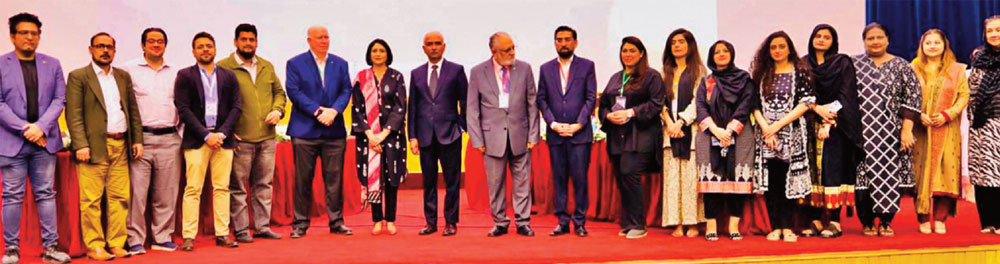
The plenary session concluded with the ceremonial distribution of mementos to the session chair, co-chair, keynote speakers, panelists, and moderator, acknowledging their academic and professional contributions. Group photographs followed, capturing the collaborative spirit, shared purpose, and interdisciplinary engagement of the conference.
Recommendations from the Panel Discussion
The conference session on “Navigating the Barriers -Interdisciplinary Value of Architecture” highlighted both the immense potential and the inherent risks of Artificial Intelligence in architectural practice. Drawing from the insights of keynote speakers, panelists, and audience interactions, several key recommendations emerged:
1. Use Al as a Supportive Tool: Leverage AI to enhance creativity, visualization, iterative design, and data analysis while ensuring human judgment remains central.
2. Ensure Ethical Oversight: Establish strong governance, professional codes, and ethical frameworks to prevent misuse and protect societal and cultural values.
3. Preserve Human Intelligence and Creativity: Maintain human agency, intuition, contextual understanding, and ethical reasoning in all decision-making processes.
4. Integrate AI Responsibly in Education and Practice: Incorporate structured training, ethical guidance, continuous learning, and reflective practice without compromising core architectural principles.
5. Promote Interdisciplinary and Informed Decision-Making: Foster collaboration across architecture, engineering, anthropology, and ethics, using AI to support analysis and scenario modeling while retaining human interpretation and contextual judgment.
These recommendations collectively stress that AI’s role in architecture is conditional upon responsible intent, human oversight, and ethical deployment. When applied thoughtfully, AI can elevate productivity, support sustainable practices, and foster innovation across academic, professional, and societal contexts.


