


By Sarah Ather Khan
Karachi’s coastline is home to communities whose lives have long been intertwined with the sea. For generations, fishing settlements have relied on local and Indigenous knowledge, strong social networks, and collective practices to adapt to changing tides, seasonal cycles, and environmental uncertainty. Today, however, these communities face mounting pressures from climate change, environmental degradation, declining marine resources, and rapid urbanisation. While development initiatives often focus on physical infrastructure, they frequently overlook the cultural knowledge, social relationships, and community assets that underpin resilience.
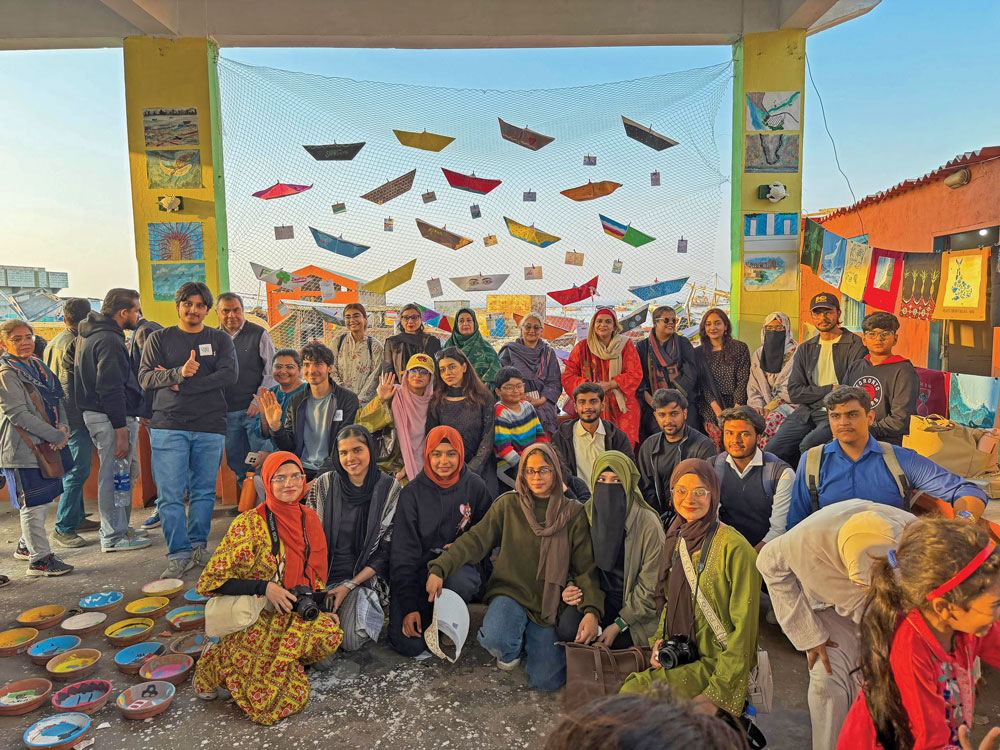
Weaving Together: Local Art for Social Cohesion and Climate Resilience, led by Sarah Ather Khan, Assistant Professor at NED University of Engineering and Technology, and supported by the British Council’s Climate Futures South Asia Programme (2025), set out to explore a different approach. The project didn’t treat art as a decorative addition to public space; instead, it positioned creative practice as a participatory design tool capable of strengthening social cohesion, celebrating local identity, and encouraging environmental stewardship. Inspired by the fishing net, a powerful symbol of livelihood, interdependence, and collective effort, the project adopted weaving as both a metaphor and a methodology, connecting people, place, and knowledge through a collaborative process of making.
The project was implemented on Baba Island, one of Karachi’s oldest fishing settlements, where public space remains central to everyday social life despite increasing environmental and economic pressures. Working alongside residents, artisans, fishermen, women, children, students, and artists, the initiative transformed the fishermen’s communal space, improving the physical environment and reinforcing the cultural values and social relationships that sustain community resilience.

A defining strength of the project was its interdisciplinary and cross-sector collaboration. The Centre for Arts-Based Methodologies and Wellbeing (CFAW) served as the lead artistic partner, designing and facilitating the participatory arts programme. Drawing on arts-based methodologies, CFAW curated creative workshops, community engagement activities, and public art installations that responded to local culture, environmental concerns, and community aspirations. Rather than imposing predetermined artistic outcomes, the creative process evolved through continuous dialogue with residents, ensuring that every intervention reflected the lived experiences and identity of the island.
Equally important was the project’s commitment to local craftsmanship and circular design. Local artisans and craftspeople were actively involved throughout the design and construction process, ensuring that traditional skills remained central to the intervention. Reclaimed and discarded materials were creatively repurposed within the installations, reducing waste while demonstrating the potential of circular design approaches in community-led placemaking. This process not only supported local livelihoods but also highlighted the value of indigenous craftsmanship as an essential component of sustainable design.
The initiative also relied on a broad network of institutional and corporate partnerships that strengthened both implementation and long-term sustainability. Community committees worked alongside academic institutions, civil society organisations, industry partners, and residents to guide the project from conception to completion. A dedicated digital platform documented the process, shared community stories, and created opportunities for wider public engagement, ensuring that the project’s lessons extended beyond the island itself.
Underlying every aspect of Weaving Together was a simple but powerful principle: meaningful public spaces cannot be designed for communities; they must be designed with them. Through a collaborative process that brought together art, architecture, environmental action, and local knowledge, the project demonstrated that creative placemaking can become a practical framework for building resilient coastal communities. The resulting intervention was a shared process through which community members became designers, makers, and long-term custodians of their own public spaces.

Reimagining the Chaan
At the heart of Weaving Together was the transformation of the Chaan—the principal communal gathering space on Baba Island and one of the island’s most significant public places. Located on the western edge of the island overlooking the mangroves, the Chaan connects the nearby commercial area, mosque, and community healthcare centre, making it an important social node within the settlement. It serves as the community’s everyday meeting place, where fishermen gather before and after fishing trips, elders hold informal discussions, children play, and residents come together during religious festivals, community celebrations, and other social events. Its central role in daily life made it the ideal site for demonstrating how thoughtful design and collective action can revitalise public space.
Despite its importance, the Chaan had gradually fallen into disrepair. The site consisted of a boundary wall with three entrances, two shaded structures, a wooden kiosk operated by the community’s only physically challenged resident, a community kitchen, a public bathroom constructed on stilts over the shoreline, a boat repair workshop, a raised concrete water tank, and several small tool repair shops. One shaded structure included permanent seating, while the other had a broken wooden structure and no benches. Although parts of the site were paved, it lacked landscaping and lighting. Years of neglect had resulted in deteriorated boundary walls, a damaged roof of the central steel shade structure, broken flooring and benches in the shaded area, accumulated solid waste, and a non-functional public bathroom without water, sewerage connections, doors, or windows, significantly reducing the quality of the space.
The design strategy focused on restoring and strengthening what already existed. A participatory design process placed residents at the centre of decision-making, ensuring that the intervention responded to local needs, everyday routines, and the cultural significance of the space. Community consultations highlighted the need to preserve the Chaan’s flexibility as a multipurpose gathering place. Consequently, no permanent structures were built in the open area, allowing it to continue to accommodate communal events, religious gatherings, and seasonal activities. The design also responded to the site’s environmental context, particularly the periodic rise in sea level during spring tides, when seawater reaches the centre of the open space.
The architectural intervention prioritized durable, low-maintenance improvements suitable for the island’s harsh marine environment. Existing concrete shade structures were repaired, and a new corrugated steel roof was installed on the steel frame. Both seating areas received marble benches on masonry bases, chosen for their long-term corrosion resistance. The deteriorated boundary wall was reconstructed on its original foundation and reconfigured to provide two controlled access points instead of three, improving circulation and spatial definition. Solar-powered lighting was installed at an elevated height to enhance visibility, improve safety, and minimise future maintenance and vandalism—every design decision balanced functionality, durability, and the realities of building within a coastal environment.
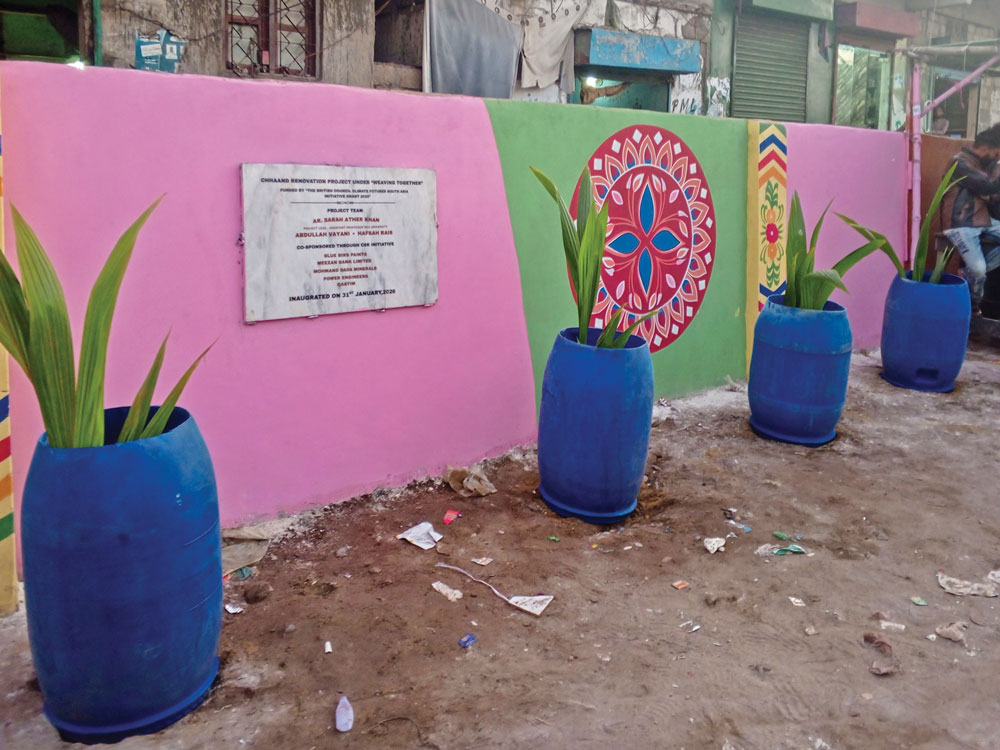
The transformation of the Chaan was made possible through a collaborative partnership between the community and a network of corporate supporters. Mohmand Dada Minerals donated the marble used for the seating, Qaayim provided the fully grown local plants that introduced much-needed greenery to the space, Meezan Bank supported project implementation, Bluebird Arts supplied paints for the artistic interventions, and Power Engineers contributed electrical consultancy and lighting for both the Chaan and the adjoining jetty. These contributions complemented the labour, knowledge, and craftsmanship provided by residents, ensuring that the intervention remained rooted in community participation rather than external delivery.
Art, Ownership, and the Life of a Public Space
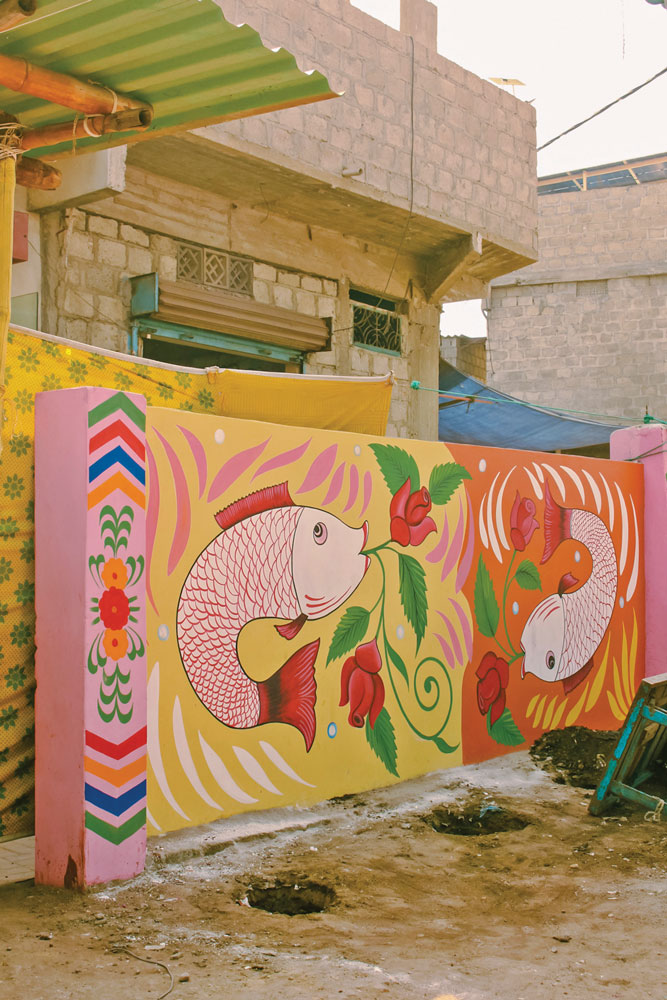
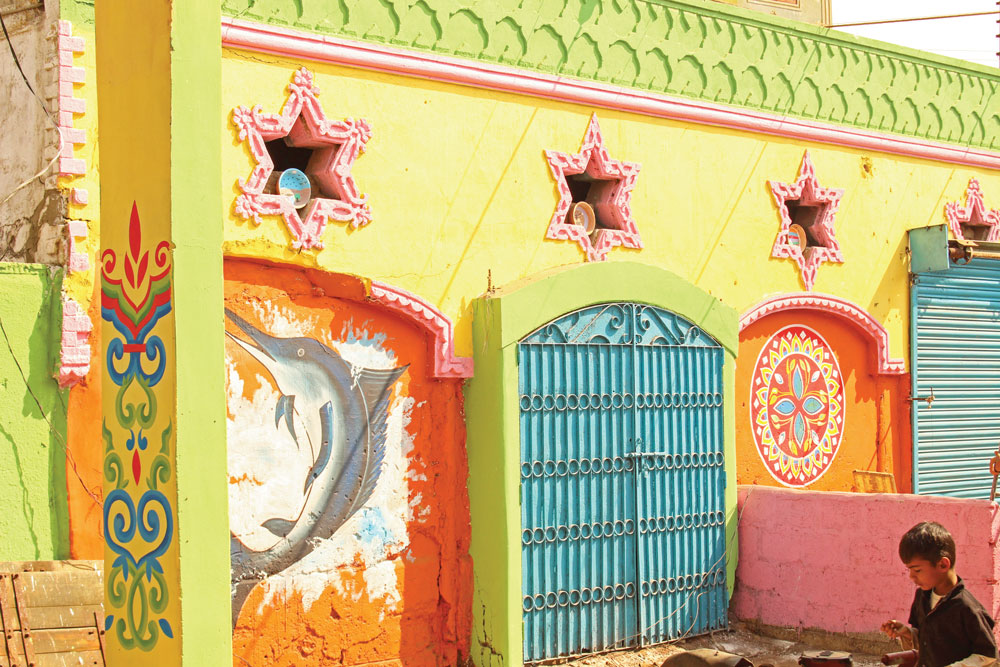
Public art was conceived as an integral component of the architectural intervention rather than a decorative addition. A local artist painted boat-inspired motifs across the walls and surrounding surfaces, celebrating Baba Island’s maritime identity and reinforcing residents’ connection to place. Simple interventions also encouraged everyday use of the space. A hopscotch court painted on the ground was immediately embraced by local children, demonstrating how modest design gestures can activate public spaces and foster a sense of belonging. Complementing these elements, a series of participatory art installations co-created with community members transformed the revitalised Chaan into a vibrant setting for collective expression. Drawing inspiration from the island’s fishing traditions, cultural heritage, and coastal environment, the installations responded to themes of livelihood, ecology, identity, and resilience, embedding local narratives within the public realm and enriching the spatial experience.
The central installation drew inspiration from the fishermen’s net, an enduring symbol of livelihood, cooperation, and survival. Handcrafted by a local net-weaving artisan, the suspended artwork celebrated traditional craftsmanship while recognising the knowledge embedded within the community. Its vibrant woven collage reflected the social and cultural diversity of Baba Island, illustrating how individual identities are interwoven to form a resilient and cohesive community.
Sustainability was explored through a second installation, Trash to Treasure, where discarded plastic bottles, wire mesh, textile waste, and other reclaimed materials were transformed into a sculptural tree at the centre of the Chaan. Textile waste acknowledged Pakistan’s prominent textile industry while drawing attention to the environmental consequences of industrial consumption. Colourful origami boats suspended from its branches represented hope and the collective aspirations of the community for a more sustainable future.
The relationship between people and the sea was further explored through Sea of Hope, a large fishing-net installation suspended against the backdrop of the coastline and the fishing boats under construction. Origami boats, painted by local children during earlier workshops, were attached to the net, creating a visual dialogue between the artwork, the surrounding landscape, and the working harbour. Positioned between land and sea, the installation became a powerful reminder of the interdependence between community, ecology, and livelihood.
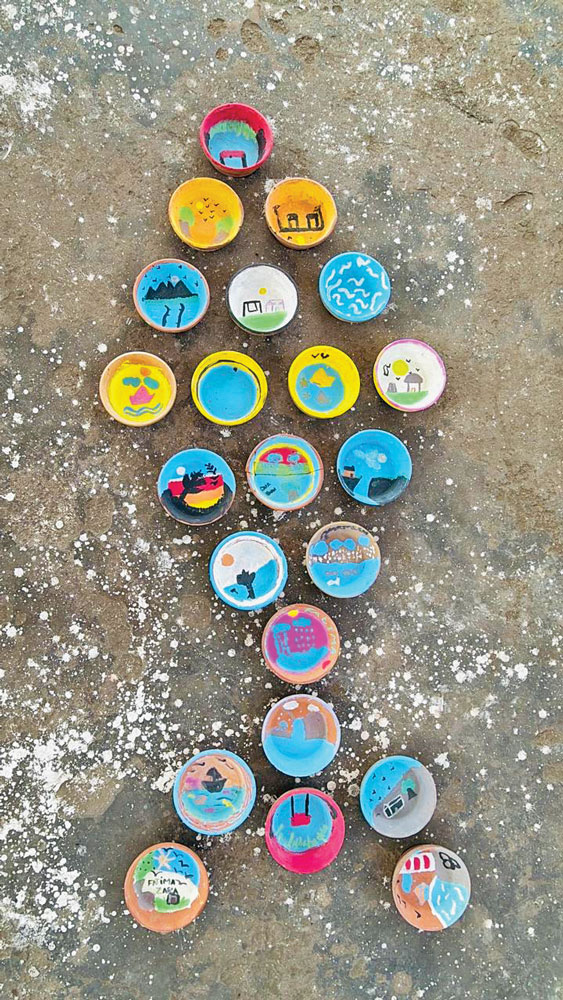
Care for the natural environment was reflected in the Community Bird Feeders, painted by children and arranged in the shape of a fish. Beyond their symbolic connection to the island’s fishing heritage, the feeders provided food and water for birds and other animals inhabiting the island, extending the project’s message of care beyond human communities to the wider coastal ecosystem.
The Chaan itself became an open-air gallery where artworks created collaboratively by fishermen, women, children, students, and artists animated the walls and public spaces. These works captured personal memories, local stories, environmental concerns, and aspirations for the future, allowing residents to see their own experiences reflected in the landscape they inhabit. In doing so, the project embedded local narratives directly into the physical environment, strengthening both identity and belonging.
More than a physical renovation, the intervention redefined the Chaan as a shared civic space shaped by the people who use it. Residents participated throughout the planning, design, construction, and artistic processes, becoming collaborators rather than beneficiaries. This participatory approach fostered a strong sense of pride, ownership, and collective responsibility, ensuring that the revitalised space reflected local identity, knowledge, and aspirations. By combining sensitive architectural improvements, local craftsmanship, and public art, the project demonstrated that even modest interventions can generate lasting social value when grounded in community participation and collective stewardship.
The impact of this ownership became evident soon after the project was completed. Community members voluntarily cared for the newly planted vegetation and, using leftover paint from the project, collectively transformed the adjoining street without external assistance. These simple yet meaningful actions demonstrated that the intervention had become part of everyday community life rather than a temporary project. The renewed Chaan evolved into a lively gathering place where people of all ages came together for daily interaction, cultural events, and informal social activities, reinforcing the role of public space in strengthening community relationships.
The experience of Weaving Together offers an important lesson for architects and designers. Resilient public spaces are not created through physical improvements alone; they emerge through processes that value local knowledge, encourage participation, and foster a shared sense of responsibility. By integrating architecture, public art, environmental action, and community-led design, the project demonstrated that even modest interventions can generate lasting social, cultural, and environmental impact when communities are recognised not simply as users of space, but as its designers, makers, and custodians.
Sarah Ather Khan
PhD Scholar and Assistant Professor
Department of Architecture and Planning
NED University of Engineering and Technology


