


Reported by Archi Times Editorial Desk
Architecture across the world is undergoing a profound shift, moving beyond hand-drawn imagination into realms where algorithms, artificial intelligence, data streams, and simulation engines co-author the built environment. Yet, Pakistani academia and professional practice resemble a pre-digital analog culture, and this growing tension was brought into sharp focus on 11 October 2025 at Kickstart Gulberg, Lahore, during “BAD: Blueprints Are Dead: From Drafting Dreams to Debugging Realities.” What was expected to be a typical academic seminar quickly transformed into a candid, urgent, and at times uncomfortable conversation about the future of the profession. The event opened with a live musical performance that softened the room before Architect Irtiza’s talk, The Evolving Landscape of Architecture: Inspiration to Innovation, which set the tone. His provocation, “Your architecture degree may have taught you how to sketch, render, and present, but did it prepare you to code, simulate, or compute?”, echoed throughout the afternoon, framing architecture not as a static discipline but as a dynamic interface between technology, contemporary tools, communal identity, and interdisciplinary frameworks.

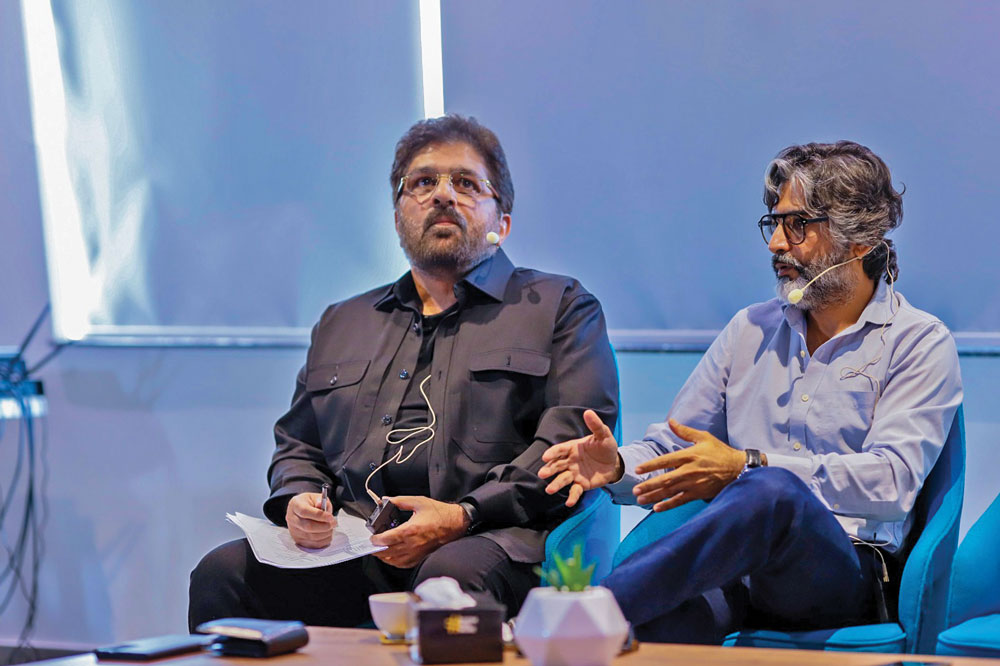
Moderated by Dr. Fatima Javeed and Assoc. Prof. Quratulain Asghar, both a Fulbright Alumni and a proponent of technology, led the first session, bringing together Dr. Faisal Sajjad, Dean of NCA Lahore, and Dr. Shariyeh Hosseini Nasab of COMSATS Lahore for a forthright evaluation of architectural pedagogy in Pakistan. When asked about algorithmic thinking, and why most schools teach CAD before computational logic or scripting, as well as the preferred year to introduce these topics to students-whether in first or final year-Dr. Sajjad (Dean, NCA) explained that he believes technological advancement is the need of the time. He further mentioned that at NCA (National College of Arts), students admitted through the quota system come from diverse backgrounds across Pakistan. This results in varying levels of access to and familiarity with technology. Therefore, he suggested that technology should not be mandatory for all first-year students. Instead, a basic, simplified introduction could be provided to everyone, with more advanced content offered as electives. Dr. Sajjad noted that while some students adapt easily to technology, others find even basic tasks challenging. He recommended offering multiple pathways, allowing less tech-savvy students to pursue architectural education using traditional tools, while others could opt for more technological approaches as they progress. Dr. Hosseini Nasab offered a comparative view grounded in Iranian curricula, explaining how technology can reinforce cultural identity rather than dilute it. In response to whether technology should be mandatory from the first year, she agreed with Dr Sajjad that some students are pro-technology, and they do well with digital tools, while some are not so tech-savvy. She believed schools should offer flexibility for all kinds of students and that the curriculum should not be rigid or fixed. Their exchanges exposed the central dilemma: education must change, but only with sensitivity to students’ varied abilities, backgrounds, and cultural limitations.
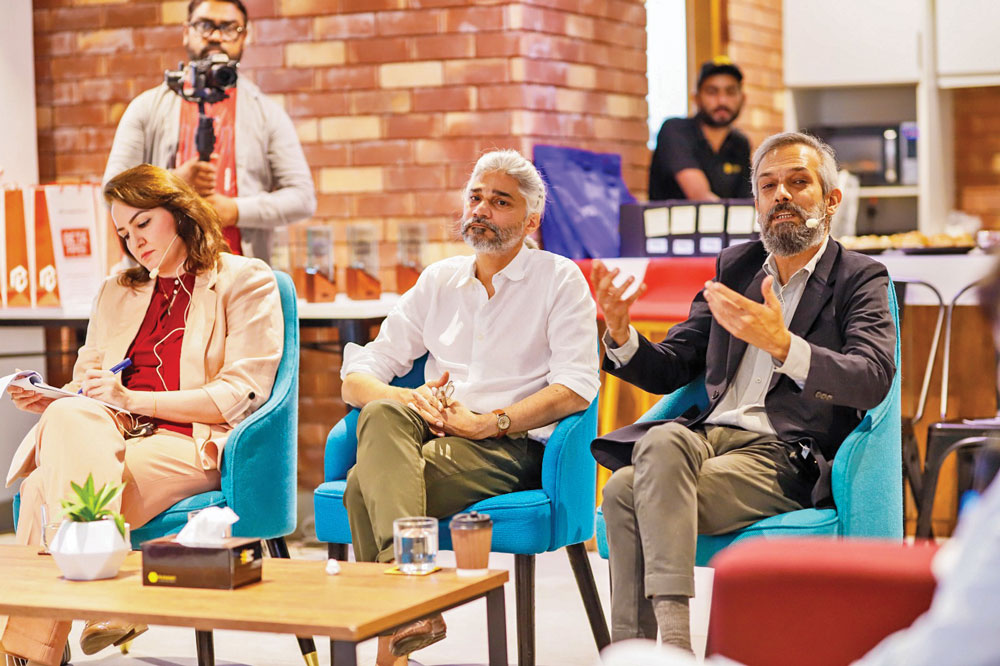

Ar. Omer Hassan was of the opinion that the use of Technology is often viewed with intimidation, despite its potential being respected. The belief is that rapid technology adoption can be risky, as it may create a false sense of arrival and complacency. He stated that in institutions like RHSA (BNU), early exposure to technology is intentionally avoided for at least 2 years. He stated that these days, technology is so readily available that formal teaching of it may become unnecessary, allowing those truly interested to pursue it independently, as was done in the past. The teaching of technological subjects is seen as a diversion from nurturing creative thinking, which is considered more essential than producing technical workers. His comment critically enhanced the conversation, reminding the audience that digital fluency must not come at the expense of humanistic depth or critical reflection.
He admitted that his firm belief is placed not in artificial intelligence, but in ancestral intelligence, the idea that historical knowledge and cultural roots should be reclaimed and prioritized. The loss of this grounding is attributed to an overreliance on Western models. A return to foundational values is encouraged, so that comfort in identity can be restored before technology is used, as an enabler, not a foundation.
The moderators pushed the conversation forward, raising questions about faculty training, AI literacy, simulation pedagogy, and the constraints imposed by regulatory bodies such as PCATP and HEC. The responses from all the panelists were a blend of hope and exasperation, a recognition that transformation is essential but slowed by institutional inertia, outdated policies, and limited faculty upskilling. After a brief interlude, the discussion shifted from classrooms to construction sites as practitioners joined the stage. Architects Syed Fawad Hussain of the Metropolitan Studio of Architecture and Ahmad Mukhtar of Al-Imam Enterprises Pvt. Ltd. spoke candidly about the widening disconnect between academia and professional practice. Mukhtar, when asked what kind of graduates the industry needs, demanded graduates who are technologically equipped from academia. He emphasized that how contemporary workflows now revolve around digital modeling, data analytics, and sustainability metrics. When asked how academia might catch up, he suggested a small opening for change through the Higher Education Commission’s renewed focus on university incubation centers. Mukhtar, trained at UET Lahore and the University of Manchester, argued that Pakistan’s studios must finally invest in computational research and development to remain globally competitive. On the other hand, Ar. Syed Fawad Hussain noted that architectural schools and professional practice operate on fundamentally different systems, shaping young professionals in distinct ways. Institutions provide theoretical, historical, and research-based foundations, while early practice, leading to licensure, teaches procedural, regulatory, and real-world skills. Because each realm has its own purpose, schools should remain focused on academic grounding rather than attempting to replicate professional practice, which lies outside their structure, capacity, and expertise.

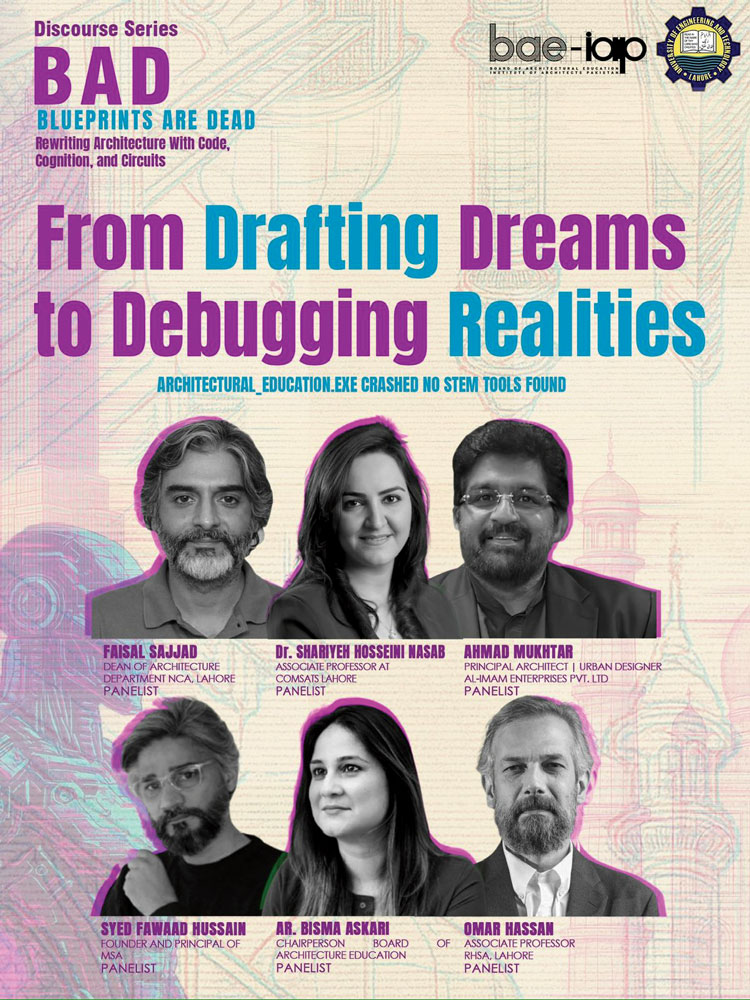

The afternoon took a philosophical turn when Ar. Omar Hassan, Dean of the Razia Hassan School of Architecture at BNU Lahore, drew from his education at RISD and his experience establishing Pakistan’s first Institute for Experimental Construction. He urged cultivating hybrid thinkers: designers who balance design with data, philosophy with performance, and ethics with innovation. Across sessions and speakers, a single theme persisted: architectural education in Pakistan must mirror the complexity of contemporary practice.
A Politecnico di Milano, graduate from the Audience, Maryam Iqbal, voiced that in institutions abroad, students are being engaged from day one through parallel networking and multidisciplinary approaches. She advocates that a high level of integrated practice, invested in technology, is evident there. Studio leadership is consistently assigned to practicing architects, which is seen as a structural norm. However, In contrast, within Pakistan, a divide is identified between academicians and practicing architects. Educational roles are being occupied separately, with little collaboration or overlap. This lack of integration is viewed as a critical issue, and she suggested that both sectors be brought together to enrich the academic environment and students’ professional readiness.
Few of the students sitting in the audience stated that building simulations, data-driven analysis, and AI-driven workflows are no longer optional specializations; they are the new foundation of architectural production globally. Students at the event voiced frustration that their degrees leave them underprepared for this new terrain, while moderators admitted that faculty development, rigid curricula, and resource limitations slow necessary change. Practitioners warned that unless academia builds stronger bridges with research-oriented practices, graduates will struggle to remain employable in a rapidly transforming field. While closing this insightful discussion, moderators emphasized that we should not only talk, but implement necessary reforms and integrate technology in the profession to facilitate Generation Z and Alpha. They insisted that senior position holders should work with HEC and PCATP to bring major reforms and policies for the architecture profession to flourish in Pakistan.
In the end, “Blueprints Are Dead” did not merely critique the present; it signaled the emergence of a new architectural code for Pakistan’s architectural evolution, one built not on the fixed precision of the blueprint but on the dynamic, iterative, and collaborative logic of computation. Whether Pakistan’s architectural institutions choose to rewrite their pedagogical software or continue relying on outdated tools will determine not only the future of its architects but also the future of its built environment.
Event hosted at Kickstart Moderated and organized by Fatima Javeed and Assoc. Prof. Quratulain Asghar
Panelists: Dr. Faisal Sajjad, Dr. Shariyeh Hosseini Nasab, Ar. Syed Fawaad Hussain, Ar. Ahmad Mukhtar, Ar. Omar Hassan


