


Takween Integrated Community Development
Esna, EGYPT
Photographer: Ahmed Mostafa | © Aga Khan Trust for Culture
Project data
Project: Revitalisation of Historic Esna
Location: Esna, Egypt
Clients: Ministry of Tourism and Antiquities, Luxor Governorate,
United States Agency for International Development Principal Donor and Strategic Partner
Architects: Takween Integrated Community Development
Kareem Ibrahim, Managing Director, Project Lead
Nevine Akl, Design and Conservation Management Director
Sherine Zaghow, Tourism and Socio-Economic Development Director
Ahmed al-Biblawi, Site Conservation and Rehabilitation Director
Structural and Geotechnical Consultants: Al-Madina Consulting Office
Electro Mechanical Consultant: Infra Group Consultants
Site Area: 107,100 m2
Ground Floor Area: 107,100 m2
Total Built Area: 107,100 m2
Cost: 8,800,000 US$
Commission: October 2016 – ongoing
Design: February 2017 – ongoing
Construction: July 2018 – ongoing
Occupancy: August 2021
Project Description
Located by the Nile about 60 kilometres south of Luxor, Esna is best known for its temple devoted to the ram-headed Ancient Egyptian creator god Khnum. The small city’s dense and richly layered urban fabric – from the Graeco-Roman, Coptic, Islamic/Fatimid, and Mamluk-Ottoman periods through to nineteenth- and twentieth-century vernacular domestic architecture – testifies to millennia as a commercial and cultural hub. Yet its entire historic core had been earmarked by the government for demolition, left dangerously fragile through decay since a river barrage built in the 1990s had caused a 95 per cent reduction in the cruise-ship tourism on which it had come to depend.
Egypt’s national planning body invited the Cairo-based urban development company Takween, experienced in participatory upgrading, to offer an alternative vision. The strategy they devised to save this precious living heritage site is one of understated yet transformative urban acupuncture: small interventions in the living urban tissue, combining cultural sustainability with inclusive economic development.
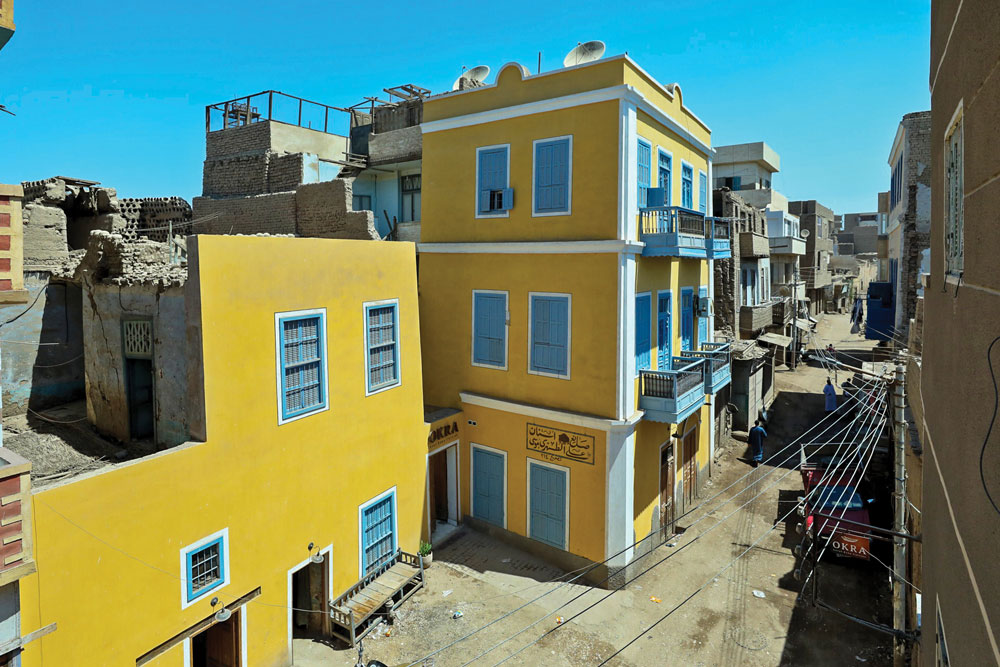


The initial phase, titled Rediscovering Esna’s Cultural Heritage Assets (RECHA), received USAID funding – a first for an Egyptian-led cultural heritage initiative. It focused on restoring and/or adaptively reusing some twenty key historic structures, employing the region’s traditional techniques – from mud brick to lime plastering, terracotta tiles, and fine wood-carving – and using salvaged materials wherever possible. Among these structures are the Wakālat al-Geddāwī – an eighteenth-century caravanserai that had been closed to the public since 1951 – and the vast Qīsāriyya Market, with its 144 shops, frequented by locals and visitors alike. The Temple of Khnum was also upgraded, improving accessibility and public services to the site that is sunken some 10 metres below today’s ground level.
A second phase, Value Investment in Sustainable Integrated Tourism in Esna (VISIT-Esna), went on to establish a broader socio-economic urban revitalisation framework by developing small and micro businesses alongside tourism services and cultural branding. Two of the new businesses are entirely female-led – the Okra kitchen restaurant, serving distinctive local dishes that visitors will not find in other parts of Egypt, and a woodworking workshop – empowering many women who previously had no paid employment.
A model of bottom-up sustainable development, the project has reversed Esna’s decline and created hundreds of lasting jobs for locals, revitalising age-old crafts and passing them on to a new generation. Since its launch, visitor numbers have tripled.


Jury citation
“The initiative to revitalise historic Esna goes beyond the usual limits of an urban conservation project that is formally framed in advance and instead presents a bottom-up strategy through an inclusive, socially structured programme to gradually improve the heritage environment. Hence, residents play a major role in maintaining the urban synergy through its living heritage, sparking sustainable regenerative momentum in what had become dilapidated built fabric.
By restoring or reusing buildings – commercial, residential, and spiritual – the project is stimulating a whole historic urban metabolism to cope with the contemporary challenge of improving human conditions and working infrastructure for craftspeople. Its community-driven initiatives are a catalyst for upgrading the local economy through small and micro enterprises. Accordingly, the project echoes local techne and know-how through innovative small and accumulative results to actively generate the conservation of the urban core, the city’s identity, cultural dynamism, and economic resilience.
In doing so, the project clearly shifts the paradigm of urban conservation to another level, prioritising the role of residents’ collective intelligence in transforming their challenging and derelict built environment. Rather than only addressing monuments and other tangible historic fabric, the focus is also on intangible cultural capital as leverage to revitalise both the material and immaterial dimensions.
The key gain from the revitalisation of historic Esna is how it reactivates historic spaces through incremental and accumulative actions to synergise the social, cultural, environmental, and economic potentials through the community’s ingenuity. Thus, it introduces social innovation as a creative tool for urban upgrading, such as the Okra women-run initiative for gender inclusion and local economic growth.
With its highly participative approach towards urban heritage conservation, the project became the first “conservation plan” for a non-monumental urban area to be approved by the Government of Egypt. Unprecedented in its combination of adaptive reuse with community empowerment while stimulating the local economy, it could bring balance to Egypt’s otherwise more formal heritage conservation strategies and policies.”


