


By: Komal Fatima & Zeaghum Ali
School of the Architecture University of Lahore a relatively new school among schools of architecture has made a name for itself in a short period of time. Remained under the visionary leadership of Dr. Syed Tauseef Ahmad and now headed by Dr. Amna Jahangir it is pertinent for the school to have an ideology and path forward. Such was the case when Vienna University of Technology visited UOL for a three-day wholesome program.
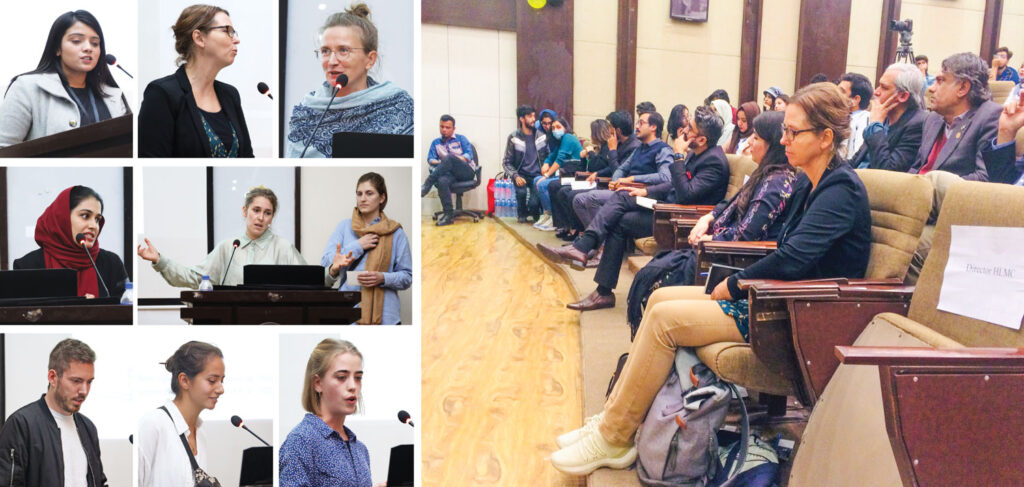
Organized by team members Ar. Syeda Komal Fatima, Ar. Syed Zeaghum Ali and Ar. Zeeshan Asim the program was divided into three days. Starting from 27 Nov the event lasted till 29th of Nov 2022. A workshop on day 1, a seminar on day 2, and a historical site visit on the third day. The whole idea was to have interactive sessions among students and faculty of both universities via different activities.
The program included a workshop by eminent architect and theologian Taimoor Khan Mumtaz. The geometric tensile structure was an exploration into the world of geometry and its integration into 3-dimensional elements of tensions and compression. Director Hastoneest, a school of traditional art and architecture Taimoor walked participants through the path of Islamic theology, linking it to geometry making them the same aspects of a coin. Starting from a dot he questioned participants about its origin. Participating actively some termed it as a starting point while others deemed it as part of the line. Ar. Taimoor directed the perspective to dot is a circle with zero radius, the center of every circle, and the origin of geometry. He while addressing the participants emphasized geometry as being the basis for every knowledge. Giving examples of scholars from traditional times like Plato and Aristotle who discovered the universe with just a compass and set square.
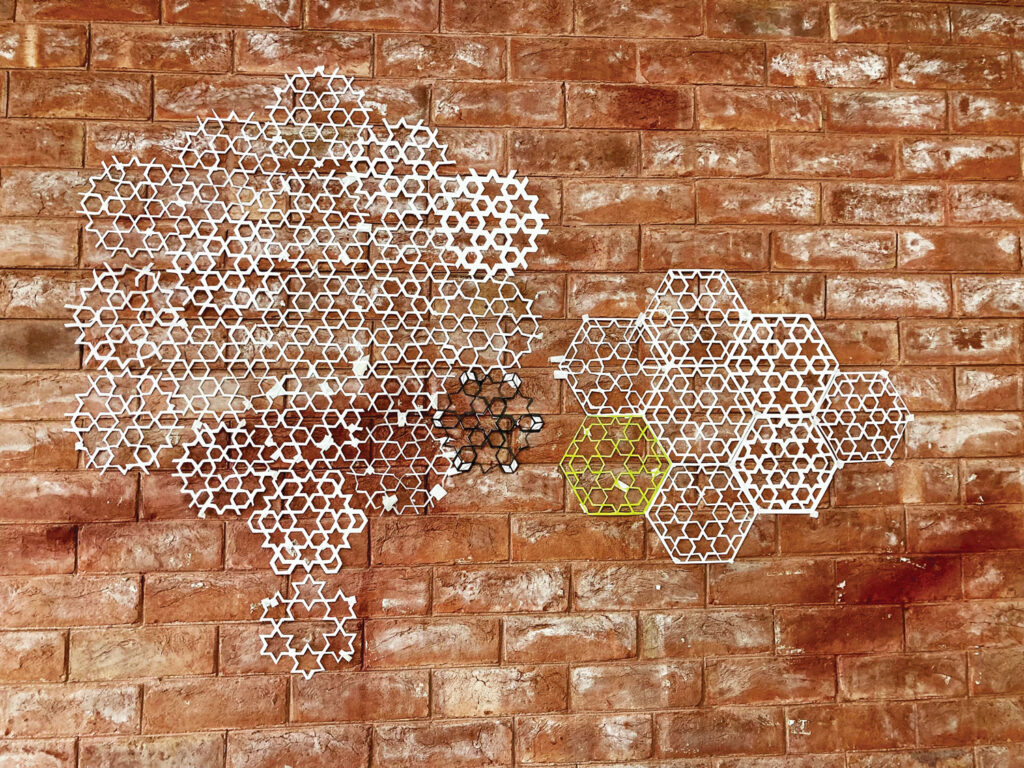
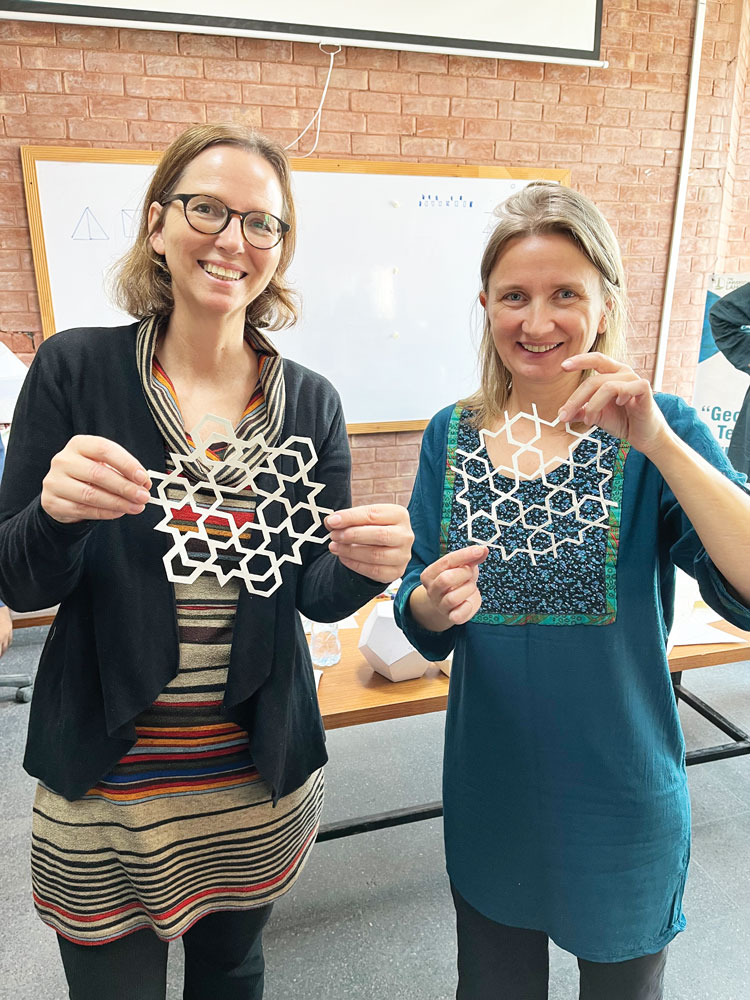
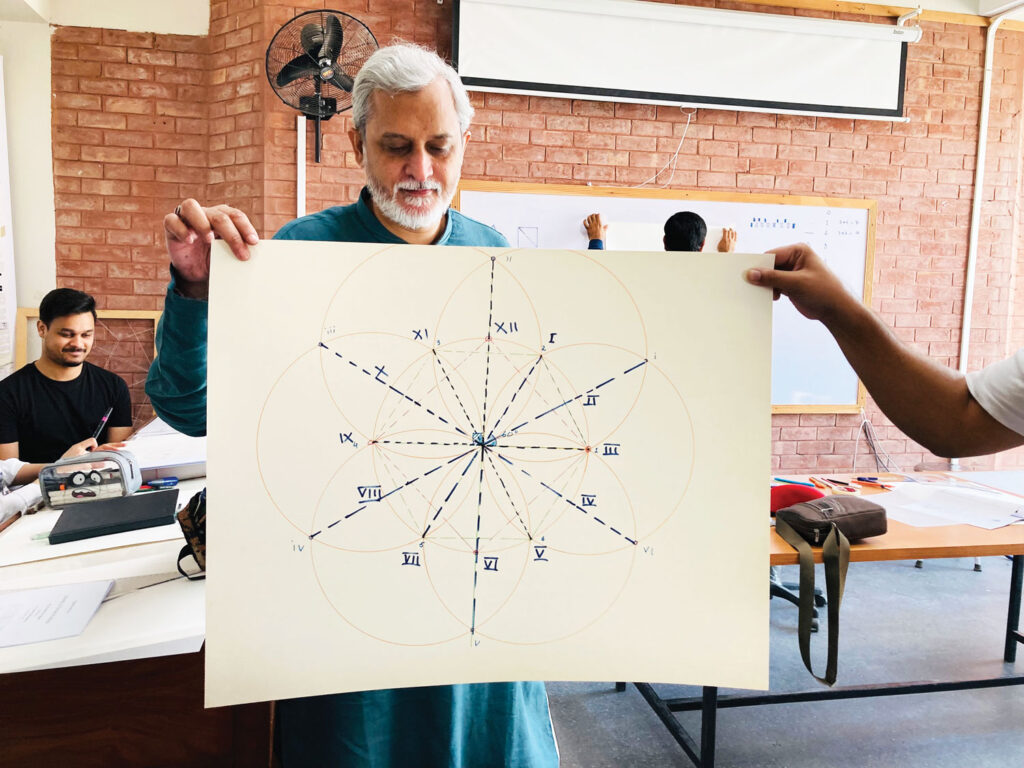


The students learned the formation of an 8-pointed star a tale of two inverted squares. They explored hexagons folded into the basic unit of a triangle. The multifold when cut in a pattern makes a screen of hexagonal geometry. Participants participated enthusiastically, each one adding to the whole structure in the wall behind. This led to the exercise of tensile geometry where students first brushed their hands on a small-scale model. The large-scale model where a wooden frame was suspended from the ground via stools made use of sticks and thread as the main material. Sticks acted as compressive elements while threading as a tensile element in a pattern of 8 pointed stars.
The second day was a day for Seminar based on the lecture series. Dr. Amna Jahangir Head school of architecture opened the session with a welcome note. Discussing the strengths of the School of Architecture she mentioned the enthusiasm of faculty in working towards the Ideology. Zeeshan Asim, coordinator school of architecture greeted the audience with enthusiasm for more such events. He reminisced a workshop held in London under the supervision of Ar. Komal Fatima and Ar. Zeaghum thanked his teammates for a successful Delivery of the project. He mentioned how the projects have opened avenues in multiple directions. Thus giving the audience a joint collaboration of the Vienna University of Technology and the University of Lahore. Afterwords Ar. Taimoor Khan Mumtaz was invited for a presentation on Islamic architecture. Ar. Taimoor gave a presentation on traditional arts and crafts and highlighted geometry as its bases. He ended his presentation with an urge to practice geometry, a harbinger of proportion and beauty, as the basis for architecture.


Rector University of Lahore, Prof Dr. Muhummad Ashraf acknowledged the efforts of the University of Lahore for uplifting its faculty and students through collaborations with international universities. He admired the organizers of the school of architecture for working towards the same goal. He thanked Dean “Of the history of Architecture Building, and Archeology”, and Andrea Rieger Jandl for bringing her delegation for a wholesome event.
After a presentation from prestigious guests certificates were distributed to participants of the workshop.
In the second half of the Seminar School of Architecture presented its efforts for zero carbon architecture in a presentation by students. The team mentioned their visit to the United Kingdom for Lari Octgareen on a groundbreaking workshop at Granary Square, University of arts London. They emphasized the importance of the structure being made by female students supervising delegates from the United Kingdom as well as Bangladesh. The structure remained displayed at High groove State of King Charles for good 6 months as a symbol of sustainable efforts by students. The University of Lahore further emphasized its contribution to efforts for sustainability by presenting projects from the combined studio of 3rd and fourth year on disaster relief shelters. Students presenting their group projects on post-disaster relief structures showed modularity and site-specific approaches in designs.

These presentations were followed by the presentation of the Dean, “History of Architecture Building, Archeology” Prof Andrea where she contributed to the effort for sustainability by showcasing efforts around the world.
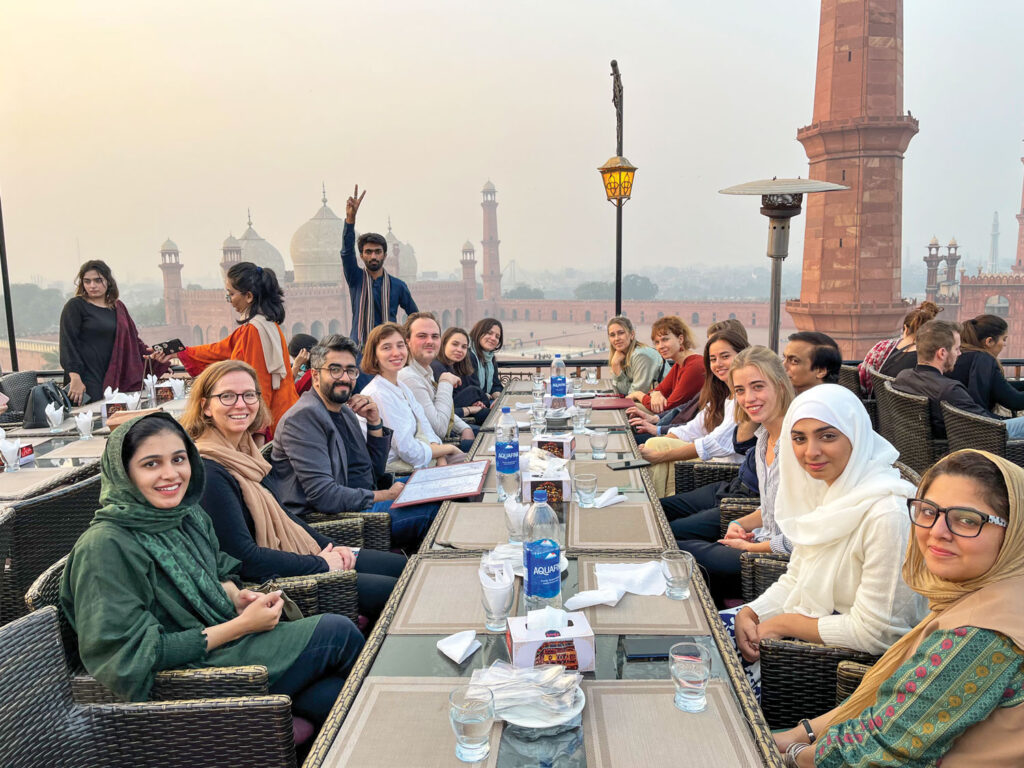
Senior lecturer Christine Lechner also administered global climate issues and its solution via a comprehensive report on solutions through architecture. Finally Assistant professor Fatima Sher from, school of architecture at the University of Lahore represented year-wise design ideology and studio inclinations. This was followed by a presentation by students of the Vienna university of technology discussing theirs. The event was concluded by a musical performance and a dinner in Poet Restaurant Lahore fort.
The third day was more of a sightseeing and taking learned things to test. Thus Lahore fort was the final destination. Students and faculty thoroughly enjoyed and explored Dehli gate, Shahi Hamam, Masjid Wazir Khan as well as Badshahi mosque and Lahore fort. Seeking through the times of glory and pure crafts the visit was a success in terms of Architectural Education.


