


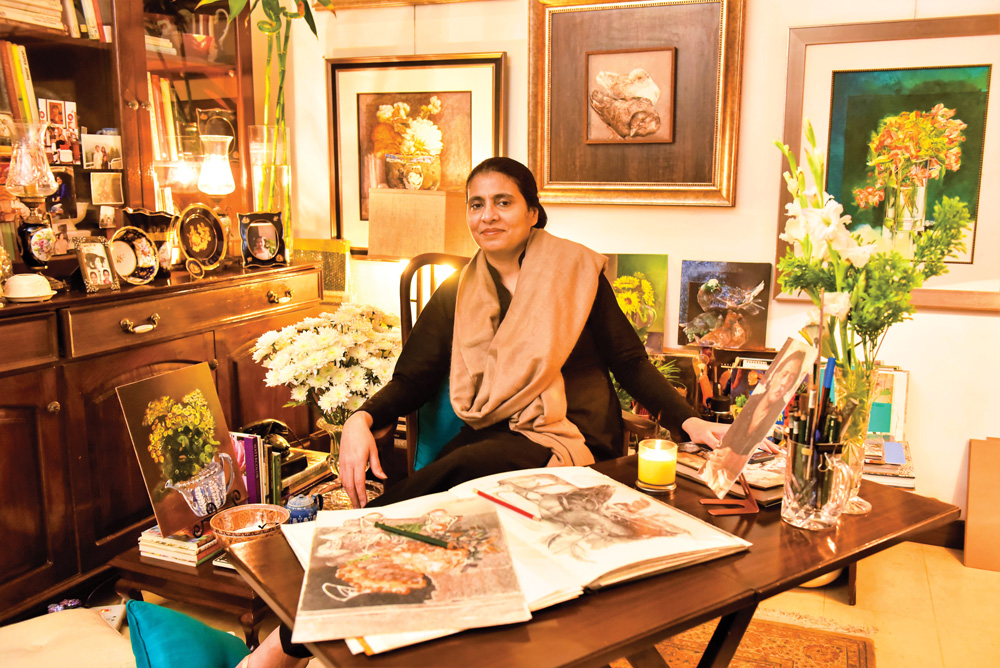
Interview by: Solmaz Regi
WHO IS MONA NAQSH BEFORE BEING “THE ARTIST”?
MONA NAQSH (MN): If I remember my childhood and our home atmosphere, it was very much decided at a very early age that I wanted to become an artist. There was no other profession in my mind. I saw my father always painting, earlier Abba was in an advertising agency he was an art director. At times I used to go to his office, his markers, his scripts, and the ads being made, I absorbed all that.
What inspired me most about my father was his discipline. About how to do everything, prioritizing work, how to show a picture, how to respect a picture, when to say yes and when to say no. All this was being absorbed.

My father had Indian roots, he used to question scenarios and we learned from his questions that were full of wisdom. His questions were meant to teach responsibility. He believed if you don’t learn from home chores, you will not be serious at your work. It is very important to be accountable as you will be responsible for every dot and line of your work.
Our household had an art environment, where they were framers, writers, collectors, poets, and musicians and we used to have art gatherings at our home. Ali Imam Saab was visiting, Shahid Sajjad Saab usually visited and we were holding art discussions, Kohari used to come and stay with us. The famous Kohari was Abba’s struggling times companion, so all this was gathering up. Although I was not serious about the field back then.
I initially just copied the masters with a pencil or other mediums.
HOW DO YOU DEFINE ART?
MN: See, art is not a profession, it’s a way of life. If something is not kept with the right positioning it will bother me. So you either have aesthetics or you don’t. Our studio was so disciplined, it had to be spick and span all the time, the color pallets, tubes, the paint brushes should be neat and clean. This is aesthetics, it’s about your attitude, how you public deal, how you treat your guests. We used to have sessions after every guest left. It was about what we did wrong and what we did right we used to get upset back then (smiles).
So art is a way of life, about learning discipline, about your seriousness, about us evolving, then you start questioning yourself, what are you doing wrong?
Abba used to say to keep a diary when you paint, ask questions to yourself and keep writing them down. As we start finding the structure then we can multiply it. Then we try to reflect on those questions and answers in our work. The observation is strengthened by the process.
Sometimes the painting’s problem is not solved in the studio, sometimes we go out and see a net and that solves it all, other times a ruined paint of a certain wall solves the problem. For all this, you need to be observant.
I’m an early riser I wake up around 4:30 am and I go to the rooftop, I feed the birds, I look at the sky colors, those colors bring me work, by looking at trees and plants. So all this childhood responsibility and process evolved eventually. I like the morning time and night time I sometimes work till noon.


DID ART EVOLVE FOR YOU AS A PERSON?
MN: See, if you are associated with a profession like painting, unless you are not interested in other professions your art will not evolve. You can make conversation in your work. Architects are sometimes inspired by certain paintings. It reflects in their work. Even my husband is a designer but he treats his work as canvases, in the end of it he applies a color that breaks all other colors. Just like our paintings we eventually find a color that wherever we apply, it becomes part of our painting. So this is how everything evolves.
WHAT ARE THE ART THEMES THAT YOU COVER?
MN: Flowers, flowers are my major theme. In Covid times that was the worst time of all, but for creative people, it was very productive, it enhanced focus. I worked so much during this time that I had never done before. Creativity increased by folds. Like do you see the images we find in clouds in the sky, I see these in trees and flowers too. Sometimes in our work, we get the logic first and cannot find the subject, but sometimes we find the subject and later on, find the logic. So the same happen to me, I worked a lot but I couldn’t understand the relationship. Then once we had a stopover at Doha while traveling and I found a book there called “Wisdom of Nature” and whatever paint work I had done so far, the entire logic of it was in that book. Although I did not exhibit in quarantine times, as I did not want to exhibit online. It doesn’t make sense.
In 2019 my father passed away, then I thought of a tribute to him through my work, the images that I was working on suddenly found a relationship between his ‘Pigeons” and my ‘Flowers”. I now had reason and logic so the path kept clearing up. It’s a small picture that I make but I’m saying everything in it, I don’t need to overdo it.
Abba was still in a coma, I told him I have brought my drawings and I will show them to him, I don’t know… but he nodded in that condition. I’m sure he was listening. The painting was a strong communication bridge between us.
WHO IS YOUR FAVORITE ARTIST?
MN: We cannot forget our masters, I still look at Rembrandt, and I still look at Leonardo. If you come to my studio you will see Rembrandt’s book is on a rehel, I do not keep his book on the floor. There is so much to learn. If we do not look back we cannot go forward. Your lines and strength are very important in how long you will trick people with paint alone. Abba of course is my all-time favorite. Even when I paint I can hear his voice simultaneously.
The younger generation is very good but they are in a hurry to provide results, do the exhibition first, to make the final exhibition video, they produce a story quickly, but don’t focus on the relation and logic of their work. One thing more, they focus on making their costumes. Costumes are not practical. Many years ago Leonardo said ‘You leave the studio with your get-ups and at the end of the day you get back to your studio becoming zero’.
Their observation is missing. How strong is the statement that they are making? How far will it go? They should do some work first, observe, talk to themselves, question themselves, silence talks to you, sit in silence, and assess yourself, you are your own best judge.


AND WHAT IS YOUR MEDIUM?
MN: Oil, watercolors, and pencil are my thing. I have not experimented with acrylics. I feel it dries up very quickly. Like we are just talking and while looking down, it’s all dry in a minute.(laughs) I’m good with oils I’d not say comfortable but I can express more with it, through oil I can talk more, I incorporate pencils in it, and sometimes colored pencils too.
If you see in paintings there are white spaces you can say silent spaces. Sometimes they become the strongest parts of a picture and converse with you, so you either have that understanding or not. I’m not talking about white color just the empty canvas. I feel that white space has importance in great master’s work.
HOW IS ART IMPORTANT TO THE SOCIETY AND INTERNATIONAL RELATIONS?
MN: Any country’s culture is a strong point for a country, we represent a softer side. Pakistan has absolutely beautiful work being done even in the interiors, although I have not been there. But what I see is amazing work and internationally it is also appreciated. I can show you hand work here that is gorgeous but we are not utilizing it properly.
If you see this industry alone, we have forgotten about colors and age. Women have stopped aging. (Laughs) I used to see women back then, they had their colors for age, I’m not limiting anyone but there is a certain elegance to age. Now we see the clothes and patterns there is no relationship. When someone wears them, how will they relate to them and how will this settle?
We are missing the mannerism, etiquette, grace, and dignity we need to bring back. Loud is not always appealing, we need to have grace in it. Every era appreciates decency, dignity, and grace.
Our film industry has finished completely and so did many areas along with it, like clothes, set designing, etc. I was amazed to be listening to an old interview of a certain director who had a Master’s degree in Literature, his inspiration was Rembrandt’s paintings and the light effects in them. So when Madam Noorjahan used to sing, the lights they wanted on her face were inspired by those paintings. Do you think the new generation would do such a thing? Or even talk in this manner?
As Andy Warhol said “A time will come when everyone will have 15 minutes of fame”
People work for a sizzling effect nowadays, I hope they will improve. If the youngsters want to learn they will learn, but if they don’t want to, they will never learn.
In our family, there are artists such as Anwer Maqsood, and others like Bajia and Mrs. Kazmi these people are museums within themselves, the struggles at the age of 90 she is still working. We just sit with them and we learn silently. There is a silent form of learning. I hope a time will come the attitude of youngsters will change.
AS AN ARTIST, HOW DO YOU DEFINE SUCCESS?
MN: When your paintings start to resale in your lifetime. I think, as after death it always happens for all artists, but in your life, if your work is already reselling that is success to an artist.
DO YOU STRUGGLE WITH WORK-LIFE BALANCE?
MN: As I’ve mentioned I’m an early riser, so I manage a lot of things, that is my time whatever I want to say, paint, read, or even listen to music I’d do it as that’s my time. Obviously, there are responsibilities that you have to tend to and if you don’t it will affect your mood and the same will reflect in your work. My father used to say when you will finish all your work and then sit for creativity, is when you will find your way. So I start working after I manage all the other stuff I know what I have to do and when. In earlier days I used to face problems, at times aggression aroused too, and it’s hard to leave the unfinished picture. But we have to manage family and other responsibilities it’s our life after all. Nothing happens by being annoyed it has to be controlled. Like my father used to say “There is an animal inside everyone it depends on how are you taming it” so we have to tame it actually (Laughs) and once it’s all done everything fits perfectly and then there is peace.


A MESSAGE FOR PAKISTANI ARTS ENTHUSIASTS?
MN: Respect your Masters, see their work, observe it, how they created it all. It’s not a video to fast-forward and teach you, in real life, it happens slowly. Be patient this work demands patience. If you are impatient then you will not get to that destiny. Creativity happens in silence and destruction has a noise. Be observant be responsible be patient and respect your masters.
______________________________________________________________________________
The writer is the Creative Head at “Ruralz Inc.” – it is an Interior Design firm in Karachi. Founder of a platform “Identity Pakistan”- A social patriotic initiative. She believes in metaphysical thinking and going beyond borders, is a multilingual, an occasional poet and a humanitarian activist.


