


A TWO-DAY JOINT WORKSHOP OF TU DELFT, THE NETHERLANDS, AND NED UNIVERSITY, PAKISTAN
By Architect Rabiya Asim
The workshop titled “LANDSCAPE BASED GROUNDWATER RECHARGE SCENARIOS” was held at City Campus NED University on 31st October and 1st November 2024. This workshop was organized by the Department of Architecture, NED University, Karachi, and the Department of Urbanism, Faculty of Architecture, TU Delft, The Netherlands. The two-day workshop was designed and conducted by Prof. Dr. Noman Ahmed, Dean of the Faculty of Architecture and Sciences, NED University along with Architect Amna Riaz, PhD Candidate, Landscape Architecture, Department of Urbanism, Faculty of Architecture and Built Environment, TU Delft, The Netherlands. The larger objective of the workshop activity was to raise awareness, share knowledge, and build capacity for sustainable groundwater recharge practices in Karachi. For this activity, the participants were invited from the Architecture, Planning, GIS, Geography, and Urban Engineering disciplines. A total of 25 participants belonging to the faculty of different architectural schools, as well as postgraduate students, from the program of Master of Urban and Regional Planning, NEDUET, and a few professionals from Geography and GIS backgrounds joined the workshop. Many distinguished water and planning professionals and academics like, Planner Farhan Anwar, Ms. Sana Adnan, Mr. Ejaz Hasan Kazmi, Mr. Younus Baloch, and Prof. Dr. Steffen Nijhuis joined the workshop as invited speakers. They addressed the technical, economic, environmental, social, and policy aspects of groundwater recharge, particularly for arid and semi-arid regions of rapidly urbanizing areas of developing countries.
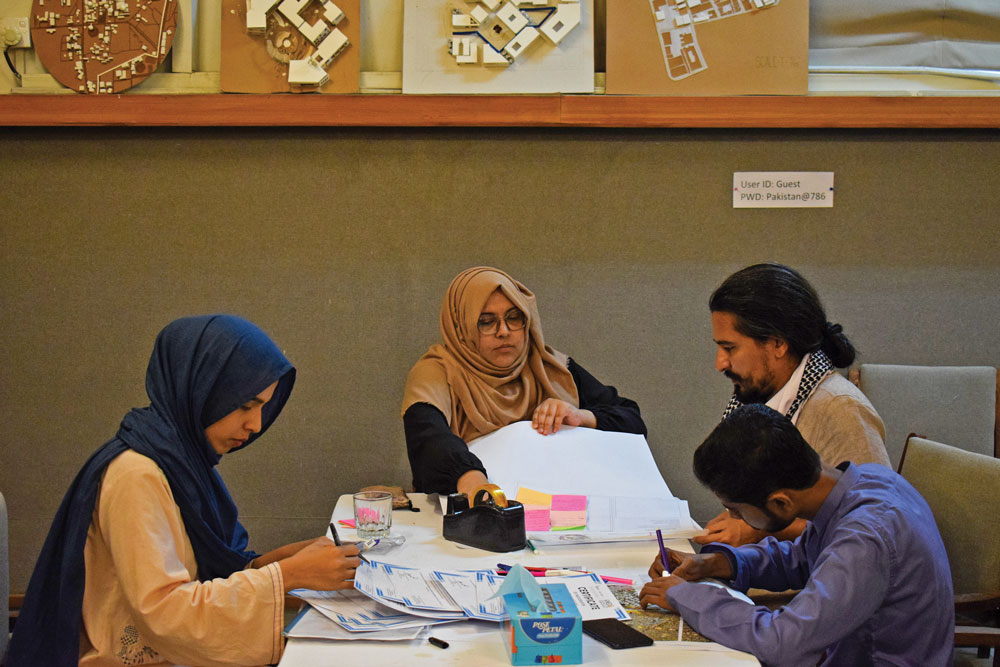
The major discussion agenda during the workshop was to explore and investigate Karachi’s urban and suburban landscapes for the options and opportunities for groundwater recharging. One of its plans was to enrich the understanding of participating students and young professionals about various possibilities of recharge in Karachi, its impact on human life, natural and built environment. The workshop was designed to enable participants to learn from key experts, and implement, and develop spatial design strategies for landscape-based groundwater recharge through workshop exercises. Similarly, focuses on sustainable practices, scalable techniques, and policy solutions.
This two-day intensive workshop had many segments, including lectures by key experts, design activities, group discussions – presentations, and feedback sessions. Working in interdisciplinary groups, participants selected various sites in Karachi to create socially, environmentally, and ecologically inclusive scenarios for groundwater recharge using multiple design tools. These activities helped participants to design spatial strategies that can reactivate the hydrological cycle by retrofitting existing urban landscapes and envisioning future urban growth trends.
During the workshop, the solutions proposed for the selected sites aimed to enhance the infiltration capacity of the land involved local stakeholders, addressed contextual social and ecological challenges, improved landscape character, and offered multi-scalar and multifunctional solutions. This co-creation workshop format enabled the participants to identify potential groundwater recharge sites, reflect on design tools and methods, utilize existing local strategic projects (e.g., urban forests), and revise the strategic framework at both urban and regional levels. The background reading materials related to these strategies and concepts aided the participants in reaching comprehensive and workable/applicable solutions.
Formal Beginning of the Workshop: The first session focused on current scenarios of Karachi as a case study. The first speaker of the workshop Prof. Dr. Noman Ahmed deliberated on the existing water supply sources to the city and how it is facing challenges due to climate change, increasing population density, poor management, and rapid urbanization. He also mentioned the importance of groundwater recharge with rainwater harvesting and properly treated sewage for a better and sustainable community and environment. The importance of Kirthar National Park was also discussed as a possible natural ground with immense recharge potential. The city-level parks, green belts, and right off ways can also serve as water recharge grounds, moreover the natural topography of Karachi’s small hills and foothills like Orangi, Nazimabad, and Manghopir hills, similarly help to maintain the groundwater recharge. Dr. Noman Ahmed concluded his briefing on suggestions and way forward through mapping and stocktaking of recharge assets, along with the preparation and enforcement of a recharge infrastructure rehabilitation plan. The second talk of the first session was by Dr. Saeed Ud Din Ahmad, he reflected upon the theoretical idea of groundwater recharge within the city, and its overlaps between urban issues, opportunities, and sustainability. During his presentation, he also discussed the extraction of groundwater by various stakeholders. Likewise, the challenges faced by the communities in areas where excessive extraction has taken place. The various studies conducted by the Department of Architecture and Planning indicated that groundwater levels are declining at a rate of 2-3 meters per year in many areas of Karachi. Dr. Saeed concluded his briefing with the solution of artificial recharge methods, which are more applicable to the city of Karachi.

The last talk of the first day-first half was by Architect Amna Raiz, PhD Scholar at TU-Delft, she fundamentally discussed the importance of groundwater recharge in the context of mega cities. Further, she elaborated on the workshop scheme of working with all participants. The first speaker of the second day was Planner Farhan Anwar also discussed the same theme and linked it with several planning characteristics like unplanned urban sprawl, unsustainable farming practices, and degradation of natural resources. All of these factors ultimately contributed to the depletion of groundwater. He also mentioned the three major river basins, Lyari, Malir, and Hub-river basins, which can act as natural aquifers. The exponential growth and development of the construction industry can also be factors, as the sand and gravel are excavated from the Malir and Gadap river basin, which were geographically natural water aquifers. The extraction material for construction from these basins ultimately created the devastation of the fertile valley of Malir and Gadap basins.
Mr. Ejaz Hasan Kazmi the next speaker in the panel started his presentation with the fact sheet of Karachi city challenges, as the city is facing several groundwater management issues, including over-extraction, seawater intrusion, and contamination. Simultaneously, the Illegal boreholes and unregulated wells exacerbate the problem, while insufficient recharge and lack of infrastructure hinder effective management, he added. Also rising temperatures creating drastic climate change and droughts further complicate the situation, demanding coordinated policy and management efforts. He emphasized the importance of treatment plants as groundwater in Karachi is increasingly threatened by industrial waste, sewage, and agricultural runoff. This contamination not only affects water quality but also poses serious health risks to the population relying on this water resource. Ms Sana Adnan, a Hydrologist by profession also joined as an invited speaker, she started her presentation with the facts of Karachi’s development over 78 years. In which she elaborated the area of the city with natural nallahs, water supply options, and sewage network. She also discussed the groundwater recharge potential in areas of Hub Dam and in the vicinity of Malir River. Likewise, towards the solution she mentioned urban planning considerations, GW recharge interventions, separate stormwater & sewerage networks, runoff volume reduction measures like urban ponds and rainwater harvesting, and last but not least public awareness for water management. She also established a theory of separate stormwater and sewage pathways; this will ultimately improve the overall situation of groundwater recharge of Karachi. She also stressed that groundwater withdrawal and consumption from stormwater drainage networks will lead to better health and lifestyle. Subsequently, she discussed the solutions in great detail, it included both engineering and planning domains. Lastly, she reinforced the importance of governance measures to minimize boreholes and develop a policy for groundwater extraction.
After all these theoretical talks and discussions on existing scenarios, the workshop participants selected their area of study, these areas are Gutterbagicha, Nazimabad, Lyari and Manghopir Hills. Five groups were formed with a pool of participants from faculty, postgraduate students, undergraduate students, and GIS professionals, all working together to develop strategies for a better and sustainable groundwater recharge system.
Mr. Younus Baloch, a social activist from Urban Resource Center also joined later in the day and discussed the challenges of climate change concerning low precipitation and its repercussions. He mentioned the case study of Cape Town, South Africa, with the situation of the sweet water scarcity two years back and how their comprehensive policy helped them navigate this crisis. It was therefore stressed that policy development and its implementation by the authority plays an important role. He further linked the challenges of Karachi’s water supply with the shift of micro and macro climate change. The discussion was also based on the socio-economic profile of the city dwellers that impacts the groundwater recharge issue.
After all these theoretical discourses, on the 2nd day of the workshop, participants come up with solutions, principally related to urban design, architectural design, and urban and landscape planning. For the major streets with sidewalks proposed with rainwater channels to save rainwater, the policy or bye-laws update for new housing development with provision of rainwater storage, the appropriate slope for open areas development to safe the surface water runoff, and so on
Prof. Dr. Steffen Nijhuis, the last speaker of the workshop concluded the whole workshop activity with deliberation on the theme of landscape-based urbanism. He discussed the several facets of landscape like landscape for urbanism, landscape for history, and landscape for climate change. The importance of well-planned landscapes for improved cities and communities was discussed and how green ultimately helps the city to breathe and connect to nature. A well-organized landscape in an urban region possesses outstanding merits. The importance of cultivating urban landscape through design was elaborated, what impacts it created on the built environment, and how it is helpful even for human existence. These were a few important topics deliberated in his online presentation.
The concluding session of the workshop was graced by eminent scholar and Planner Architect Arif Hasan, this session was based on the participants’ presentation on the analysis of their case study area and the proposal of planning and design interventions for improved groundwater recharge. Planner Arif Hasan commented on and discussed the workshop output with reference to other megacities of the Global South. The workshop ended with the souvenir presented to Architect Arif Hasan and Architect Amna Raiz, along with the certificate distribution among the participants by the management team of the workshop.


