


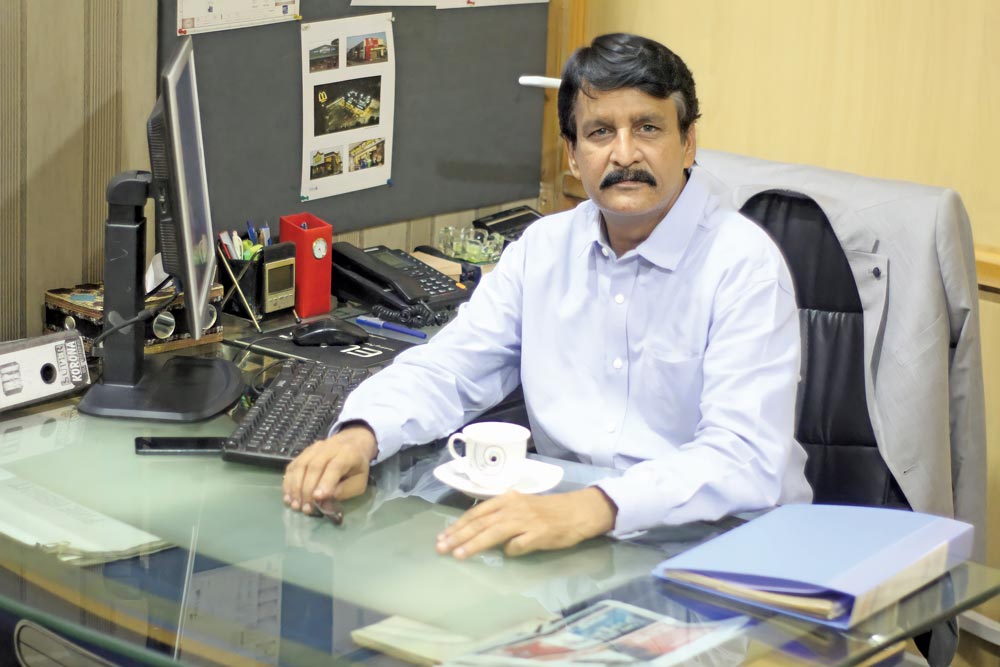
ARCHI TIMES Interview | Photo courtesy: Engineer
ARCHI TIMES (AT): Before we begin talking about your engineering, would it be good to know your educational background?
Farhat Baig (FB): First of all, I would like to thank Newage Cables for their consideration and invitation for this interview in Engineer Series.
I did a Bachelor of Technology (B-Tech. Hons) in Electrical Technology from the Government College of Technology, Karachi, in 1996.
I started my professional career in 1997 as a Site engineer with an electrical contracting firm, In my long professional journey of more than two decades, I have remained involved with various well-reputed Electrical Consultancy Firms. Recently, I am working at Econs as General Manager Projects.
AT: Tell us about ECONS and its role.
FB: Econs is a Multi-Disciplinary Engineering Consultancy Company co-founded by myself and Engr. Faisal Siddiqui in March 2011 to bridge the gap between the ever-changing needs of the construction industry and consultancy services. ECONS is responsible to analyze the design of complete MEP system in commercial or residential buildings, Infrastructure projects, Industry, Power Plants and recommend solutions or possible improvements.
AT: What kind of services and programs are offered at ECONS, and how are these designed?
FB: Econs provides the professional and technical skills, to plan, design, and supervise the construction of a wide range of MEP Services From conception to delivery. We provide the following service:
* Electrical & Allied services
* Mechanical & Plumbing services
* Communication & Information
* Fire, Life Safety & Security
* Automation
Our design stage follows a rigorous process of understanding every client’s requirement. Following are the steps we imitate:
Project Scoping
In this step, we perform a detailed study of architectural layouts, and then we develop schematic design & development criteria incorporating the end user’s needs and operational demands.
Design Development
In this intermediate step, we develop a detailed design in line with the approved Schematic design and the client’s requirements. Along with it, we perform coordination with architectural & associated layouts, detailed study of proposed systems to optimize, final design approval, development of tender documentation and drawings, and finally Issuance of tender, scrutiny of bids, and award of works.
Construction
This is the final step. Upon implementation of design drawings by the contractor, we monitor the work progress and provide supervision with periodic site inspections.
AT: What should be the role of engineers in our society?
FB: I believe the basic objective of engineers is to propose solutions that are safe and economical. Every unnatural thing in this world has been “engineered” by someone. Transportation, communication, Information Technology, etc. engineers have brought all these things to life. Hence engineers just like doctors and teachers are essential for survival and progression of the society.

AT: The role of engineer you have mentioned, do you think engineers are playing their role today?
FB: I reckon that engineers are full filling their role. Engineers continue to be the backbone behind the smooth functioning of our society. The innovations in technology that we continue to witness are because engineers are not only contributing but also flourishing in this role.
AT: How can the efficiency of electricity generation, transmission, and consumption be improved in Pakistan?
FB: Pakistan suffers from a critical electricity shortfall. In Pakistan, even typical power generation methods are not efficiently utilized. The conventional electricity generation and efficiency can be improved by replacing the obsolete and insufficient thermal power plants with highly efficient combined cycle power plants.
Additionally, Pakistan has massive potential in the renewable sector. Hence in the future, we may see more and more people moving towards solar energy and this transition has already slowly begun.
Electricity transmission and distribution can be improved by reducing the technical losses on the transmission side and improving the power factor by installing capacitor banks on the distribution side. Increasing the Power Factor in turn increases the current carrying capacity of transmission lines.
Electricity can be consumed more efficiently by making the consumers aware of methods for efficient utilization such as advising them to unplug inactive electronics, operating air conditioners at a more optimum temperature, etc.
AT: Nowadays global warming and climate change are the main challenges, how are you addressing these challenges, particularly in Pakistan?
FB: Global Warming and climate change are a massive challenge globally as well as in Pakistan. As engineers, it is our responsibility to address this issue. Because of these problems, Pakistan’s climatic changes are expected to have wide-ranging impacts, such as reduced agricultural productivity, increased variability of water availability, and increased frequency of extreme climatic events.
Considering its eco-friendly nature, we consistently propose renewable solutions as they help in reducing carbon footprint. We also propose people to use automation in projects as it helps in much more efficient consumption of electricity.

AT: Can you explain the link between energy sustainability and technology?
FB: Sustainability is closely linked to the technology. Modern technologies, necessarily do not only lead to a positive impact. Many environmental problems result directly from the application and implementation of technology. A sustainable society will only function if it can rely on eco-friendly technical systems and products. These should be as efficient, sustainable, and affordable as possible.

AT: How important is architectural lighting for a spatial environment while designing any project and what considerations do you keep in mind?
FB: Lighting plays a vital role in the way people view and admire the architecture. Lighting can bring emotional value to architecture. Especially, building façade lighting enhances the scenic view of the building. Lighting is a unique part of our design as it is the only part that is exposed, apart from that, almost everything is hidden and hence hardly anybody could see and appreciate the contribution of the electrical consultant in the project. Thus, given its unique feature, lighting design is a part of our project we are particularly focused on.
While designing architectural lighting layout, we make the following design considerations:
* The Appearance of the Space and Luminaires
* Color temperature & Rendering
* Lighting Control
* Cost of Implementation
* Conservation of Energy

AT: What type of problems have you ever faced from the owner and contractor?
FB: During our decade-long working experience at Econs, we have faced various problems from owners and contractors. The most common one on the client’s end is compromising on standards as a tradeoff to save money. It is something we are highly reluctant and we generally propose some alternative solutions while still following the concerned standards. Whereas the most frequent problem on the contractor’s end is complaints about unavailability of products and failure to meet deadlines of the project. To resolve these problems, we propose three alternative products for each item so complaints about the unavailability of product go out of the window. To avoid the latter issue, we set payment criteria for a contractor in several stages so he is forced to meet the deadlines along with it we perform periodic site inspections to monitor the progress. With all these adaptations, we have been able to complete the projects despite how challenging we thought it was in the beginning.

AT: What are the considerations for building safety in terms of electrical designing and what important tips would you like to give designers and the public at large?
FB: Building safety is the fundamental parameter of our design stage. We adopt various standards including IES, NFPA, IEC, ANSI/TIA, NEMA, etc. Standards for electrical, telecommunication, lighting, and fire alarm system protection and safety in our designs.
As an experienced professional in this field, I would suggest fresh designers avoid any negligence in engineering design and ensure proper adoption of laid out standards for building safety and the citizens must cooperate with concerned authorities by communicating and sharing information; Hence collectively ensuring building safety in terms of electrical design.
AT: What measures would you suggest to be considered for reducing electrical loads in buildings?
FB: We can adopt various methods to minimize power consumption in buildings. On our end, we strive for a more efficient design as ultimately it will yield minimal power consumed. We suggest the following measures for energy consumption:
* Usage of LED Lights
* Installation of Solar Panels
* Usage of Air Compressors
* Adoption of Automation
* Improvement of Power Factor

AT: What is your opinion about the use of solar energy in buildings in general and houses in Pakistan vis a vis cost of the project?
FB: As the era of renewable energy is upon us, solar energy (on-grid) is widely considered to be the best alternative energy source. At Econs we strongly recommend solar power. As local electricity utilities such as K-Electric are now allowing a net metering system, it will be beneficial to both the utility and consumer. Contrary to that, storage of solar energy in batteries (off-grid) isn’t cost-effective.
AT: Any message for young professionals?
FB: My advice for young professionals is to always remember that failure is an important element to success. The experiences they get in failure are some of the best lessons they can apply in their life.
Do hard work, be consistent, and keep the focus on your work, never be disappointed with your mistakes, they increase your experience and experience decreases your mistakes.
AT: What are your comments on this Newage Engineers Interview series? Do you think young professionals, particularly students, are benefitting?
FB: I believe this is a step in the forward direction by “Newage Cables Engineers Interview Series” which must be highly appreciated among the engineering community. This not only appreciates professional experienced engineers but also paints the true picture to young professionals about to demand industry from engineers. It conveys that Instead of finding an escape route from the country, it is time like these when both experienced and young engineers must join hands and strive together to take engineering in Pakistan to the next level.


