


By: Iqra Wazir – Images Courtesy: Engineer
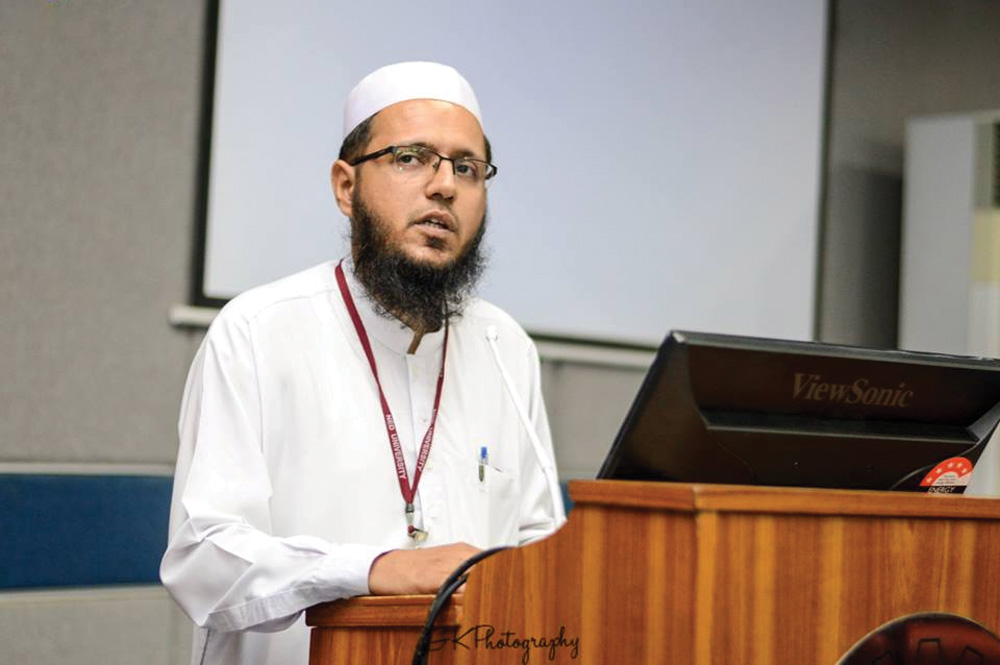
Prof. Dr. Saad Ahmed Qazi is the Professor and Dean of the Faculty of Electrical and Computer Engineering at NED University of Engineering and Technology, Karachi. He earned a Bachelor’s in Electrical Engineering in 2001, a Master’s from Lancaster University, UK in 2002, and a Ph.D. from Brunel University, UK in 2006. He has a keen academic interest in Digital Signal Processing and Intelligent Algorithms and has more than 25 publications to his name. He joined NED University in 2002; and has since worked in several academic as well as administrative positions including Advanced Studies and Research, Chairman of Electrical Engineering, and Director of Quality Assurance. He represents NED University on several national committees and boards. He is also PI of the Neuro computation Laboratory at NED University under the National Center for Artificial Intelligence. He currently holds several funded R&D Projects.
ARCHI TIMES (AT): Before we begin talking about your engineering, it would be good to know your educational background.
Saad Ahmed Qazi (SAQ): I went to Nasra School Malir which also had a branch in Soldier Bazaar. I was part of the first batch of the school and studied there till 7th Grade. Later, I went to Pakistan Steel Cadet College where I stayed till HSc Pre Engineering. It was a wonderful learning period of my life, at that time it was under the Pakistan Army’s Administration so the discipline and rules were spot on – and at the same time we enjoyed diversified learning experiences. In 1996, I got admission to a four-year program in Electrical Engineering at NED University and graduated from there.
AT: Also tell us about your professional career experience, its up and downs as you have been working for so many years.
SAQ: My father was stationed in the UK at an engineering facility as part of his work and there I got an opportunity to experience engine endurance tests at Rolls Royce for bird strikes and hailstorms. These tests were quite extraordinary and were designed to see how an engine would respond in case of a failure or various scenarios. At that time in 1998, the experience was unheard of; and I was fortunate to observe that test happening. I was amazed at the thousands of sensors collecting real-time data from every part of the engine and producing a real-life visualization on computer screens when the test happened. Remember, I was an electrical engineering student at that time and we were studying circuits, controls, computers, and programming, but did not know what digital signal processing was as a field and we seldom studied from the applications point of view. This entire experience opened new windows for me and I decided to enter the world of digital signal processing where you capture information in the form of signals and process them to make various decisions – now this field has matured into machine learning and Artificial Intelligence.
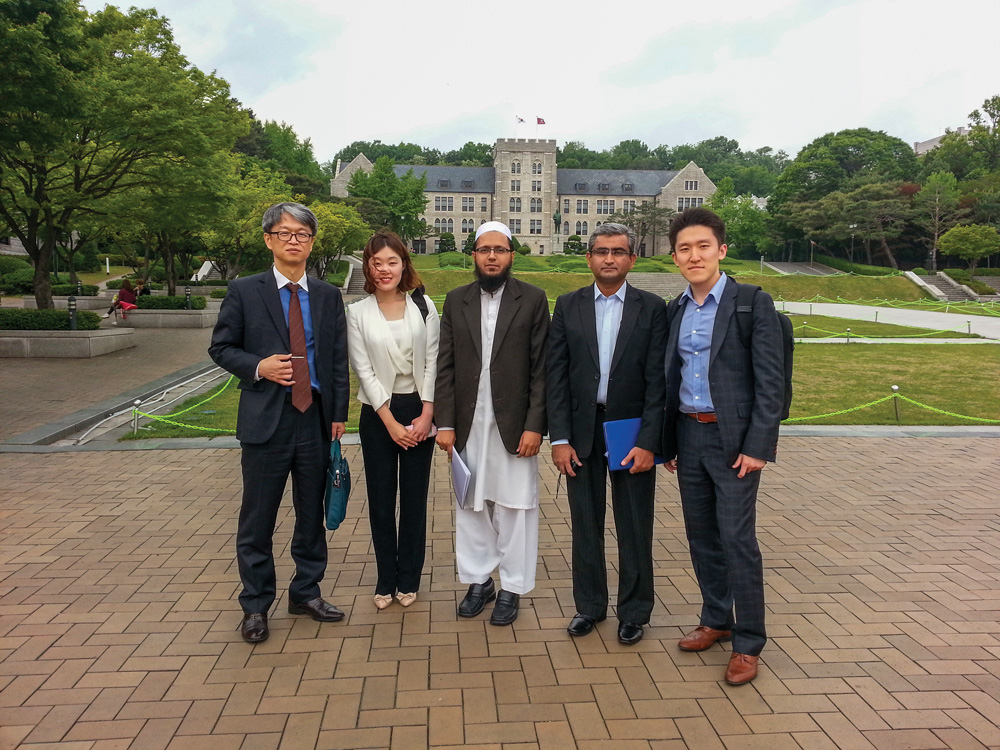
After my graduation, I had already made up my mind to do Masters in Digital Signal Processing and started looking for options. I got a scholarship in Lancaster University which has one of the leading engineering schools in the world. I completed my masters in 2002 and came back to Pakistan to meet family – I was determined to return for a PhD. To be honest, I had no inclination of staying in Pakistan in the long term. During my visit to Pakistan, I came to NED to see my teachers and colleagues. There I was convinced by the then Vice Chancellor, Abul Kalam sahib, to join NED University. In 2003, I left for pursuing PhD at Brunel University, London. It was an extension of my masters work in the area of signal processing and representation of signals in multi-dimensional domains.
My career is fused with my studies. While I stayed at NED in 2002 and 2003, I realized for the first time how much teaching inspires me, so after completing my PhD in 2006, I continued at NED. Since then, I have been fortunate to serve NED and beyond. In various academic and administrative capacities.
AT: What should be the role of electrical engineer in our society?
SAQ: I will broaden the answer with a similar question i.e. Why do we study anything? Actually, whether it is Architecture or Engineering or any other discipline; basically it’s about service delivery to society as an individual, team or organization – for which one has to have satisfactory knowledge about our domain and the skills to make that knowledge meaningful. This only will enable your connection with the society. We as individual should be on the same page as the societal needs otherwise we cannot make any positive impact irrespective of the field.
Over all, university graduates are gradually losing relevance and a general feedback is that companies hiring them have to reside on lots of training. Generally, graduates are excellent in the body of the knowledge of their field but they lack in other soft skills such as team work, communication, inter personal skills, leadership, problem solving, negotiation, decision making, time management etc. We as higher education sector must look into these things. Recently, we have initiated alignment of our programs to an international system of education known as outcome-based education (OBE) for addressing the very same issue I mentioned earlier.
AT: Are you also doing engineering practice?
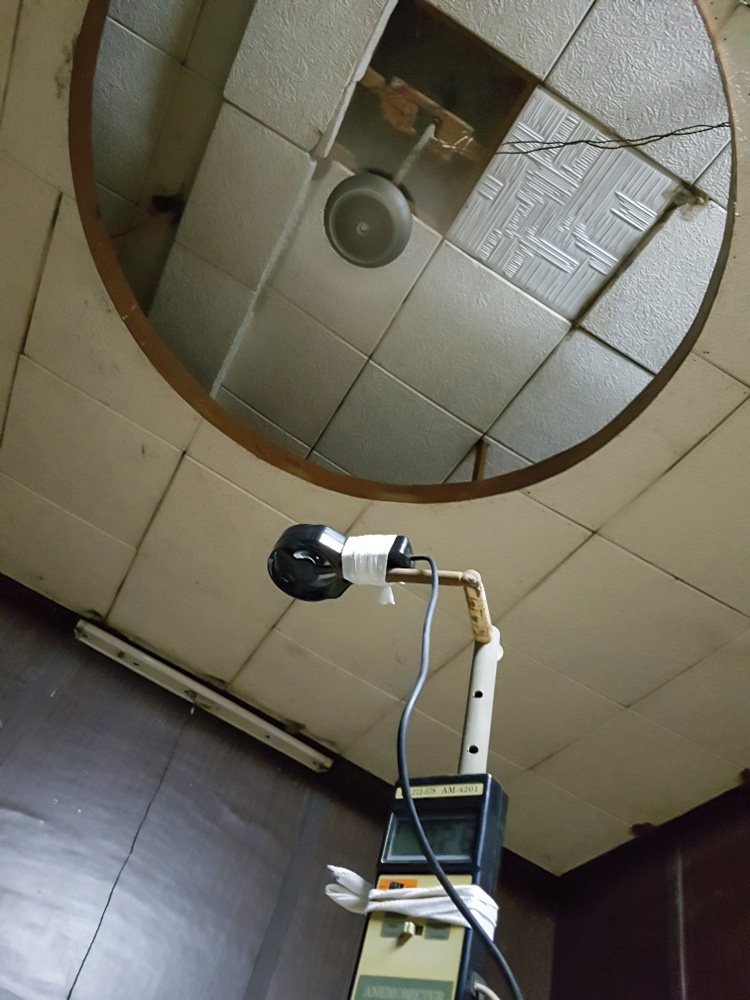
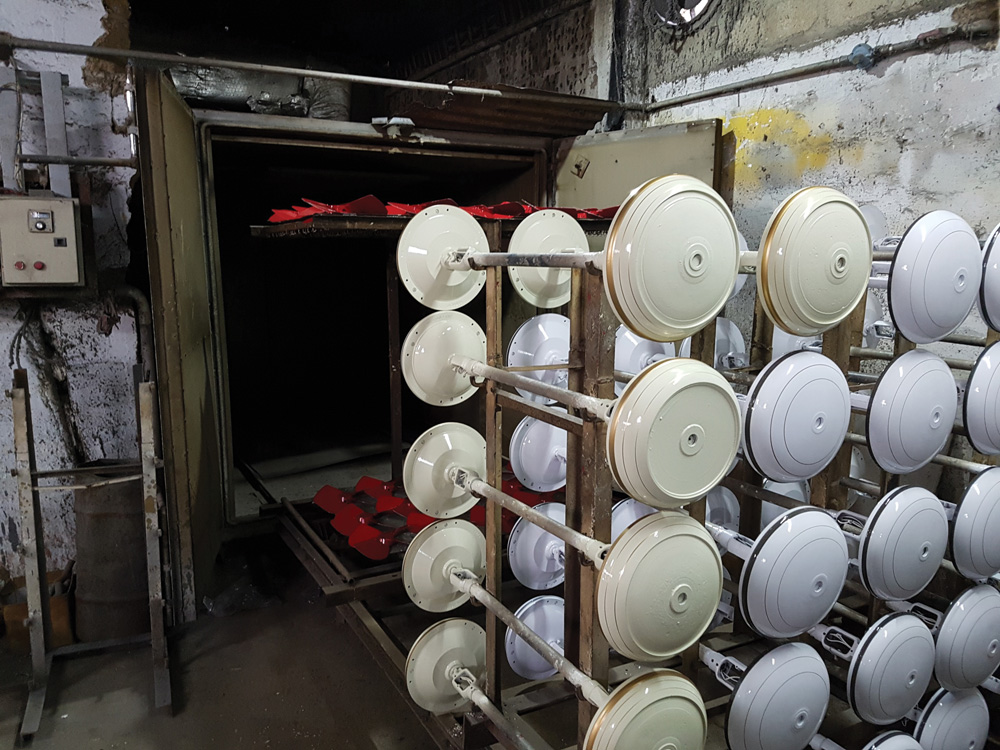
SAQ: No, I am basically an academic. I have not been practicing in its perceived sense but yes! I am engaged in lots of exciting projects which are necessary for Pakistan and beyond. One such project is working towards an app that helps a Hafiz in remembering the Holy Quran. We can use technology to correct mistakes and remind him/her of the lines as per reciters convenience. Also, I am engaged in a Green Campus project, which aims to convert NED University campus into a carbon neutral campus by 2021. It is a very impactful work as potentially it will convert the campus into a climate change live lab. I also have a technology development grant awarded recently for development of smart fans. I would also like to mention that working with Sindh Engro Coal Mining Company, I am also working on a student mobility project between Karachi and Thar regions to address the problem of expanding carbon footprint.
AT: How do you feel about the standard of engineering education at our institutions?
SAQ: It is satisfactory to the level that our graduates are being hired by the top most professionals and companies around the world – but we also need to keep improving in response to global and local changes. One of the things that NED University is focusing currently is the up-gradation and inculcation of sports facilities with studies. We are pushing the students to use these facilities and organize tournaments etc. Secondly, NED University has started Chinese language here because that will add value for our graduates in Chinese market. Also, a community service programme has been started at the university and it is mandatory for every student to do some community work during his/her initial phase of studies.
Basically, books can teach you theory but not the practicality of the field which is waiting out there for the students. Internships play an extraordinary role in bringing changes as well as final projects with senior faculty members of professionals. Interaction with the professionals is of utmost importance. Responsibility of an institution does not end with teaching alone, grooming these students also comes with the package of responsibility.
AT: What do you think are your biggest strengths as a faculty member?
SAQ: I feel that it is not easy to bring change. One needs to be consistent and persistent for it. If you just want to try and back off than it is not going to work. I feel I normally have more positive approach towards things and believe in giving time for bringing a difference. Every organization has its own momentum and inertia. The key point is to match your speed with the speed of the people you are trying to create a change in. If we overdose, there will only be frustration and demotivation. The thing to learn is to prioritize, adopt the right methodology to solve that issue and be ready to spend time on it.
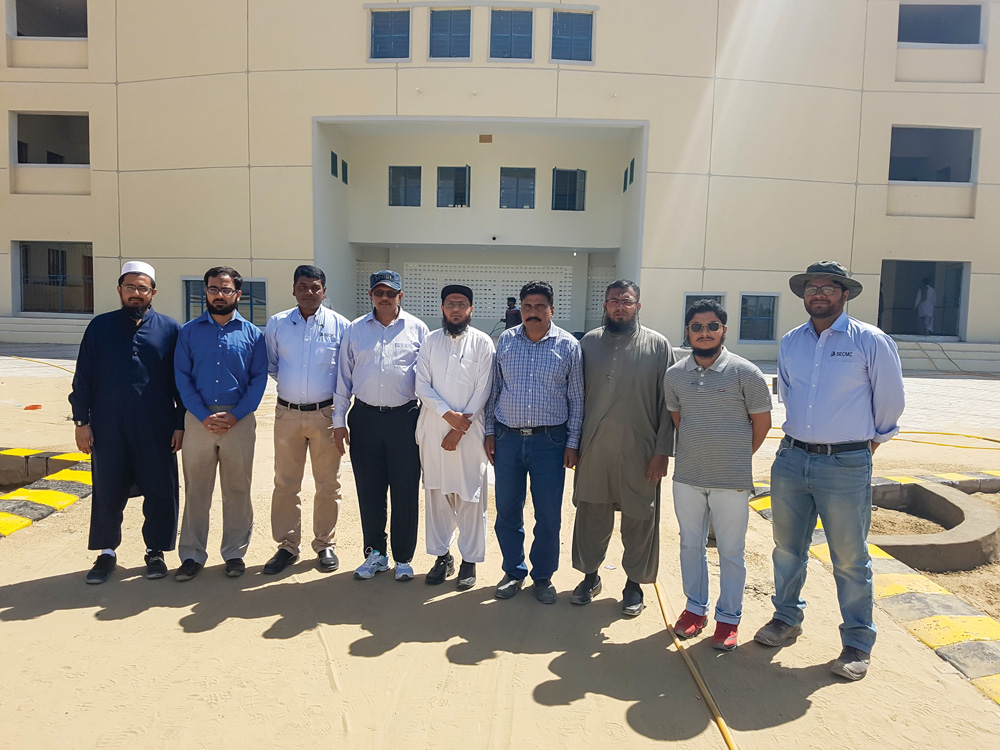
My faculty of Electrical, Computers, Electronics and Biomedical have recently won National Centers for Artificial Intelligence, Cyber Security, Data Analytics, and Robotics. I am lucky to have faculty members who are hardworking, responsible, academically brilliant and sincere. We have just started – the journey still continues. I was and am mostly involved in administration and that has helped me greatly in understanding human and organizational psychology; and this has a lot to do what little I have been able to do so far.
My strength is also my students. They are of high quality with extreme potential. There is diversity amongst the students. They have been subjected to hard work and subtle challenges which creates robustness, strength and a will to prove themselves. As a faculty member, this student body actually gives me the energy to get up in the morning.
AT: Do you think there is a need for Engineering Education reforms?
SAQ: Decline starts the day you stop continual improvement. We are working on a proposal with a professional firm regarding faculty inspirational and motivational development aspects. This will decrease the stagnancy and allow the faculty to have the exposure they otherwise don’t have access to. There is need for continual reforms and improvement. I believe in bringing reform from within the home.
AT: Describe an experience in which you identified the educational needs of your students and successfully developed a way to teach /train them.
SAQ: There are numerous examples that I can recall but let’s focus on a minor one. My first year students were once studying in class during scorching weather in the afternoon, and the direct sun rays were bothering some of the students; Also, our water cooler was also not working properly. As they were very frank with me, they rightly started complaining. Generally, one would ask them to write application and send it somewhere to wait for the issue to get resolved. I engaged with them in order to help them focus on possible solutions within our capacity. We got an estimate for the cooling gas and the paint for the windows and realized that collecting it among ourselves would not be a difficult. So, we did open contribution in class, got the paint and the gas and got our problems solved. It appears to be a very small example but this particular batch did remarkable things later on specially in solving various problems in the university. This batch started a magazine with the name Impulse’. Later, they also organized first NED Electrical Alumni Reunion which was a great success. So that little experience had a positive impact on them. Thing to remember is that as teacher we have a lot of say in shaping future of our nation. We need to realize this.
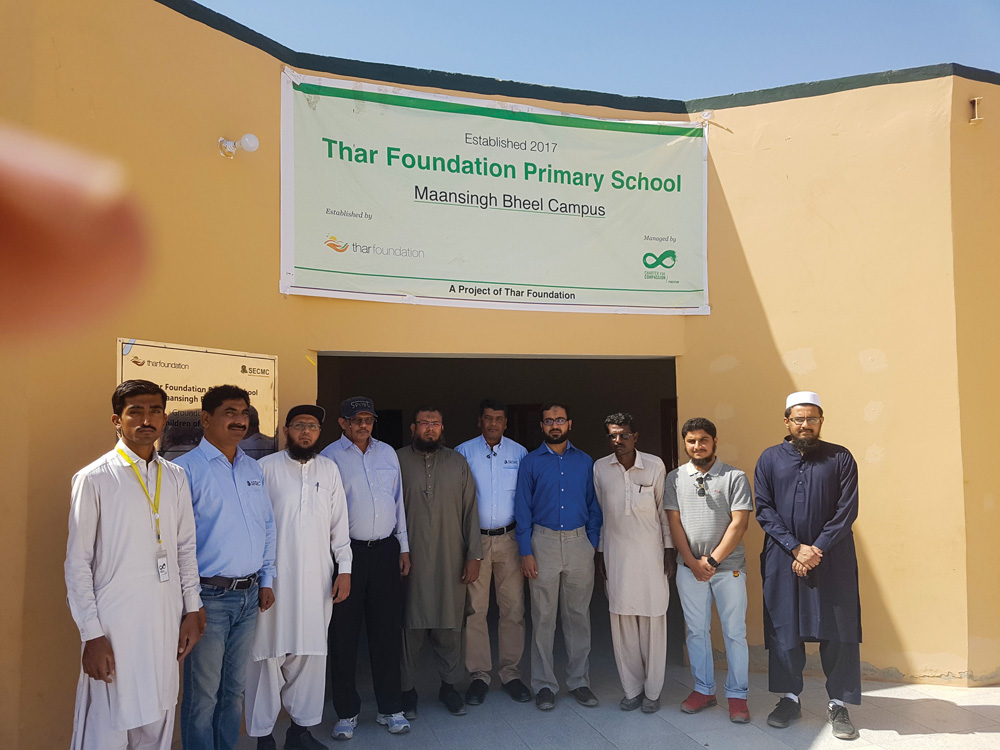
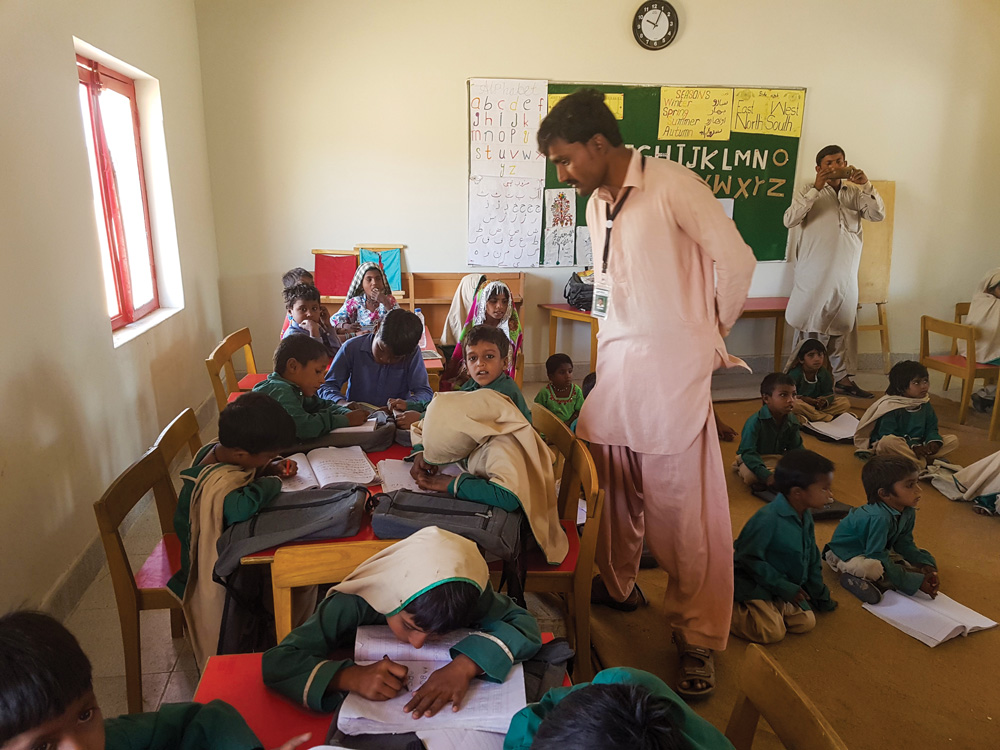
Thar Foundation School in SECMC Block II, Thar
AT: How important is architectural lighting for spatial environment while designing any project and what considerations you keep in mind?
SAQ: It is of utmost importance and proves to be the pivot point where Architecture and Engineering merges. Successful projects are those where the merger goes well. Engineers can provide you solution but when it comes to user experience then that should be entirely up to the Architect’s expertise. In building design, I feel that engineers should have some basic aesthetic sense and the Architects should have some degree of knowledge about the building structures and related topics. Architectural domain is more qualitative focusing on the feel, experience, ambience and aesthetics. While, engineering on the other hand is more about measurements and is intrinsically quantitative. One needs to be very precise to create the fusion by quantifying the qualitative domain which is a hard task – but if done properly results in extraordinary results.
AT: What are the considerations for building safety in terms of electrical designing and what important tips you would like to give designers and public at large?
SAQ: We really need to look into building codes and make sure they are applied at any cost. It will take time to make the user learn about the hazards and safety of the building but in a basic thumb rule “never take electricity lightly”. Even if it is an installation or repairing or maintenance, always assign that job to a professional person. Never save money in this sector as all decisions are generally taken on financial basis because it is a real life and death situation and shouldn’t be taken lightly at all. We continue to observe a lot of incidents where people have lost lives because of carelessness towards building safety and electrical designs.
AT: What would you suggest measures to be consider for reducing electrical loads in buildings?
SAQ: The Vice Chancellor, NED UET has taken an initiative of converting this campus into carbon neutral campus by 2021.We will reduce the amount of energy we use from K Electric and convert buildings on solar energy. Energy efficient appliances should be used to reduce the loads. Make sure their usage is appropriate and awareness is given about it. Invertor ACs should be used which reduce loads up to 30%.
AT: Have you had chance to work in other countries, what differences do you see in approach to electrical design?
SAQ: I have travelled a lot and for studies I have had elongated stays in the UK too. Honestly speaking, we are not very far behind from other nations. It is the matter of raising national pride and sense of responsibility among the people. We need to look at the development of youth more seriously. Related to electrical design, we are ok as far as the design is concerned but we are far behind in terms of maintenance and utilization – and that I think is due to poor literacy rates.
We have lack of awareness when it comes to utilization of public facilities. Islamabad Airport is a remarkable new addition in Pakistan but I seriously fear for its state in a couple of years from now. I am sure we will quickly recover of our lost image if we are able to educate our people regarding civic responsibility and ethics.
AT: Do you have a dream project – something you haven’t done yet in the context of electrical engineering?
SAQ: Yes! I would really like to see our classrooms and labs merged into one space. We currently have separate classes for theory and practical. I would love to fuse them together and make them go hand and hand in an interactive environment with focus on strong tangible outcomes. Teachers will then be playing moderators and not the providers of the knowledge anymore. Students will be allowed to use any source for learning. Teachers will help the students in rightly navigating them. But that is a huge transformation because it requires both infrastructure as well human resource change. Who knows, in near future we may not even have physical universities due to the rapid pace of growth of technologies and everything being digitized at such a breakneck speed.
AT: What are your opinion about the use of solar energy in buildings in general and houses in Pakistan visa vis cost of project?
SAQ: It should be used as much as possible. It has a lot of potential. We will be seeing a lot of use of solar energy in the coming times.
AT: Any message for young professionals?
SAQ: I would want to advise them not to lose hope in a blink of an eye and stay persistent to achieve their goals. Nothing comes easy in life. Hard but smart work should be the strategy. Change requires patience and think positive to bring people forward. Also, always give priority to physical engagement over cyber engagement.
AT: What are your comments on the starting of this NEWAGE Engineers Interview series? Do you think young professionals particularly students will be benefitted?
SAQ: Oh yes! It will definitely be beneficial and it’s a great initiative taken which should be continued forward. It is the perfect fusion between Architecture and Engineering. Students will get to know more about journey of different professionals. It will help them in understanding what is actually happening out in the field; and will help in flourishing new and bright ideas.


