


Text & Photography By Ar. Humaira Nazir – Assistant Professor SSUET
Away from the hustle and bustle of Karachi city, an isolated spot exists that is known for quite a long time in history with the name of “Chaukhandi Necropolis-a shehr e khamoshan (silent city)”. Deprived of its appeal and its clearly carved sand stones of yellow colours, cold-blooded criminals, dealers, and the land mafia are damaging its glory. These factors have separately and overall stolen tombstones, leaving a gap in the previously struggling verifiable story of Sindh.
The Chaukhandi necropolis, a site of immense interest for both tourists and archaeologists, stands as an ancient Islamic cemetery, representing a forgotten chapter of history. Recently recognized as a national heritage site, this cultural treasure, dating back 600 years, is located 29 kilometers east of Karachi on the route to Thatta, within Pakistan’s Sindh province, along the National Highway N-5. The construction era of this necropolis expended over three centuries’ between the 15th and 18th centuries during the rule of Mughal, when Islam turned out to be dominant. The graves in this cemetery belonged to the Jokhio and Baloch ethnic groups. According to Professor Shuhrat Ilyas Jokhio, the people of the Jokhio tribes came from Rajasthan, a state of India. Those people travelled to Sindh, Lasbela, and other districts of Baluchistan for trade and commerce. The Jokhio tribes were combatants, and they shifted to Sindh from Rajasthan and took hold of the area. The tribal system started in the Jokhio community during the era of Mughal Emperor Shah Jahan. Jam Mureed bin Hajji, who was the leader of the Jam tribe, is also buried in this graveyard, and he is called “Shahib Chaukhandi,” with the word Chaukhandi engraved on his grave. The orientation of this necropolis is from south to north, and it covered an area of 100 acres with 600 paved and hundreds of unpaved graves.
The word Chaukhandi means “four corners,” because in Sindhi, Chawin means “four” and Khundi means “corner or pillar,” and it is considered that this name of graveyard is due to the fact that all graves had four corners. Conversely, many scholars do not agree with this meaning, and they believed that the word Chaukhandi referred to the name of a place because the word Chaukhandi has been engraved on the tomb of the leader of the Jokhio tribe.
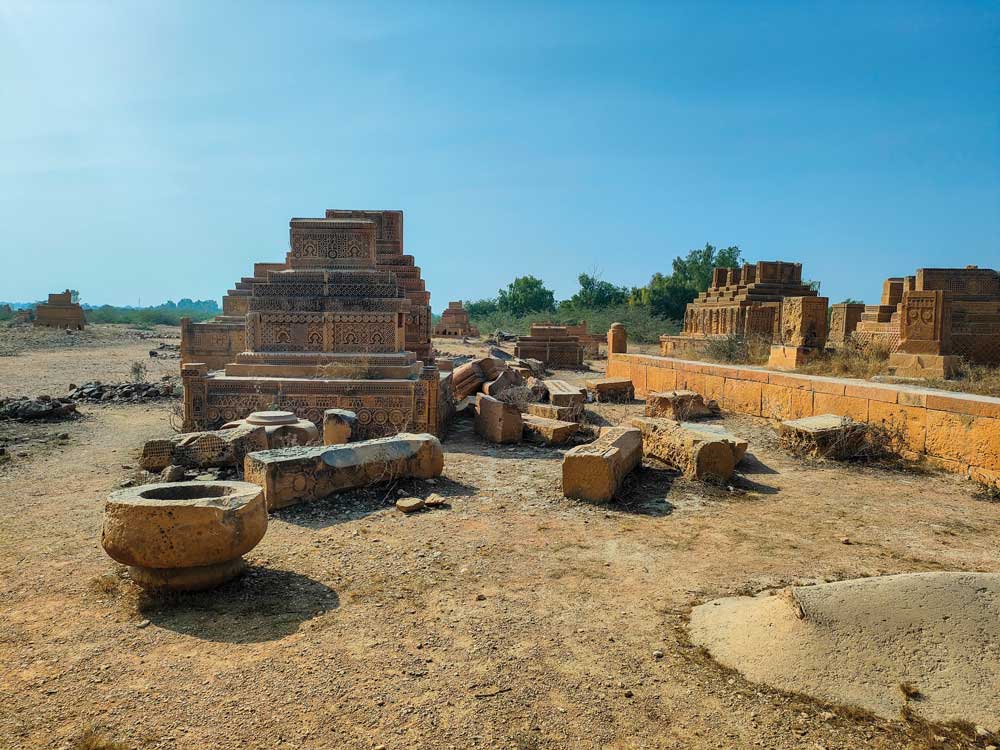
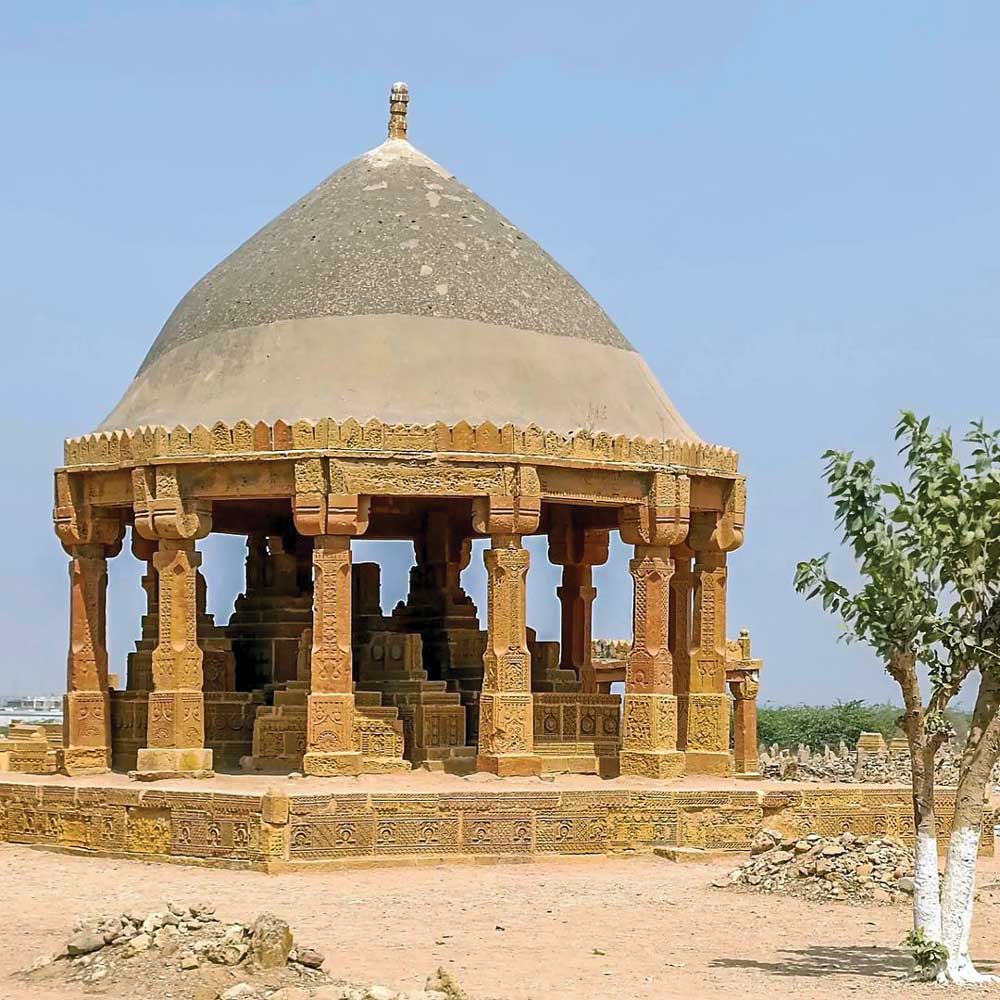
The most interesting feature of the graves is their construction on multiple levels, like pyramids, because these were the graves of the pharaohs of their time. They were manufactured like pyramids to demonstrate their power over the poor. The graves that were built on a single level belonged to poor people, while graves on multiple levels are an indication of the rich and leaders’ graves. The graves are 2 ½ feet in width, 5 feet long, four to 14 feet in height, and have a rectangular shape. The tombs were built over a raised platform of yellow sand stones that are quarried from Jungshahi, a town in Thatta district, Sindh, Pakistan. All the stones were transported on horses and donkeys and cut with great care by hand. The styles of these tombs are similar to the tombs of Makli Graveyard near Thatta.
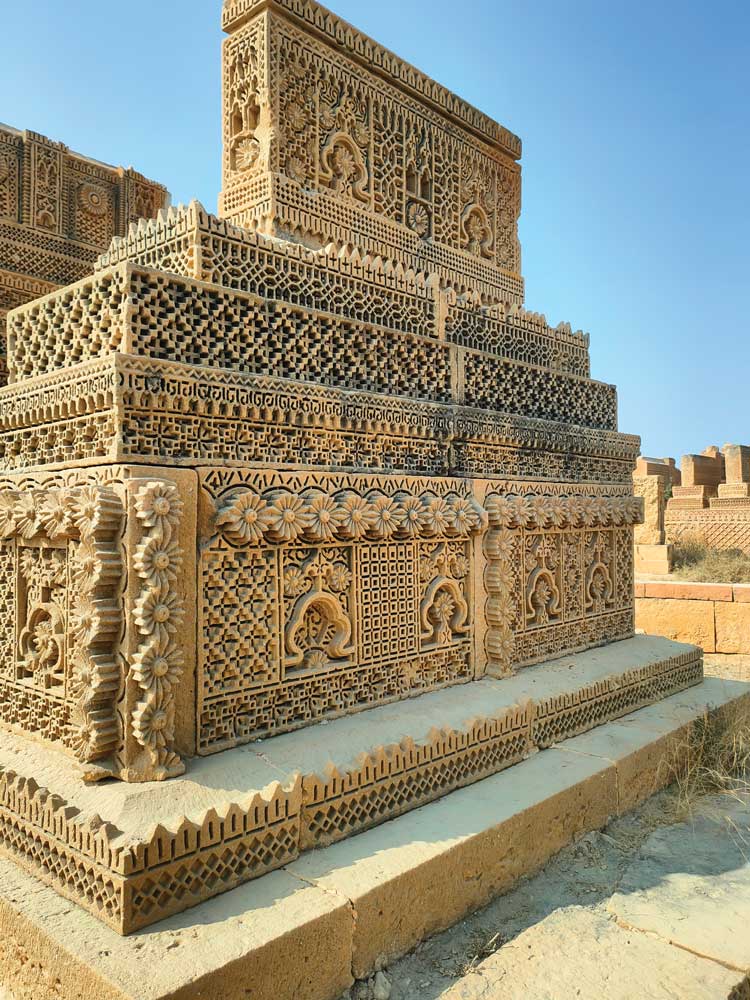
The graves are constructed by stacking the sandstones into levels and carefully carving them with different patterns, scenes, and drawings, which feel like woodcarving. The carvings on a number of the male graves display chasing scenes of a horseman with his weapons: a sword, arrow, bow, and shields. Additionally, male graves are furnished with a supervisor-shaped projection on the north side to hold the turban of the deceased. The graves of females are carved with adornments, for example, neckbands, bracelets, rings, anklets, and so forth.
The tombs are remarkable for their intricate and magnificent carvings. The design style is not only common in the vicinity of Sindh but also unique in the sense that it cannot be found anywhere else within the Islamic world.
Some of the tombs were carved out in recent times. These comprise the tombs of Jam Bijar Khan Jokhio, the chieftain, and his son, which were constructed in 2008 and 2018. These carvings of newly built tombs look like the old ones, giving honour to the architects of the preceding. Though the buff-coloured stone is still obtainable at Jung Shahi, the skilled architect is no longer present, and the carving on these tombs is done by machines.


In addition to these details, it’s important to note that the cemetery lacks a designated entrance gate and clear boundaries. The absence of these features has been repeatedly cited as the reason for the widespread theft of tombstones. Heartbreakingly, the graves of recently departed loved ones are often adorned with vandalized gravestones taken from more aesthetically appealing old graves. The lack of security at historical sites like this one encourages relic thieves to loot as they please. During our visit to Chaukhandi, we encountered only one caretaker, named Allah Dino, affectionately known as “Chaha Chaukhandi.” The cemetery is scattered with shrubs and littered with broken glass and plastic wrappers. The original occupants of the burial ground are now outnumbered by the recently deceased, whose graves are adorned with intricately carved stones, some even painted in vibrant blue hues. These modified graves are enclosed with low white walls, created hastily. Pieces detached from the original graves have been reassembled using cement to prevent further damage to the stones. With an endless fascination and regard for the funerary design provided in Islam, this robbery is shocking.
The route leading to the Chaukhandi necropolis is enough to disappoint those who are lovers of cultural heritage. The pounded road that keeps running for miles, filled with depressions, chock-a-block traffic, and simply lawlessness, in the midst of widespread illegal development, sets us up for an unsatisfactory visit to one of the most figuratively speaking places the metropolis can flaunt. On the other hand, the little path encouraging the cemetery entrance has hurriedly built shops whose authenticity can be questioned. The smoking industrial facility at the most distant end of the burial ground, along with a few built structures and even a private lodging plan that will undoubtedly encroach on the burial ground land, are a demonstration of the carelessness of the government that is permitting these structures to be gradually cleared out of existence.


Apart from the complex decoration on graves, another significant factor that needs to be discussed is that ghosts frequent this necropolis. The tombs at Chaukhandi are renowned for being the most haunted places on the site, and visitors are warned against coming into the cemetery at night. As per the general population who live adjacent, they heard individuals yelling and observed some irregular or paranormal activities. Generally, the Chaukhandi necropolis has its own antiquated magnificence that draws in visitors, yet no one will take the risk to visit it after nightfall. Not to overlook the extraordinary factor of black magic, normally done in this cemetery with a head of goat.
The past, present, and future are interconnected, shaping one another. Drawing lessons from our past is essential to moulding our future. Recognising the significance of the Chaukhandi necropolis, it’s evident that this site is gradually losing its identity. Preserving this heritage site is crucial, as it embodies our cultural identity. By safeguarding our heritage, we not only maintain a legacy but also provide future generations with a foundation upon which they can build their perspectives about the world.
Until the early 1990s, Chaukhandi was a prominent tourist destination for people from European countries. However, this appeal faded over time and eventually declined in the late 1990s due to the uncertain law and order situation in Karachi. Furthermore, what has been most disheartening for Chaukhandi necropolis is the negligence displayed by the state in its preservation efforts. This ongoing neglect threatens the overall authenticity of the burial ground and must be addressed promptly before this invaluable heritage is lost to us forever.


