


By Fariha Tahseen | Lecturer, DAP-NED UET
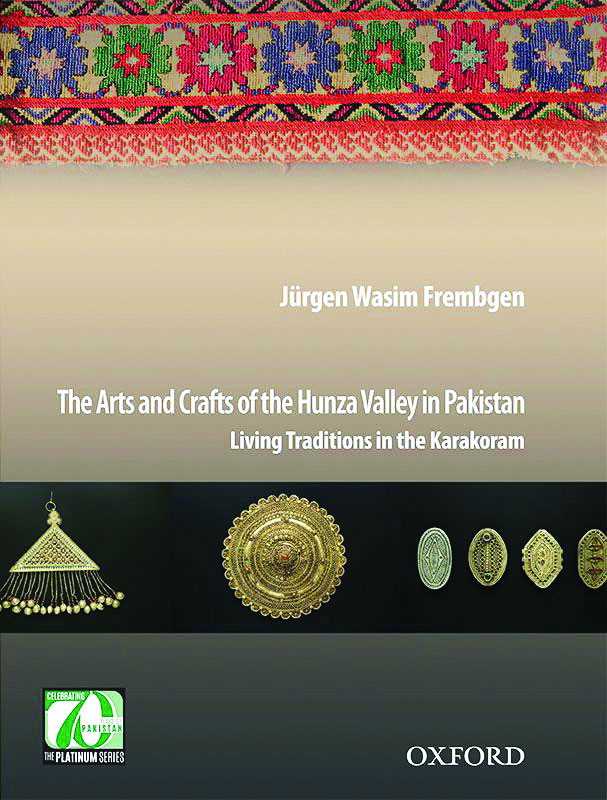
The districts of Hunza and Nager formerly princely states of Gilgit Baltistan, are the absolute stunning valleys in the north of Pakistan, adorned with luscious scenic beauty and rich in material culture and traditions since ages. This book “The Arts and Crafts of the Hunza Valley in Pakistan; living traditions in the Karkoram” is an anthropological narrative of living tradition through material culture of simplistic as well as intricate artifacts of aesthetical value. The book is of worth study regarding disciplines of history, ethnography, anthropology, art, craft and socio cultural studies. The author of this valuable publication Dr. Jurgen Wasim Frembgen, a German Scholar, owes credit to numerous other publications on the subject of ethnographic fieldwork, anthropology, art and material culture and Sufi traditions. The Aura of Alif: The Art of Writing in Islam, Journey to God: Sufis and Dervishes in Islam, At the Shrine of the Red Sufi: Five Days & Nights on Pilgrimage in Pakistan and Wrestlers, Pigeon Fanciers, and Kite Flyers: Traditional Sports and Pastimes in Lahore are few of his good reads depicting his deep rooted interest in Sufiism and culturally rich areas of Pakistan enriched with unique art and craft treasure. Dr. Jurgen has also been a curator at the museum of Ethnology in Munich that is why deeply connected with mentioned subject areas.
The book introduces a concise account of ethnographic overview, land cultivation, religious reforms, and historical kinship background of Hunza and Nagar with mentions of their geographical binding with mountainous regions of Karakoram. The extensive ethnographic field work of around 20 years by author has been fruitful in documenting rich traditions of the region intertwined with anthropology, local history and the ancient political system. Predominantly, the material culture, which is on edges of extinction, had been key objective of this extensive fieldwork to be preserved possibly. Besides theoretical accounts, valuable services with respect to showcase and preserve artifacts of embroideries, jewelry, textiles, wood carvings, tools of craftsmen as depiction of local skill and craftsmanship, had been collections of the Museum Funf Kontinente in Munich from April to September in 2003. Concise yet in depth exploration of 14 local crafts including luxury items for the elite, jewelry, embroideries, silk production, weaving, architecture and carpentry, woodcarving, musical instruments, basketry, lather work, accessories of falconry, stones vessels and calabashes had been the core of description.
Materiality as elsewhere had been the symbol of wealth, power and status for the royal elites of Hunza and Nager. This materiality wealth was showcase of artifacts such as gilded silver crowns, gilded throne like chairs, precious jewelry, robes, rugs, crockery etc. The local craftsmen were basically the ordinary peasants who had to support their families by cultivating lands but practiced the skills in their spare times. The local farmers were expertly self-sufficient in producing ropes made from goat hair, footwear made from long strips of goat leather, stone pots, clay vessels and whetstones to sharp knives and axes.
The jewelry makers interestingly learned the skill from their ancestors over a period of 3 years, practiced in workshop annexed to homes and usually situated close to the ancient royal castles. Ornamental woodcarvings in form of wooden box shaped containers of varied sizes and functions from keeping, jewellery, and cosmetics to even cradles had been a notable craft. The woodcarving in form of motifs usually floral ones also had been evident in frames, doors and windows of local architecture of forts, shrines and mosques. Apart from jewelry and wood carving, embroidery has also been an exquisite mark of local folk art by people of Hunza and Nager. Women caps, bridal face veils, purses and small bags deserve special mention. Birds, floral motifs and geometric patterns with bright colors represent traditional sense of style and taste. Significantly, the richness of articulation, uniqueness and diversification of patterns, designs and styles had been manifestations of local craftsmen acquainted with skills that was learned and adopted as trading norms and extending marriage connections with neighboring states of Central Asia like Kashmir, Gilgit, Afghanistan, Turkmenistan, Tajikistan, Yamen etc.
Music, despite influence of reformist Islamic movements, is popular on occasions, festivals and weddings. A catalogue of hundreds of different melodies is still preserved by old masters. Flutes, string instruments, reed instrument and drums are particularly most played by locals. The art of weapons, tools and the craft of blacksmith are next to fondness for music by men.
The skill of basketry and mat weaving is although not well documented in literature as an art form however it was found as the most common art in practice by local people. The craftsmen of leather work are almost on edge of extinction as the profession was stigmatized as the lowest and poorest. Leather shoes, sacks (although replaced by jute sacks later), rain coats, horsewhips, belts, protective gloves and small bags are some mentions of leather products produced by locals. Accessories of falconry (a hobby practiced by royal nobles) like anklets for the bird and soft tiny hood, woven band with flowers to be put around the bird’s neck and the small brass bell used by falconers was made by silversmith, are unique crafts found from author’s findings and documentation. Colorful images of all craft materials compliment the contents discussed in the book. The book concluded with although briefly described yet elaborately presented through pictures of stone vessels and calabashes (a round pot for keeping vegetable and fruits) as unique material crafts of rich culture of Hunza and Nager.
The book was explicitly found to be simply yet beautifully oriented with an insight into unique and less commonly known material crafts and craftsmen skills of region to readers, however, it was also desired to know more about basic yet interesting information about local dress style, most celebrative occasions, local celebrations, cosine, weather and local economy of the region to know more about life style, cultural, social and economic lifestyle of the people of Hunza and Nager. Incorporating less commonly and general yet important and interesting information would enable readers to actually visualize the region and would of course promote tourism by boosting wish to visit the place personally.


