


Book Review by: Prof. Jit Kumar Gupta
Book Author & Curator: Ar. Apurva Bose Dutta
Book Publisher: Altrim Publishers
Book Publication: May 2023
Book Images Provided by Apurva Bose Dutta
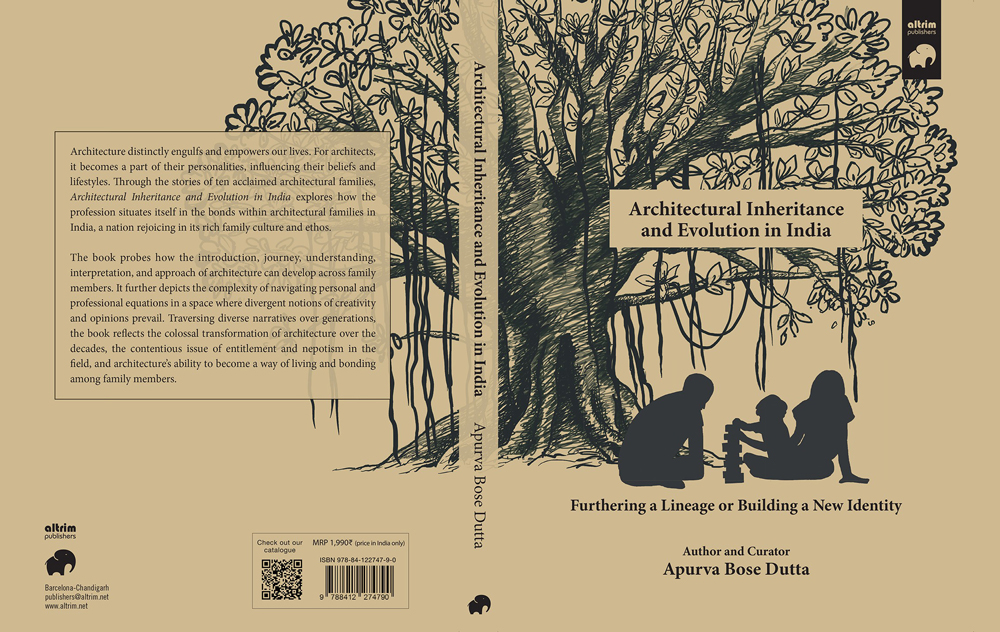
Mapping and unmasking forty-four architects within the framework of ten families and illustrating their ideologies, perceptions, approach, understanding and delivery of architecture remains challenging and involves much multitasking. Architectural Inheritance and Evolution in India, a recently launched book, accomplishes this task effectively and features ten architectural families from India that remain unique, different, and distinct in adopting and pursuing architecture as a profession and practice. The book has been authored and curated by Indian architectural writer Apurva Bose Dutta, known for her meticulous approach and clinical synthesis in the art and science of architectural writing.


The book examines how the subject and profession of architecture, ably led by senior generations, and appropriately supported by mid-generations, has been put on a fast trajectory of growth and development by the millennials. If maintaining professional ethics and promoting social values were at the core of architectural practice by the senior and mid-generations, it is adapting and intelligently managing the diktats of commercialisation, which is largely prevalent in the younger generations’ approach. This trend appears to have been followed by the majority of the families documented and defined in the book.
As one gradually and keenly undertakes a journey browsing through the 150 printed pages of the book, one can comprehend how each family has remained distinct and distinguished while serving the architecture profession. If the family of Ghoshs probes deeper into negotiating theory and practice in architecture, the Jains epitomise morality, humility, and simplicity while practising architectural practice and promoting teaching-learning in architecture. If modesty, grace, and righteousness are the qualities embedded and cherished by the Kanvindes, the Kembhavis trademark their ode to architecture, culture, and evolution as the governing principles of their architectural practice.


If Khans manifest conviction, strength, and liberation in their approach, Puris remain distinct, resolute, regularly evolving, devolving, and never static in their architectural discourse. While the largest clan of architects in an architectural family in India, the Shahs-Gores family, exemplify faith in embracing self-belief over privilege and legacy, the family of Shahs-Khannas have created an architectural canvas with eclectic architectural strokes while learning and growing under the shadow of a legend in architecture. If ethics, integrity, and solidarity are the hallmarks of the legendary Sharma family in their architectural practice spanning seven decades, Zacharias© young and energetic family stand out with their passion, sensitivity, and cheerfulness while paying their ode to architecture.
A close look at the book’s intent, coupled with evaluating the contents and understanding the scope and coverage, clearly indicates its potential to contribute to the vocabulary of Indian architecture significantly. Certain aspects of the book make it distinct and unique in India’s existing architectural literature. It is the first book which documents logically and maps rationally the families of architects, both individually and collectively, highlighting how each family member perceives and practises the profession and how they collectively and jointly, as a social unit, cherish and promote professional values. Dedicated essays on the different families bring lucidity in how every documented family has its exclusive knowledge drivers, values, ideas, approach, culture, professional philosophy, liking and disliking, agony and ecstasy, happiness, and sorrows, while treading a long journey in architecture. This underlines the uniqueness of different families, which the author has been able to document and map with great sensitivity and clinical precision.


Another unique feature that makes the book different, distinct, exclusive, and valuable is the honest, transparent, objective approach and methodology adopted by the author for mapping and deciphering the families and family members. This demanding objective has been achieved by conducting the study based on well-defined and pre-defined researched parameters. The narrative defined for documenting the families remains comprehensive and inclusive. The framework prepared for mapping each family, besides being based on exhaustive research, also includes detailed discussions with each family covering the length and breadth of decades of the journey of each documented family in architecture. The discussions include significant areas in terms of;
- family’s introduction and exposure to architecture
- changing perception of architecture through generations
- evolution of career path and working equations
- overlap and differences prevailing in professional philosophy, ideologies, and working methods opted
- structure and values cherished by the family members
- challenges and advantages encountered while having architects in the family
- valued architectural projects and reasons for being valued
- diverse mediums of the contribution of the family members to the profession
- impact on social life by adopting architecture as a way of life and learning
Images of some special and favourite families’ projects, along with memorable images of their journeys, make the book distinct and unique.
The contents of the epilogue make the book analytical and provide sufficient and quality food for thought to the readers, where the author reflects and synthesises each family in terms of their debuts in architecture, architectural dynamics impacted by professional and personal attributes, and their trials, tribulations, and adaptions. The families are mapped based on their working philosophies, ideologies and value systems, and the individual family members in terms of personalities, interests, gender dynamics, educational background, and geographical locations. By implying these ten families as case studies representing the large volume of architectural families in India, Apurva investigates how architecture effectively emerges as the common anchor for different architectural families in India, strengthening their familial bonds.
Observing the depth of the study and extent of coverage of the listed families of eminent architects of the country, I would like to place on record my appreciation for Apurva for her dedication, commitment, sincerity, and the quantum of hard work invested in decoding the listed families with objectivity, conviction, clarity, and honesty. The book will serve as an invaluable resource for students, professionals, faculty, and researchers operating and involved in the domain of profession and academics in architecture. It is hoped that the book will not only simplify but also help understand the complexities of architecture through the messages and learning provided by the distinguished families in the book, which will empower readers to become better professionals.
I hope Apurva continues her passion for writing, investigating, and documenting various unexplored areas of architecture to make it more visible, useful, dynamic, and qualitative. This book will surely serve the larger cause of humanity, communities, societies, and states by making this planet more sustainable and a better place to live and work.
The book is supported by the Council of Architecture of India. For more information on the book, please visit: www.apurvabose.com/book-architectural-inheritance-and-evolution-in-india/

Prof. Jit Kumar Gupta
Chandigarh-based Prof. Jit Kumar Gupta has more than five decades of professional experience in architectural education, urban planning, policy planning, urban legislation, capacity building in sustainability, green buildings, affordable housing, smart cities, urban laws, urban missions, rural planning, public participation, and urban local bodies. Having held leading designations with academic and professional councils and being an advisor to acclaimed architecture and urban planning bodies, he has published 13 books and over 300 technical papers. He has recently been awarded the Madhav Achwal Gold Medal for lifetime contribution to architectural education by the Indian Institute of Architects.

Apurva Bose Dutta
Indian author, award-winning architectural journalist, curator, editor, and educator Ar. Apurva Bose Dutta (www.apurvabose.com) works at the intersection of architectural design writing, thinking, discourse, curation, journalism, criticism, and communications. Apurva’s passion for communication and academic background has translated into her unique 18-year career with the AEC industry, involving global collaborations with prominent multimedia publishing houses, firms, organisations, and institutions affiliated with architecture, design, and building. Apurva is extensively recognised for her pioneering initiatives in architectural writing. Her well-received first book, Architectural Voices of India, documented the voices of nineteen distinguished Indian architects and built a framework for a discourse on architecture.


