


Text & Photos By: Sarah Hafeez & Asifa Rasool
While numerous historic structures are superintended and maintained, many are coordinated into the lives of the local inhabitants in Pakistan. This combination restricts intercession as well as twists its cultural importance now and again. As result, heritage constructions subsequently are sidelined and lost to time and function. Although we preserve, conserve and restore the historical landmarks, we often fail to look after the parts of conservation. The paper will zero in on two case analyses from Sindh, specifically, Mohenjo-Daro and historical monuments at the necropolis of Makli. Every two sites are enrolled in UNESCO World heritage sites and have the capability of being remembered for the unique nature of planning and beautifying finishes also, these historical sites own exceptional conservation issues which need solutions for a sustainable future. The proposed paper will momentarily discuss the historical backdrop of Architecture of these landmarks, their restoration issues, and methodologies embraced to revive them to the original cultural value. How much the government is successful in undertaking genuine conservation and rebuilding. The paper makes determinations concerning successes and failures in these projects and sees to what degree the objectives of conservation have been accomplished.
INTRODUCTION
Sindh, the vast province of Pakistan, is known for its historical, classical, and historical buildings, tombs of Sufi saints, castles, mosques, and imperial palaces that have remarkable and attractive architectural splendor, and many of them are of great value in our cultural heritage. Some of these effects are a group of problems caused by neglect of people and the environment decay and other factors such as aging and natural decay. Conserving heritage sites and monuments is a difficult task for the Ministry of Culture. However, this department is ready to meet the expectations of the people of Sindh as well as the local and international experts. Therefore, the objective of this research is to start by classifying the importance of historic buildings, then examine the status of some of these buildings, including the listed buildings (Mohenjodaro and Graveyard Makli Hill), in a limited geographic area to discover the degree to which they are falling into decay and to put forward appropriate methodologies for the conservation of at least a reasonable proportion of them, bearing in mind the economic conditions in the country.

HISTORY
Among the urban cities and towns conquered by the Arab armed force under Muhammad ibn Qasim in CE711. and those established by the Muslims in Sindh, so many heritage settlements. The majority of the architectural structures were built during the time of the Mughal Empire in India. During the Mughal Empire, Sindh had been managed by the Kalhora and Talpur lines separately. Similar to a portion of the leaders of the Mughal Empire, a couple of the leaders of the Talpur family were keen on the erection of unique, monumental, and remarkable designs.
The history of this archaic land has been composed and reworked, passing on an apparent audience appreciation around the world. It is the land that has attracted tourists, saints as well as armed forces, and officers from many parts of the world. History observes the attack of Alexander the Great, the triumph of the Muslims, and the battles with the Persian Empire. To a large number of passing water birds. Its coast has mangrove forests, the regular and busy seaport of Karachi. The Arabian Sea offers brilliant freedom in water sports and its sunny beaches constantly welcome tourists with great enthusiasm. This research proposal offers the surprising characteristics of Sindh.
Sindh owns the honor to travel a few centuries wealthy in culture and heritage. The native progress of Sindh traces back to 7000 BC. The principle work of the earliest occupants of Sindh relied upon cattle farming, irrigation, goods exchange, fishing, and the development of harvests. Sindh anyway has proceeded with its ancestor’s practice. It is an agrarian land. Cotton, wheat rice, and sugarcane are the critical harvests developed here. Sindh consists of 6 divisions also 29 districts. Each district in Sindh holds a captivating history. Unmistakable urban areas of Sindh namely, Sukkar, Sehwan, Mirpurkhas, Larkana, Shikarpur, Umerkot, Therparker, etc. The waterfront areas encompassing Karachi are loaded with fish and evaluated for having gigantic fishing spots. Sumai, Pomphret, lobsters, shrimps, sharks, dolphins, and other sea-going life exist in the Arabian Sea just as in the sweet waters of Indus, Manchar, Keenjhar, and Haleji lakes.
However basically considered as peaceful and horticultural, Sindh has eminence for materials, ceramics, leatherwork, and other prominent artworks. The historical backdrop of the craftsmanship of individuals of Sindh traces back to the time of Mohen-jo-Daro human progress. the age of Sindh is evident with the oldest and biggest necropolis in the world.



CASE STUDY I: MOHENJO-DARO, LARKANA, SINDH
Mohenjo-Daro, a metropolitan focus of the Indus Civilization, is one of the unique in the heritage world in its town arranging with heated block structures adjusted in ordinary request and has been perceived as of world significance because of this uniqueness of the city. It is not just necessary that this ever-first urban planned city of the world be restored and preserved for tourism, but in addition, create and promote the economic development of Mohenjo-Daro as a social and tourist place.
Mhenjodaro is located by the site of the River Indus close to the advanced city of Larkana in the province of Sindh, Pakistan, Moenjodaro was discovered in 1922 and has been under excavation from 1922 until 1964 when the practical issues of conserving the excavated bodies daunted the exposure of additional areas. The unearthed regions are estimated to be minimal under 10% of its total area of around 3 million square meters. More than 50 km of walls of various measurements and over 50000 enlisted objects, among them a great many seals, bronze figurines, terracotta figurines, household items, and jewelry have been found from the excavation of just 10% area of the site.[3]
The edge was conspicuous during the period of the Indus Valley Civilization, permitting the city to remain over the nearby plain, yet the flooding of the River Indus has since covered the greater part of the edge in stored silt. The site involves a focal situation between the Indus River and the Ghar-Hakra River. The Indus streams toward the east of the site. Yet, the riverbed of the Ghar Hakra on the western side is currently dry. Mohenjo-Daro was no doubt perhaps the biggest city of the old Indus Valley Civilization (after Harappa. One more significant IVC site, which is situated toward the north of Mohen Jo-Daro in Punjab. Pakistan).
DETERIORATION
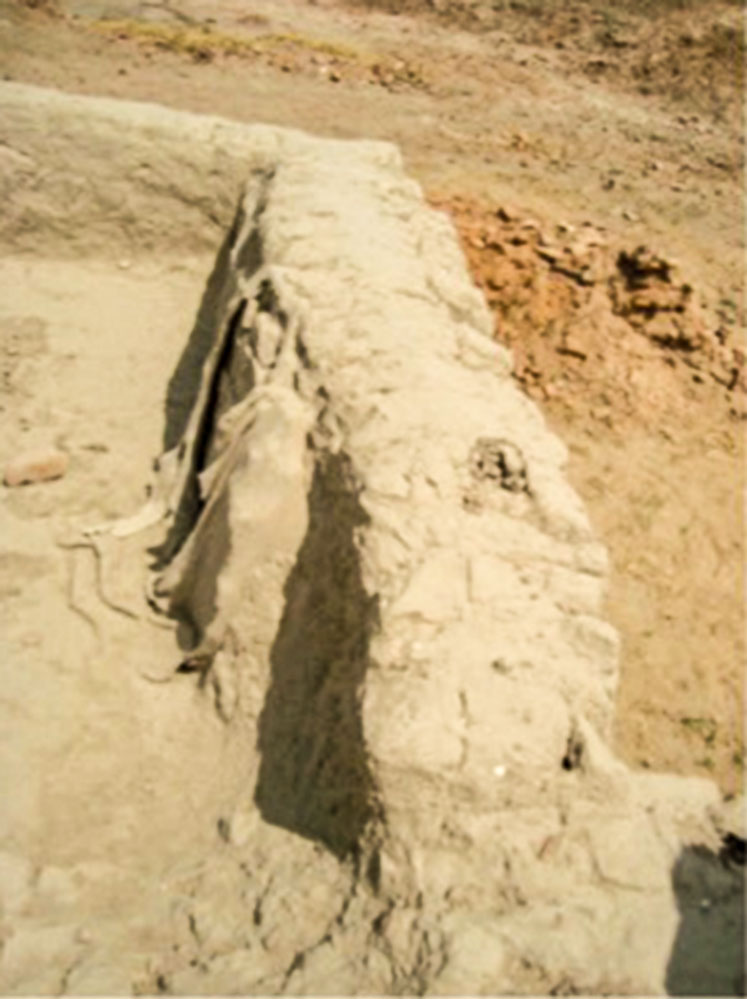
After excavation of the site, the primary remaining parts at Moenjodaro began decaying from salt, thermal problems, and lack of drainage system. The consistent increase of groundwater table inciting the salt-loaded dampness to move into the site through capillary action, subsequent upon the development of Sukkur Barrage and its organization of trenches in 1932, had a speed of deterioration. The brick facades with a complete length of more than 50 km were at that point at risk for a collapse in the late fifties because of their material destruction and structural worsening by hydration/dehydration cycle of salt, downpour, and outrageous thermal anxieties(Figure 3). The River Indus showed an inclination to push toward the west toward the remaining site, warning the actual presence of the site. By the mid-1960s the circumstance at Moenjodaro turned out to be more critical.

CONSERVATION AND METHODOLOGIES
The UNESCO International Conservation Campaign for the Moehnjo-Daro World Heritage Site during 1974-1997 got dynamic worldwide help. The contribution of roughly US $ 9.400 million just as offers for technical help and pieces of equipment from everywhere the world were gotten. The Government of Pakistan additionally added a significant measure of roughly US $ 14,100 million.
Mohenjo-Daro contains two parts: a central region, where the Buddhist stupa was developed with (rough) bricks on the remains of Mohenjo-Daro in the 2nd century AD, and to the east, the ruins of the lower town extend along from the banks of the Indus. Here the structures are located along streets that intersect at right angles, in a deeply organized type of town planning that has also merged the structures of the drainge and sewerage system.
The Historical Ruins at Moenjodaro involve the most antiquated arranged city on the Indian subcontinent and applied extraordinary effect on the urbanization of human arrangement.
As the eldest and best safeguarded metropolitan remains placed in the Indus Valley tracing back to the third thousand years BC, Mohenjo-Daro bears excellent declaration to the Indus Valley civilization.
All Archaeological ruins are as yet present and appropriately preserved. Anyway, the factories of the property are threatened by the saline activity due to the rise of the water table of the Indus. This was the subject of an international UNESCO conservation campaign in the 1970s, which somewhat mitigated the deterioration of mud block structures with different supports (Figure 4).
A detailed master plan has been prepared by the Department of Archeology and Museums of the Government of Pakistan to recognize the actual extension of the MohenjoDaro archaeological site and upon approval of the proposed master plan, the MohenjoDaro archaeological site was transferred from Federal Department of Archeology to Department of Culture, Government of Sindh. Under the Constitutional Law of 2010 (18th Amendment), the Ministry of Culture of the Government of Sindh is currently responsible for the proper conservation and maintenance of the heritage site.
The central head office upheld to manage the issues of preservation and different issues scientifically with conventional strategies. The issues of salt-action, downpour, and thermal pressure are managed through an all-encompassing methodology including utilization of mud slurry, mud covering, indicating, and other union works, for example, under-sticking to hold the realness and authenticity of the property. Other than the above dangers there is the risk of flood which was moderated somehow by building embankments as well as spurs. Nonetheless, a break of the dam upslope would result calamitous harm. The organization is in this manner undertaking normal checking of the dam and is looking for a secure donation from the Government, and extra benefactor organizations to fortify it.
CASE STUDY II: NECROPOLIS OF MAKLI, THATTA, SINDH, PAKISTAN
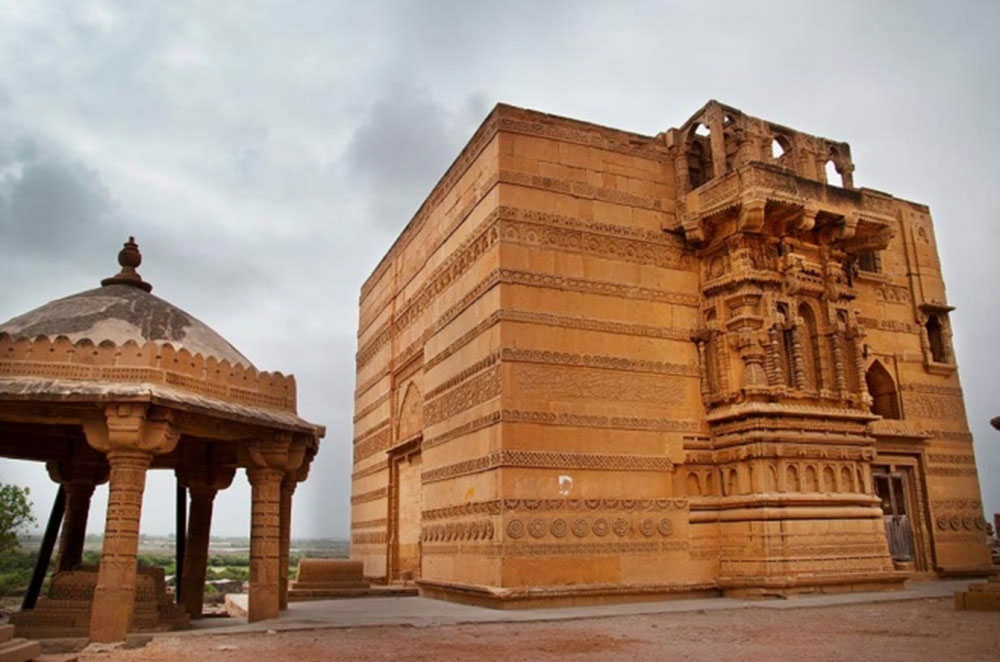
Makli is the biggest and oldest grave having graves made of rocks and put with lime Chiroli and so forth, having a place with the time of Summa dynasty. Makli Necropolis is one of the biggest funerary destinations worldwide, spread over a space of 10 square kilometers close to the city of Thatta, in Pakistan’s province, Sindh. The site houses around 500,000 to 1 million burial places worked throughout the span of a long-term period. Makli Necropolis includes a few enormous funerary landmarks having a place with sovereignty, different Sufi holy people, esteemed researchers, and scholars. The site was engraved as a UNESCO World Heritage Site in 1981 as an “extraordinary confirmation” to the Sindhi community between the fourteenth and eighteenth hundreds years.
The historical background of Thatta is associated with the last period of the Summa rulers, the magnificent rule of the Summa Sultans when Sindh accomplished the apogee of her cultural accomplishment. Thatta is referenced as the prospering city to the extent A.D. 1351, when Muhammad Tughlaq, the Sultan of Delhi. From the fourteenth century onwards it was the historical backdrop of lower Sindh created and up to 1739 Thatta saw the progressive rise and fall of four Muslim ruling periods.
Thatta and the necropolis on the Makli Hill, which is a position of most noteworthy fascination, the hill is known as Makli are arranged around three miles from Thatta. These huge necropolises extended as far as human sight can see. However, these are no normal graves. Inside them lie the remains of King and Queen, Sufi, Scholars, and Soldiers of a period when the city of Thatta was the capital of Sindh as well as a seat of learning and culture. On the Makli Hill from the south to the north one can recognize three primary gatherings of landmarks. The primary (Southern) period, addressing the Mughal time frame, the second (center) period is of the Tarkhan and Arghun and the third (Northern) period, gathering to the super north of the main site, connects with the Summa Period.
DETERIORATION
The general condition and position of the Monuments were not good, Due to the attacks of time and nature it supported numerous primary issues which are described as;
General threats to monuments
Cracks because of inconsistent settlements of huge areas of main structures. Spalling, parting, and lifting because of the volume increments coming about because of implanted ferrous material and scaling and powdering stone surface connected with blossoming and because of solvent salt crystallization harm.
The action of wind.
The monument has fallen inside a zone of high wind speed. The speed on occasion can arrive at 30 miles each hour, which regularly, is restricted to a couple of hours every year. wind at these speeds other than their saline nature has different actions for the monuments at Makli. The wind is the commonest dynamic burden experienced by structures. suddenly applied loads like breezes would bring about exposing the construction to a lot more prominent stress than similar burdens applied gradually.
Decay from salt
The presence of calcium sulfate is an extremely unmistakable possibility for which the research facility testing of blocks and mortars should be dispatched. There are possibilities that pollutants were available in the original structure fabrics and may have been once again introduced accidentally in materials utilized for restoration work in recent occasions.
Rainwater treatment and organic productivity
Entrance of rainwater inside the structure will cause a few sorts of deterioration. After immersion of the stones or bricks surfaces, water will spill down vertical surfaces and wind tension will constrain this through breaks or through the material itself. Because of downpour penetration, the sorts of the roof of the burial chamber and the wall mosque are separated/broken off. The coated tiles/blocks have been tumbled from the inside just as outside of the Mehrab, walls, and so on.
Thermal Problems
Disclosure of the monument to a high diurnal scope of temperature couldn’t endlessly delay the impacts of rehashed warmed and cooling of the external skin of the brickwork. The high differentials in the developments of the external appearances and internal course might call breaks. Reiteration of the cycle throughout an extensive period will make the cracks broaden step by step. Because of thermal extensions, breaks have been created both inside and outside of the tomb at places.
CONSERVATION AND METHODOLOGIES
At Makli, Thatta, Heritage ruins is an ensured artifact as far as the Antiquities Act, in the year 1975, under the decision of the Parliament of the Islamic Republic of Pakistan. The Government of Sindh full regulatory and monetary authority over all legacy locales situated in its region according to the Constitution of Pakistan (eighteenth Amendment) Act 2010 (Act No. X of 2010). The Culture Department of the Provincial Government of Sindh is answerable for the administration and security of the Historical Monuments at Makli, Thatta. The site is staffed by a custodian, archeological conservator, specialized associate, supporting staff, and chaperons. Financing comes from the Provincial Government of Sindh; this funding is perceived as lacking.
A program of desalinization for a huge scope is suggested; deciding the selection of strategies to be utilized. Assurance of salt levels will be fundamental both during and after the use of the desalination methodology.
SURFACE TREATMENT OF BRICKWORK
All the lime and Chiroli mortars ought to be thoroughly tried for their sulfate substance. Deformities seen in brick facades are as under:
* Maturing and rot of pointing
* Disappointment of individual blocks
* Vertical breaking in curves and the walls above
* Diagonal breaks
The adequacy of a brick facade against the downpour entrance and its solidness rely on the state of its pointing. In pointing and once again pointing work, the color of mortar alongside the profile and surface of the pointing is significant. Raking out of brickwork joints ought to be to a base profundity of ¾”. Pointing ought to be embedded perfectly with a reasonable scoop guaranteeing there are no smudgy edges.
In the restoration of the essence of a wall, the new brickwork should be tied back to the old. This is best done as in cavity wall development. The hole between the old and the new ought to be grouted in to forestall any water leakage.
Detailed examinations will uncover that core work, in its current state, contains poor enduring material, for example, chalk and rotted lime mortar Retention and openness of such material to the activity of the climate is hurrying finished deterioration. For both economic and future support it will be legitimized to supplant chunks of chalk and rotted mortar or break down stonework of poor enduring quality with comparable materials of more prominent solidness. Substitute brickwork would coordinate with the first in appearance as intently as could be expected.
In the combination of the essential point will be to conserve the wrecked layout of the demolished wall somewhat that to force standard levels and falls upon it. Grass and plants should be eliminated, the brickwork wiped off, and, where free or shaping water traps, numbered, shot, lifted, and installed. Evacuation of soil may require profound uncovering into the wall head. The brickwork will eventually be returned as found expect in those occasions where changes are called for to guarantee that water doesn’t lake on a superficial level.
CONSERVATION IN SINDH
Since freedom (1733 A.D) various projects were embraced by the Department of Archeology in Sindh however scarcely very few examples have been drawn for the genuine protection of future undertakings. The principal reasons were the absence of research on conservation and building materials, insufficient training programs of professional and qualified staff and laborers, working conditions, and lack of government support for the protection of Heritage sites. Despite the fact that the department of Archeology set up a Pakistan organization of Archeological Training and Research in Sindh basically is a dead association.
Preservation is profoundly practical and specialized work. It needs total information on hypothesis, comprehension of specialized issues and consequently, requires inventive management in specific regions. At present none of the individuals from the National Committee established by UNESCO has any reasonable experience in conservation nor do they visit the site. To keep up with legitimacy careful documentation is needed at each progression. This incorporates a wide range of photography, the working drawings for future reference and development. Periodical distributions might be brought out showing the success and failures for future direction and education.
From the above case analyses, the unmistakably adequate examination isn’t done before the beginning of conservation projects. The site investigation, lab, and library research should be made compulsory both at the hour of readiness of preservation plan just as execution of the project. The work may not be started until the essential research is finished. At present, the work is either completed on the verbal guidelines of the concerned specialists or left at the caution of the project head.
The staff of the Department of Archaeology deputed on the previously mentioned conservation projects were not prepared in the site of project management. Hence, every one of the tasks could not be finished on schedule. These postponements are seen due to the targets. For future protection projects, it should be guaranteed that staff should be prepared with present-day project executives methods in case they are sufficiently prepared previously. The junior staff should be trained by them, balancing of record of occasions and activities, arrangement of meetings with technical staff and recording of minutes are very fundamental for the conservation project.
Looking into these realities, it is firmly recommended that detailed research and methodology possibly be followed for conservation projects of the World Heritage sites. This incorporates careful documentation, complete exploration, training, workshops, serious professional staff, the expert advisory committee, and intermittent publications on the victories and challenges experienced during the conservation projects and solutions looked to defeat such challenges.


