


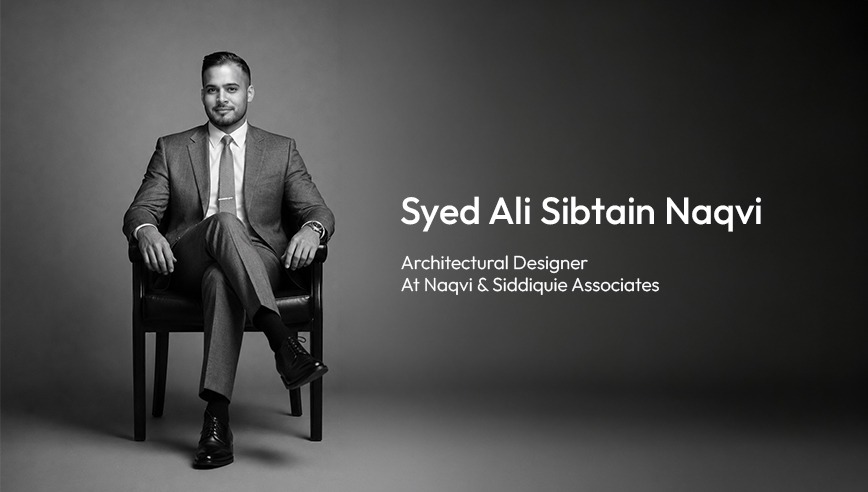
Architect Syed Ali Sibtain Naqvi is a forward-thinking design professional known for his thoughtful approach to architecture that seamlessly blends functionality, context, and contemporary aesthetics. With a strong focus on creating meaningful spaces, his work reflects a deep understanding of user needs, materiality, and spatial harmony. Driven by innovation and precision,
Ali Sibtain has been involved in a diverse range of residential and commercial projects, delivering designs that balance modern expression with practical performance. His architectural philosophy emphasizes sustainability, clarity of form, and enduring design value, positioning him as a promising voice in the evolving architectural landscape.
TELL US ABOUT YOUR EARLY SCHOOLING, PROFESSIONAL EDUCATION, AND YOUR BACKGROUND.
ALI SIBTAIN NAQVI (ASN): I come from a close-knit family of six, rooted in diverse yet complementary professions. My father is an architect, my mother a doctor, my eldest sister also an architect, my elder brother a data scientist, and my twin brother a banker. Beyond my immediate family, most of my uncles and aunts are doctors, engineers, or artists. Growing up in such an environment meant being constantly surrounded by discipline, creativity, and intellectual curiosity. Each of these influences, in its own way, has shaped my outlook and contributed to the person I am today.
I completed my schooling at Foundation Public School (FPS). My A Levels was pursued privately and I went on to complete my Bachelor’s degree in Architecture from Beacon-House National University (BNU), Lahore, where my formal architectural thinking began to take shape.

HOW DID YOU DECIDE ON TAKING UP ARCHITECTURE AS A PROFESSION?
ASN: My decision to pursue architecture was driven primarily by the discovery of passion and genuine interest. Architecture is an all-consuming discipline; it demands commitment far beyond routine practice, and I believe one can only sustain it through true passion.
Belonging to a family with three generations of architects meant that I was naturally and constantly exposed to the field from an early age. This proximity cultivated my interest well before I formally understood the profession. There is something profoundly grounding about walking through spaces thoughtfully designed by your predecessors—experiencing their work not as drawings or photographs, but as living environments that continue to function and inspire.
In a world that rarely slows down to acknowledge the past, seeing institutions and organizations still value and respect my ancestors’ work decades later is deeply meaningful. To me, it is a powerful reminder that architecture, when done with integrity, speaks louder than words and endures far beyond its time.


WAS THERE A SPECIFIC EXPERIENCE OR PERSON THAT INSPIRED YOU TO EXPLORE THE ARCHITECTURE PROFESSION?
ASN: I was born in a house in North Nazimabad, Block N, thoughtfully designed by my grandfather. That home left a lasting imprint on me through its spaces, motifs, patterns, corridors, materiality, and architectural ornamentation. Even as a child, the house quietly taught me how architecture could shape memory, emotion, and everyday life.
My grandfather, Architect Sibtain S. Naqvi, was an extraordinary personality. He had a deep interest in music and sports—tennis, golf, swimming, and snooker—and was an avid traveler who explored the world extensively. He was also a passionate collector, gathering souvenirs, coins, matchboxes, and postal stamps from across the globe. Always impeccably dressed, he carried himself with effortless grace, as if perpetually prepared for a celebration. His home reflected his intellect and curiosity, with a vast library filled with books collected from around the world.
What truly set him apart, however, was his cultural sensitivity and emotional intelligence. He was a genuine people person—maintaining deep personal relationships and always willing to go beyond himself to understand and support others. His passion, energy, and integrity were boundless. It was impossible not to be inspired by such a magnetic presence.
Although I spent only about four years of my life with him, his influence on my decision to pursue architecture has been profound and enduring. Through the honesty and dignity of his work, he quietly set a benchmark that I now carry forward as a third-generation architect.

Above all, my father and sister embody the same values and spirit. They have been a constant source of inspiration, guidance, and support, allowing me to learn at every stage of my life while reinforcing the legacy of architecture rooted in integrity, humanity, and purpose.
WHICH ARCHITECTS INFLUENCED YOU AND YOUR WORK?
ASN: My work has been influenced by a diverse range of architects across eras and philosophies. Frank Lloyd Wright and Le Corbusier shaped my understanding of spatial order, proportion, and the relationship between form and function. Peter Zumthor instilled a sensitivity toward materiality, atmosphere, and emotional experience. Contemporary architects such as Bjarke Ingels encourage innovation rooted in practicality, while Zaha Hadid and Frank Gehry inspire boldness, experimentation, and the courage to challenge convention.
Lastly, credit for my architectural understanding go to Dr. Gulzar Haider Dean of BNU & further faculty, who instilled in me the qualities of an architect in my prime years of observation. approach to contextual modernism, clarity, and precision.
These influences collectively inform a design approach that balances rigor with imagination and tradition with forward-thinking exploration.
HAVE YOU WORKED WITH ANY OTHER ARCHITECTURE FIRM BEFORE JOINING YOUR FATHER’S FIRM?
ASN: Yes, before joining my firm, I completed my architectural internship at Arcop (Pvt.) Ltd. The experience was instrumental in shaping my understanding of team dynamics, studio culture, and professional workflows. Working within a large practice gave me valuable exposure to the coordination and processes required to deliver projects across multiple scales.
While I have not yet had the opportunity to explore the profession more broadly, I remain eager to learn from diverse practices and seasoned architects, as I strongly believe that continual learning is essential to growth in architecture.
DID YOU EVER FEEL THAT JOINING AN ESTABLISHED FIRM LED BY AN ELDER FAMILY MEMBER LIMITED YOUR ABILITY TO FORGE YOUR OWN PATH OR DEVELOP AN INDEPENDENT ARCHITECTURAL VOICE?
ASN: I don’t believe there is a predetermined formula for success, nor a fixed path that guarantees it. I consider myself fortunate that my genuine interest aligned with the profession of my grandfather and father, but legacy alone does not sustain a practice—skill, integrity, and commitment do.
An established name only holds value if it is continually earned. If I fail to deliver, the name means nothing. Likewise, if my predecessors had not upheld the quality and honesty of their work, the firm would not have endured. For me, joining an established practice is not about following a set path, but about carrying responsibility—adding value through my own contribution while respecting what came before.
WHAT IS YOUR DESIGN PHILOSOPHY AND METHODOLOGY?
ASN: Design Philosophy
My design philosophy is rooted in integrity, continuity, and human experience. Architecture must first serve people—emotionally, culturally, and functionally—before it serves form. Influenced by legacy and lived spaces, I value designs that age with dignity, where material honesty, proportion, and spatial clarity take precedence over fleeting trends. Architecture is a lived condition—meant to be felt, inhabited, and remembered. I see it as a dialogue between past and present, where innovation emerges through restraint, relevance, and thoughtful evolution.
Design Methodology
My methodology begins with listening to the client, the site, and the cultural context—followed by research, spatial analysis, and conceptual clarity. I prioritize strong concepts and geometry that guide the project from inception to execution. Materiality and detailing are considered early, ensuring the design intent translates seamlessly into built form. Through iteration, collaboration, and precision, I aim to create timeless, functional, and quietly powerful spaces that endure and resonate.
RECENTLY, YOUR FIRM, NSA, HAS COMPLETED A DOUBLE TREE HILTON HOTEL PROJECT. WHAT WAS YOUR CONTRIBUTION TO THIS PROJECT?
ASN: The DoubleTree Hilton project came to our firm during the COVID-19 period, when I was in my third year of architecture studies and classes had shifted online. Despite this, my father and I continued regular visits to the office, which allowed me to engage with the project from its very inception. The excitement of the project inspired me to put all my ideas on paper for discussion with my father and the team.
As a student, I contributed creatively—some of my ideas were incorporated, while others evolved with the design. Over time, while the project grew in scale, its core character and concept, particularly the connectivity between interior and exterior spaces, were preserved. Additionally, I played an active role in the detailed design development and renderings, collaborating closely with the team to bring the project to life.
WHAT DO YOU ENJOY MORE, ARCHITECTURE OR INTERIOR DESIGN PROJECTS?
ASN: My primary passion lies in architectural design, as it allows me to shape spaces holistically and engage with users, context, structure, and experience. That said, I genuinely enjoy all types of design projects, including interior, furniture design, joinery details because each presents unique challenges and opportunities to create meaningful, human-centered spaces.
WHAT IS YOUR DREAM PROJECT YOU WISH TO DESIGN AND WHY?
ASN: Given the current state of our cities, I see immense opportunity in designing thoughtfully—whether starting from scratch or intervening with sensitivity. I don’t have a single dream project; rather, I have many aspirations. While it may not be possible to realize them all, I believe in striving toward each one. After all, even attempting to bring these visions to life is a meaningful pursuit in itself. If there were a way for me to participate in Karachi’s master plan, I’d love to contribute to add value in the lives of the people of Karachi.
WHAT FUTURE GOALS DO YOU HAVE IN MIND?
ASN: My future goals are to uphold and strengthen the legacy of my family firm while contributing meaningful value to the society we serve. I aim to pursue my master’s and further studies to broaden my expertise. At the same time, I look forward to expanding our services both locally and internationally, gaining valuable experience abroad that can be applied here to benefit our communities and built environment.
Many thanks for talking to us!


