


SYMPOSIUM ON COMPUTATIONAL DESIGN AND EMBEDDED INTELLIGENCE – DEPARTMENT OF ARCHITECTURE, UNIVERSITY OF ENGINEERING AND TECHNOLOGY (UET), LAHORE
Text by Quratulain Asghar
With the rapid integration of technology and artificial intelligence across all fields, there is an urgent need to recognize and reposition architecture as a STEM discipline within Pakistan’s academic and professional frameworks. The symposium titled “Computational Design and Embedded Intelligence: Architecture under STEM” emerged from this realization. It aimed to highlight the global paradigm shift in architecture. The symposium emphasized a shift that is increasingly interdisciplinary, data-driven, and technologically integrated.
The Department of Architecture at the University of Engineering and Technology (UET), Lahore, hosted one of Pakistan’s most forward-thinking academic events: the international symposium CoDE 2025 from April 16-18, 2025. Organized by Quratulain Asgher and Fatima Javeed, with active support from the student-led platform ArchiHub, the symposium brought together architects, academicians, researchers, and students to explore how computation, AI, and embedded systems are transforming design education and practice.
The three-day symposium featured a diverse mix of lectures, panels, workshops, and exhibitions. Each day focused on a specific theme contributing to a larger question: How must architectural education evolve to address the demands of an increasingly digital, intelligent design world?


Whitepaper and Institutional Impact
Following the workshop, Fatima Javeed authored a whitepaper summarizing key outcomes and recommendations. She mentioned that countries such as the United States, Singapore, and China have officially classified architecture as part of STEM disciplines. This policy change has facilitated interdisciplinary collaboration, research funding, and educational reform. The document was submitted to the Pakistan Council of Architects and Town Planners (PCATP), the Higher Education Commission (HEC), and the Academic Council of UET. The effort urged Pakistan to take similar steps and equip its architects with the skills and tools needed to lead the future.
The PCATP team responded with great appreciation, acknowledging that the whitepaper’s insights aligned closely with the Council’s vision for the future. It emphasized the urgent need to recognize architecture under the STEM umbrella in response to technological shifts, such as the rise of smart cities, AI, IoT, automation, digital fabrication, and sustainable computing. Fatima’s whitepaper not only documented the event but also proposed concrete recommendations for STEM-based curriculum reform, sparking institutional dialogue.
Day 1: Foundations of Computational Thinking
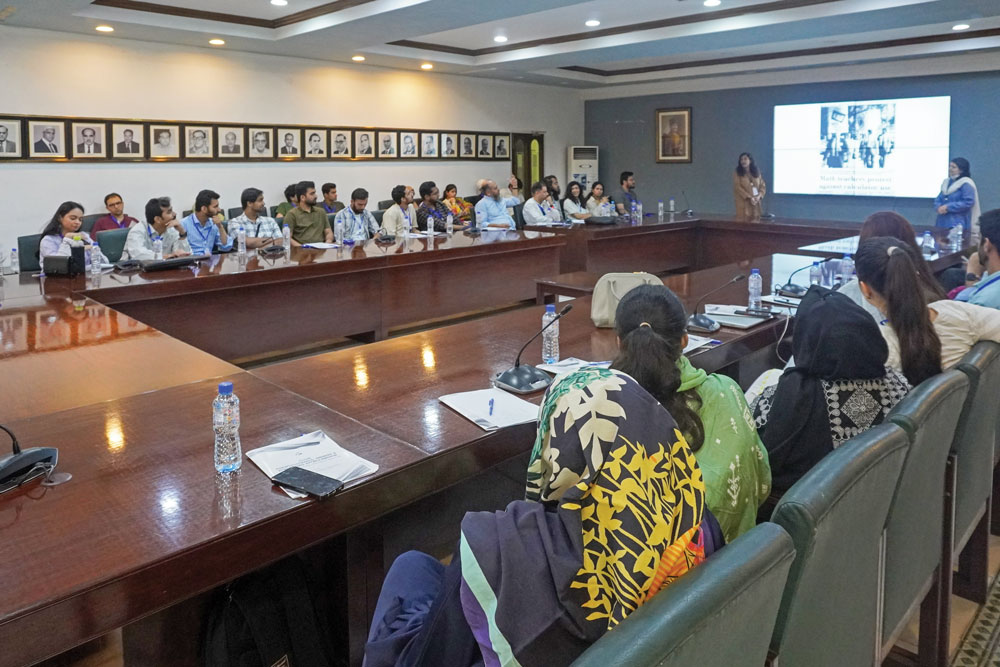
The symposium began with a formal session at the Vice Chancellor’s office, setting a respectful tone for the days ahead. In her welcome address, Department Chairperson Ar. Munazzah Akhtar stressed the urgency of integrating computational thinking into foundational design education, particularly in countries like Pakistan, where conventional models resist change. Ar. Quratulain Asgher opened the symposium with a keynote lecture unpacking the WHAT, WHO, WHY, and HOW of computational design and embedded intelligence. She laid out the necessity of adopting digital technologies in architectural education and practice. The keynote stated that Architecture is no longer limited to static spatial design in the rapidly changing global landscape.

Ar. Zeeshan Zaheer followed with a presentation on data-driven design. During his live cases on his campus, he demonstrated how physical modeling leads to analysis and performance, ultimately resulting in more resilient structures. Dr. Hafsa Imtiaz mapped spatial emptiness using space syntax, offering a renewed lens on spatial experience and flow. Her study on NCA’s campus encouraged attendees to reflect critically on space through data. Her study brought participants back to their own spaces with a renewed perspective, measuring spatial experience and presenting differing readings of built form in the form of data and movement.
In a post-lecture discussion moderated by Fatima Javeed and Quratulain Asgher, students openly voiced their concerns. Many feared being left behind as global curricula advance. They expressed that universities in Pakistan were not evolving quickly enough to meet international standards. Some questioned the future of architectural roles in the face of AI, while others emphasized the need to redefine the architect’s place in a tech-driven world.
Attendees included participants from major institutions: NCA, Punjab University, UMT, COMSATS, University of Gujrat, LCWU, University of South Asia, IDAP, and others. The response was overwhelmingly positive. Students valued the chance to engage with new tools and appreciated that faculty and professionals in decision-making roles were addressing these timely issues.Field professionals also shared pressing challenges, such as IDAP’s struggle to find local expertise for kinetic façade design, which led them to seek external collaboration from Sri Lanka. This case highlighted a national skills gap and underscored the need for curriculum modernization.
The day transitioned into a beginner workshop on parametric design, led by James Chadud, introducing tools like Rhino and Grasshopper. For many participants, it was their first exposure to procedural, iterative design thinking-a marked shift from intuition-driven methods. A fishbowl session before lunch allowed participants to speak candidly about their challenges, confusions, and aspirations.
Day 1 concluded with a sense of purpose, having laid the foundation for understanding computation not merely as a toolkit, but as a way of thinking.
Day 2: Algorithmic Design and Emerging Research
Fatima Javeed opened Day 2 with a session on AI-based smart building systems and IoT integration in architecture. She invited participants to envision buildings as intelligent systems-responsive, adaptive, and context-aware. The session introduced the underlying technologies of smart systems, including IoT devices, sensors, and microcontrollers, illustrating how buildings can interact with users and their environment in real time. For many students, this represented a significant paradigm shift in how architecture is conceptualized. The session also featured a brief hands-on segment, where students experimented with basic coding for sensors and microcontrollers, offering a practical introduction to embedded intelligence in physical spaces. Ar. Quratulain Asgher returned with a thought-provoking presentation drawn from her PhD research, advocating the transition from CAD to algorithmic logic in design pedagogy. She emphasized that CAD should change from a representational device to a design logic.
This was followed by a series of engaging research presentations from the Department of Architecture at UET, Lahore. Assistant Professor Madiha Zaman discussed her research on generative design and shape computation, arguing that architects should extract the essence of form, not mimic it. Assistant Professor Hina Nabeel shared her research on the role of technology in conservation, showing how digital tools are revolutionizing the documentation and simulation of historic structures. Architects Faryal with Rida, and Abrar presented their team’s web-based tool, which was developed in the Architecture Informatics course taught by Fatima Javeed. The tool helps architects conceptualize spatial layouts while calculating their carbon footprint, aiding sustainable design from the ideation stage. Their joint session reflected on curriculum gaps, faculty training, and the need for institutional support to foster digital design in Pakistan.

In the afternoon, Dr. Philippe Morel delivered a conceptual workshop titled Computational Shifts, challenging attendees to rethink the epistemologies behind software use. He argued that computation encodes ideology and aesthetics, not just function. Later, Valentino Tagliaboschi introduced students to digital fabrication, guiding them through prototyping processes and the logic of machine-material interaction. It was the students’ first exposure to CNC workflows, 3D printing, and computational materialization.
Day 3: AI, XR, and Immersive Intelligence
The final day extended the conversation into AI, XR, and emotional spatial design. Dr. Samer El Sayary conducted a workshop on AI-assisted creativity, demonstrating how generative AI can serve as a collaborator in the design process. Students explored various tools that opened up new formal and conceptual possibilities. Later, Architect Shahzaib held an impromptu session on Prome AI, where he shared real-world examples of how to integrate AI into design workflows.
Ar. Mavra Ahmad closed the lecture series with an insightful talk on immersive architecture and XR technologies, connecting virtual/augmented reality to spatial storytelling. Her presentation sparked a deeper conversation on presence, memory, and inhabiting digital space.
The symposium concluded with a student exhibition, showcasing semester work created using the very tools and technologies discussed. From posable joints to responsive mechanisms, the models embodied a digitally literate design process.
Closing Reflections
The closing ceremony was attended by Pro Vice Chancellor Dr. Nasir Hayat, PCATP Chair Ar. Ejaz Qadri, and IAP Lahore Chapter Chair, Ar. Faisal Rasool. In her closing remarks, Fatima Javeed emphasized that architecture has historically been deeply intertwined with science, mathematics, and engineering. During the Islamic Golden Age, Muslim architects were also astronomers, geometers, and mathematicians, seamlessly integrating scientific knowledge into spatial design. During the Renaissance, architects were not only designers but also engineers, cryptographers, and shipbuilders. They are truly polymath individuals whose diverse expertise influenced the development of the built environment.
She urged the audience to see the STEM alignment as a return to architectural roots, not a departure. She underlined that this tradition must continue in the modern era, especially as developed countries have formally recognized architecture as a STEM discipline, both in policy and education. Architects have never advanced the field merely by studying history, but by actively applying knowledge across disciplines to innovate and build. She concluded with a message of her own that encapsulated the core spirit of the symposium: “Change is inevitable.
We can either embrace it and lead, or resist it and become victims of that change.”
The Chairperson of PCATP also acknowledged and appreciated the workshop, emphasizing the importance of such academic initiatives in shaping national policy and elevating professional standards. He highlighted the critical need to integrate technology into architectural education and professional development. He drew on historical parallels and referenced the invention of the printing press, noting that the Muslim world fell behind because it failed to quickly recognize and respond to this technological shift. He urged that Pakistan must not repeat such mistakes and shared his vision for embedding technology into the architectural curriculum to equip the next generation of architects to lead in a rapidly evolving, technology-driven world.
Symposium Outcomes
– Participants unanimously recognized architecture’s alignment with STEM
– High interest in learning computational tools, AI, IoT, and digital fabrication
– Strong demand for curriculum modernization and faculty upskilling
– Encouragement of institutional transformation to prepare future-ready architects
More Than a Symposium:
A Vision for the Future
CoDE 2025 was truly impactful, not just for the knowledge shared but also for the vision it catalyzed and inspired. It challenged students to think critically, empowered faculty to rethink pedagogies, and asked institutions to lead rather than follow. In the intersection of student passion and academic foresight, CoDE 2025 revealed what Pakistan’s architectural future could look like: digitally fluent, globally aligned, and socially responsive.
Quratulain Asghar
Ms Architecture,
Pratt Institute, NY, USA.
B Arch, University of Engineering and Technology, Lahore.


