


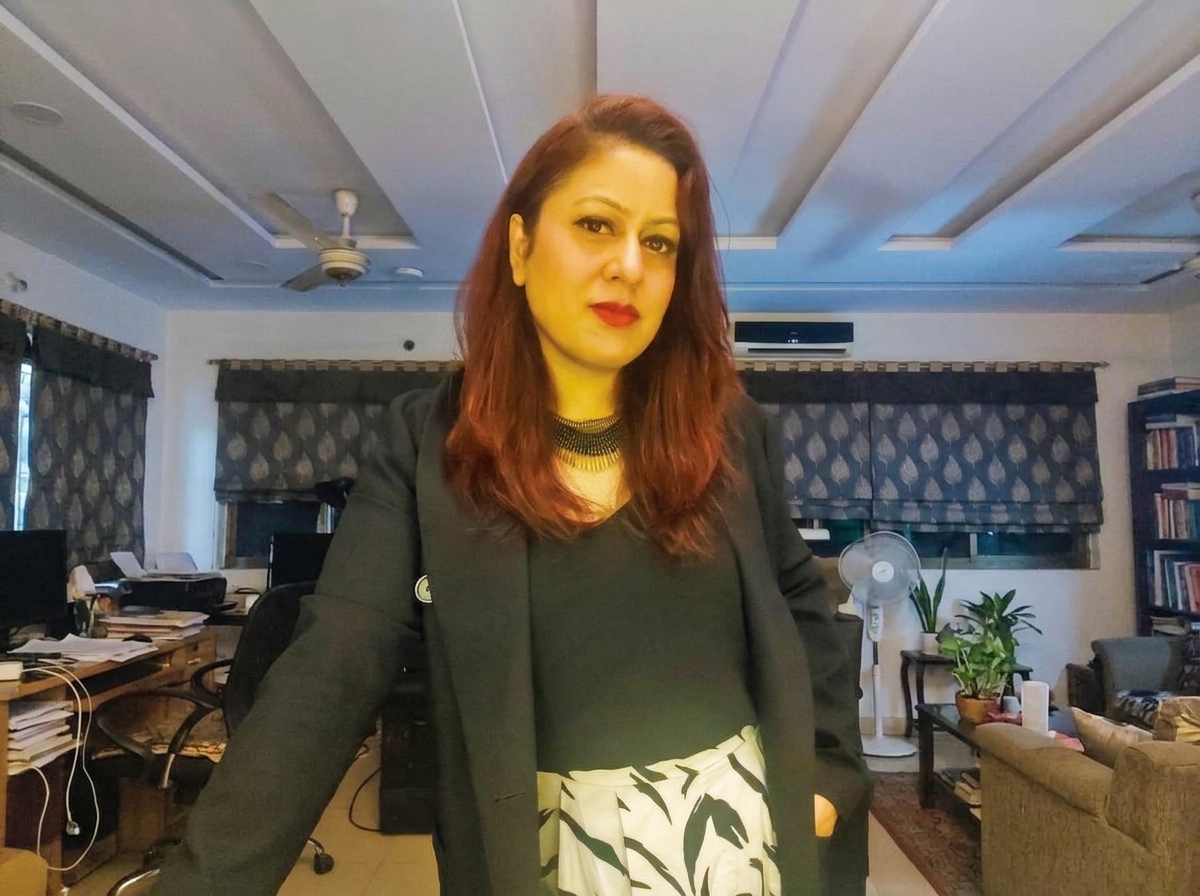
ARCHITECT, PEDAGOGUE, FEMINIST DESIGN RESEARCHER
Dr. Mamuna Iqbal is an architect, educator, and researcher whose work operates at the intersection of pedagogy, practice, and critical inquiry. Currently serving as an Assistant Professor at the University of Engineering and Technology Lahore, Dr. Iqbal received her PhD from Welsh School of Architecture (WSA), Cardiff University, UK, where she also worked as a Design Tutor. As Vice President of Women in Architecture Pakistan and through her practice with government bodies such as WCLA and PHATA, she focuses on the ideas of Feminist Design Research and Socially Inclusive Built Environment.
CAN YOU BRIEFLY SHARE YOUR EARLY LIFE AND HOW YOUR EDUCATION IN ARCHITECTURE HAS SHAPED YOUR THINKING AND WORK TODAY?
MAMUNA IQBAL (MI): I come from a background where access to higher education was limited, especially for women. I am the first person in my extended family-male or female-to attend university and complete a professional degree, which is something I take great pride in. My mother, who grew up in a small village and was unable to study beyond primary school, was my greatest source of motivation. Her lifelong desire for education shaped my own aspirations and commitment to learning.


WHAT LED YOU TO CHOOSE ARCHITECTURE AS A CAREER, AND HOW HAS THAT MOTIVATION CHANGED OVER TIME?
MI: I chose architecture because I was drawn to the idea of creating something from imagination and giving it form. Over time, this interest developed into a deeper engagement with architecture as a way of understanding social and cultural realities. During my PhD, I explored how students’ social backgrounds shape their architectural learning. This made me question conventional teaching methods, which can often be restrictive and overlook diverse experiences. It also led me toward feminist approaches in architectural research, particularly around inclusivity and representation-questions that continue to inform my work today.
ALONGSIDE TEACHING, HOW DO YOU ENGAGE WITH ARCHITECTURAL PRACTICE, AND HOW DO THE TWO AREAS INFORM EACH OTHER IN YOUR WORK?
MI: Alongside teaching, I engage with architectural practice through a research-driven and collaborative approach. Rather than treating practice and academia as separate domains, I see them as closely interconnected. My practice becomes a space to test ideas, explore design methods, and engage with real-world complexities, while teaching allows me to reflect on and critically frame these experiences. This relationship works in both directions. My academic work-particularly in design research and questions of inclusivity-informs the kinds of projects I take on and the approaches I use in practice. At the same time, my engagement with practice brings current challenges and institutional realities back into the classroom, making teaching more grounded and relevant. For instance, my work with the Walled City of Lahore Authority (WCLA) involves research, condition assessment, and adaptive reuse design of a 19th-century British pumping station and water reservoir in the Walled City of Lahore. This project engages directly with questions of heritage, infrastructure, and community, allowing both my students and me to work within a historically layered urban context. Similarly, my role as an academic expert with PHATA focuses on contributing to the evaluation of low-cost housing programmes and organising workshops, seminars, and conferences around housing and urban development. This work brings policy, affordability, and social equity into focus and feeds directly into my teaching and research. I am particularly interested in creating learning environments where students can engage with real stakeholders, work across disciplines, and see design as a form of inquiry rather than just problem-solving. In this way, practice supports teaching by providing live material and experimentation, while teaching supports practice by opening up space for critical thinking and innovation.

WHAT WAS THE FOCUS OF THE INTERNATIONAL COLLABORATIVE STUDIO, AND WHAT WERE YOUR MAIN GOALS IN SETTING IT UP?
MI: The International Collaborative Studio was developed as a focused, three-year initiative (2023-2025). Rather than working on multiple unrelated projects, the studio centred on a single, evolving design-research agenda aimed at testing and refining an Architectural Design Research (ADR) model within the context of the Global South. As a part of this studio, we organized ADR workshops in collaboration with IAP-LC and WCLA. They brought together students and faculty from architecture schools across Lahore, alongside international collaborators. The context of Walled City Lahore with its dense historical layers and complex socio-spatial conditions, became a live laboratory for exploring how design can function as a form of research.
At the core of the initiative was the idea of embedding research within the design process, rather than treating it as a separate or preliminary stage. The ADR model we developed was based on iterative design-research loops, where students moved between contextual analysis, theoretical inquiry, and design propositions in a continuous and reflective process. The thematic focus evolved over the three years but remained anchored in questions of urban heritage, identity, social justice, and inclusion. The aim was to move beyond conventional approaches that either replicate Western design models or rely on uncritical historical revivalism, and instead develop contextually grounded, socially responsive architectural thinking.
The broader goal behind establishing this initiative was to address the gap between architectural education and practice, particularly in Pakistan, where research and design are often disconnected. By integrating them through a structured pedagogic framework, the studio sought to train students to engage critically with complex realities and to produce meaningful, context-sensitive design interventions. One of the key outcomes of this work has been the development of a design-research model tailored to the Global South, which has now been published in an international impact factor journal. More importantly, the initiative demonstrated how architectural education can shift from a model of knowledge consumption to one of knowledge production-where design itself becomes a tool for inquiry, reflection, and social engagement.
WHAT DOES “SOCIAL EQUALITY” MEAN TO YOU IN THE CONTEXT OF ARCHITECTURE AND ARCHITECTURAL EDUCATION?
MI: To me, social equality in architecture is about recognising that the built environment is not neutral-it reflects and often reinforces existing social hierarchies. In both practice and education, it means questioning who is included in the design process, whose needs are prioritised, and whose knowledge is considered valid. In architectural education, social equality requires moving beyond one-size-fits-all teaching models. Students come from diverse social, cultural, and economic backgrounds, and these differences shape how they learn, think, and engage with design. Creating an inclusive learning environment means acknowledging these differences and allowing multiple perspectives to inform the design process.
In practice, it involves designing with an awareness of social context-considering issues such as access, representation, and everyday lived experiences, rather than focusing only on aesthetics or technical outcomes. It also means engaging with communities as active participants rather than passive recipients of design. For me, social equality is therefore not just an abstract idea but a guiding principle that shapes how we teach, research, and practice architecture in more inclusive and responsible ways.


YOU FOCUS ON ARCHITECTURAL DESIGN RESEARCH IN YOUR WORK. HOW DO YOU USE DESIGN AS A WAY TO EXPLORE AND UNDERSTAND COMPLEX URBAN AND ARCHITECTURAL ISSUES?
MI: I approach architectural design not simply as a process of producing solutions, but as a method of inquiry-what I frame as Architectural Design Research (ADR). In this approach, design becomes a way of exploring and understanding complex urban and architectural conditions rather than just responding to them. Through my work, particularly in the Lahore Design Research Workshop Series, I developed a process based on iterative design-research loops. This means that students move back and forth between site analysis, theoretical reflection, and design proposals in a continuous cycle. Design is not the final outcome but part of an ongoing process of questioning, testing, and refining ideas. Working in contexts such as the Walled City of Lahore, with its layered history and dense socio-spatial conditions, allows this approach to engage directly with real complexities. Issues such as heritage, identity, informality, and social dynamics are not treated as background information but become central to the design process itself. This method also challenges more conventional models of architectural education, where research and design are often treated as separate stages. Instead, ADR integrates them, allowing students to generate knowledge through design. In this way, architecture becomes a critical tool for understanding urban realities and imagining more inclusive and context-sensitive futures.
IN YOUR OPINION, WHY DOES ARCHITECTURE MATTER TODAY, AND HOW CAN ARCHITECTS CONTRIBUTE TO SOCIETY AND CULTURE IN MEANINGFUL WAYS?
MI: Architecture matters today because it shapes how we live, interact, and experience the world around us. It is not just about buildings; it is about creating environments that influence social relationships, cultural identity, and everyday life. In many contexts, especially in the Global South, architecture also plays a critical role in responding to rapid urbanisation, inequality, and environmental challenges. Architects can contribute meaningfully by moving beyond a narrow focus on form and aesthetics, and instead engaging with the social and cultural realities of the communities they design for. This means understanding local contexts, working with existing conditions, and designing in ways that are inclusive and responsive to diverse needs. I believe architects also have a responsibility to question dominant ways of thinking and practicing. Through design, research, and education, architects can challenge dominant frameworks and expose the structural inequalities embedded in housing, heritage, and public realm, opening up more inclusive and context-responsive ways of thinking and practicing. Engaging with communities, collaborating across disciplines, and treating design as a process of inquiry can lead to more grounded and meaningful outcomes. Ultimately, architecture matters because it has the potential to shape more equitable, inclusive, and culturally relevant futures, and architects play a key role in making that possible.


WHAT INSPIRED THE FORMATION OF WOMEN IN ARCHITECTURE PAKISTAN (WAP), AND WHAT ARE ITS MAIN AIMS?
MI: Women in Architecture Pakistan (WAP) was formed out of a recognition that, while many women are entering architectural education and practice, their presence and contributions often remain underrepresented and undervalued within the profession. There was a clear need for a platform that could bring visibility to these issues and create a space for dialogue, support, and collective action. The main aim of WAP is to highlight and address the structural challenges that women face in architecture, both in education and professional practice. This includes issues of representation, access to opportunities, workplace dynamics, and the broader cultural attitudes that shape the profession.
At the same time, WAP functions as a network that connects women across different stages of their careers, encouraging mentorship, collaboration, and knowledge-sharing. It also seeks to create more inclusive and equitable spaces within architectural discourse by amplifying diverse voices and experiences. Ultimately, WAP is not just about representation, but about advocating for meaningful change-challenging existing norms and working towards a more inclusive and supportive architectural culture in Pakistan.
HAVE YOU FACED ANY CHALLENGES IN YOUR CAREER AS A FEMALE ARCHITECT, PARTICULARLY WITHIN PROFESSIONAL PRACTICE OR ACADEMIA?
MI: The challenges I have faced as a female architect have often not been overt or immediately visible. Instead, they are subtle and embedded in everyday expectations shaped by the social context in which we work. In many cases, these expectations influence how women are perceived, the roles they are encouraged to take on, and the opportunities that are made available to them.
These challenges appear in small but persistent ways-such as assumptions about commitment, authority, or professional priorities-and they can shape both academic and professional environments. While they may not always be openly acknowledged, they create conditions where women often have to navigate additional layers of negotiation in order to be taken seriously or to access the same opportunities. Over time, I have come to understand these experiences not as isolated incidents but as part of broader structural patterns within society and the profession. Recognising this has also informed my interest in questions of gender, inclusivity, and representation in architecture, and has shaped the way I approach both teaching and practice.

FROM YOUR EXPERIENCE, WHAT KINDS OF GENDER-BASED CHALLENGES EXIST IN THE FIELD OF ARCHITECTURE, WHETHER FACED BY YOU OR OTHERS?
MI: One of the key gender-based challenges in architecture is the gap between participation and leadership, as women remain underrepresented in positions of influence. We see a large number of girls enrolling in and graduating from architecture programmes, and in many cases, they are among the highest-performing students in their classes. This clearly shows that the issue is not one of capability, intellect, or commitment. From my experience, the issue lies in broader social and cultural expectations, which often influence how women see their own roles, how their work is valued, and the kinds of opportunities they are able or encouraged to pursue. In many cases, women have to negotiate between professional ambitions and socially defined roles, which can limit their ability to fully exercise their agency within the field. So, the challenge is not about inclusion at the entry level, but about retention, progression, and leadership. Addressing this requires a shift in how the profession and society at large support women in not just participating in architecture, but in shaping it. That said, there are already signs of progress, with growing awareness and gradual improvements in women’s representation within the profession.
HOW DO YOU VIEW THE CURRENT STANDARD OF ARCHITECTURAL EDUCATION IN PAKISTAN?
MI: In my view, the current standard of architectural education in Pakistan is shaped by a strong emphasis on curriculum content, with insufficient attention to the pedagogical frameworks that develop critical thinking and inquiry. This reflects a broader issue within the discipline, where Architectural Design Research (ADR) remains largely disconnected from both teaching and professional practice. Research is often treated as a formal academic requirement-primarily producing publications for career progression-rather than as a dynamic process that informs design. When it does enter the design process, it is typically confined to a preliminary stage, rather than functioning as an iterative and generative method of inquiry. This reinforces a divide between academia and practice, limiting the potential of architectural education to produce meaningful, context-responsive knowledge.
At the same time, professional practice in Pakistan tends to rely either on imported Western models or uncritical adaptations of historical forms. Both approaches struggle to engage with the complex socio-economic, cultural, and environmental realities of contemporary contexts. This reflects a deeper disciplinary fragmentation, where architecture is reduced to problem-solving or aesthetic production, rather than understood as a critical and socially embedded practice. In this context, architectural education risks reproducing these limitations unless it shifts toward a more integrated and reflective model-one that connects design, research, and practice, and positions architecture as a civic and social responsibility rather than merely a technical or commercial pursuit.
DO YOU THINK ARCHITECTURAL EDUCATION IN PAKISTAN NEEDS CHANGE? WHY OR WHY NOT?
MI: Yes, architectural education in Pakistan does need change, but not simply in terms of producing more “field-ready” architects, as is often argued. This critique from professional practice tends to reduce education to skill-based training, whereas the role of academia is much broader. Universities should not only prepare students to enter practice but also equip them to question, challenge, and reshape it. The need for change becomes clearer when we consider the existing disconnect between academia, research, and practice. As discussed, research is often treated as an isolated academic exercise, while design education remains largely detached from critical inquiry. This limits the ability of architectural education to produce knowledge that is both meaningful and applicable to real-world complexities.
In this context, academia must strengthen its own position-not by simply aligning itself with conventional practice, but by expanding its scope. Engagement with practice is important, but it should go beyond traditional architectural work to include research, interdisciplinary collaboration, technological innovation, and social engagement. Only then can academia move from passively responding to professional demands to actively shaping the direction of the discipline. Ultimately, meaningful change requires a shift from a narrow, skill-focused model to one that is research-driven, critically engaged, and globally connected, while remaining grounded in local realities. This is essential if architectural education is to contribute not just to the profession, but to society at large.


WHAT SPECIFIC CHANGES OR IMPROVEMENTS WOULD YOU SUGGEST TO STRENGTHEN ARCHITECTURAL EDUCATION IN PAKISTAN?
MI: Architectural education in Pakistan needs structural, not incremental, change. The priority should be to shift from a content-driven model to a pedagogy that integrates design and research, positioning studios as spaces of inquiry rather than solution-making. This would allow students to engage critically with complex socio-spatial conditions rather than relying on predefined approaches. A key improvement is to bridge the disconnect between academia, research, and practice. Research should not remain an isolated academic activity but must become embedded within the design process as an iterative and generative tool. At the same time, engagement with practice needs to expand beyond conventional architectural work to include policy, technology, interdisciplinary collaboration, and social agendas.
There is also a need to move away from uncritical reliance on imported models or historical replication, and instead develop context-responsive approaches grounded in local realities. Strengthening international collaborations can support this, but they must be critically adapted rather than adopted. Ultimately, architectural education must reposition itself as a space for knowledge production and critical engagement-one that equips architects not only to operate within the profession, but to question and transform it.
WHAT ADVICE WOULD YOU GIVE TO YOUNG ARCHITECTS AND STUDENTS, ESPECIALLY WOMEN ENTERING THE FIELD TODAY?
MI: My advice to young architects and students is to see architecture not just as a profession, but as a way of thinking and engaging with the world. Designing the future is not simply about responding to present needs; it is about reimagining how we live, work, and connect in a constantly evolving world, while remaining grounded in the social, cultural, and historical contexts that shape us. To do this meaningfully, it is important to move beyond technical skills and develop the ability to question, reflect, and form your own critical position within the discipline.
For women, in particular, the challenges you may face are often subtle and embedded within everyday expectations, but they are nonetheless significant. Recognising these structures without internalising their limitations is important. Trusting your perspective, building supportive networks, and creating spaces for collaboration can be powerful ways to navigate and reshape the profession.


