


Prof. Dr. Amir Pasic, Aga Khan Award winning architect for his historic preservation works in Mostar passed away
By Dr Noman Ahmed – Professor and Dean,
Faculty of Architecture and Management Sciences,
NED University of Engineering and Technology, Karachi
Prof. Dr. Amir Pasic, renowned academic, researcher, activist and moving spirit behind the famous Mostar Bridge Restoration Project, passed away recently. Those of us who had closely worked with him in various capacities were shocked by his sudden demise. Full of life, energy and hope, Prof Amir believed in the future of his beloved city Mostar – and restoration of its heritage during the worst of civil war. And his conviction and hope worked. Despite badly destroyed during the war in Bosnia and Hercegovina, the Mostar bridge and other artefacts and spaces were able to rise from ashes. An accomplished architect with many talents, Prof Amir led a unique process of restoration with enormous inclusiveness with local and international stakeholders. I had the opportunity of attending several heritage conservation initiatives that were spearheaded by Prof Pasic to evolve ideas about rebuilding the Mostar bridge and other public spaces. Below are some random accounts when we first succeeded to step into Mostar after a painful civil war that lasted several years.
Imagination of cities in Bosnia Hercegovina during the 1990s brings views of plunder, devastation, rubble, debris, buildings razed to the ground, scattered refugee camps, human misery, plight, broken and run-down infrastructure, snipers in the hiding and groups of people taking cover for safety. This was perhaps the exact situation when the civil war was at its peak. Situation, however, considerably changed after 1996-97. Advent of peace keeping troops under the auspices of United Nations, rebuilding effort by the people and support organizations such as European Union (EU) and the World Bank and the overall enthusiasm of the people towards re-construction caused all the difference.
After ceasefire, landing at Sarajevo International Airport was an exciting experience by itself. Controlled by the European troops and managed by the Bosnian authorities, the airport gave a fine impression of a medium sized facility in any developed quarter of Europe. As one drove out onto the main street, the roads and allied infrastructure were amazingly in place. Road surfaces were properly carpeted without making the motorists feel bumps on the way. The side drains functioned without any sight of stagnant water despite heavy down pours that were common especially during late summers. One reached Mostar – a scenic Bosnian town in the proximity of Croatia – in about two hours without any mis adventure! Mostar had been known in the Balkans for its low-profile elegant architecture and the reminiscent of Ottoman and Austro-Hungarian heritage. It was also the context of some of the finest architectural conservation projects and programmes, one of them even received the prestigious Aga Khan Award for Architecture in 1986. And above all, Mostar was a friendly city with a plural and multi-cultural society. It was a site of immense interest for architects, planners, engineers and other design professionals having interest in heritage and its conservation. This town was severely hit by the civil war of the early and mid 1990s leading to large-scale destruction. Though at places one comes across various buildings which are completely devastated or hollow dead structures with no life, the overall appearance of the city showed signs of recovery. Many public structures such as the municipality building which belonged to the Austro-Hungarian type – had been severely damaged. There were not enough funds to restore the building despite its urgent need.
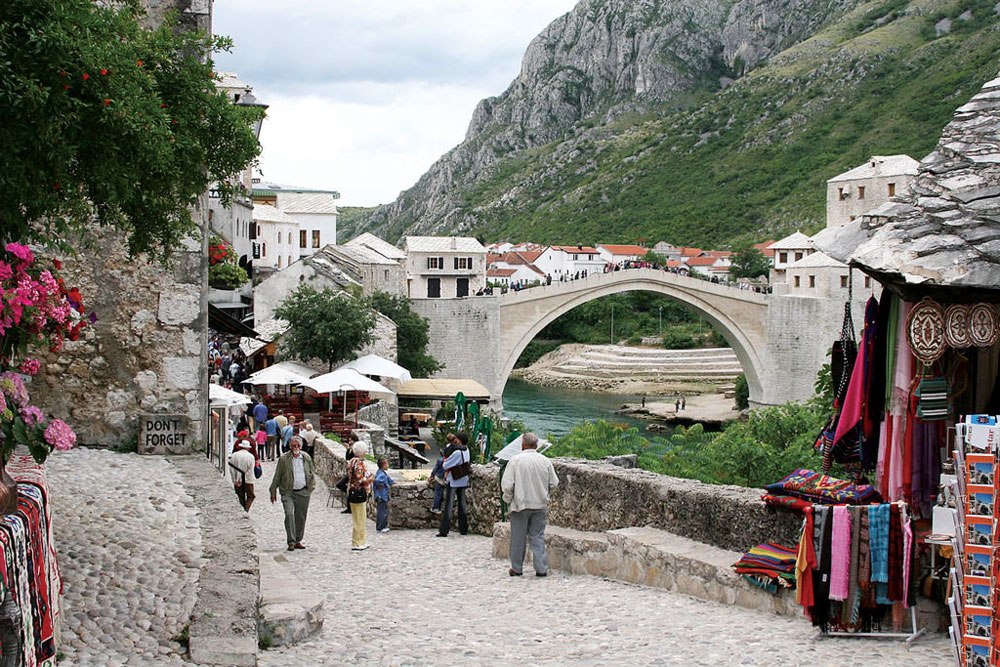
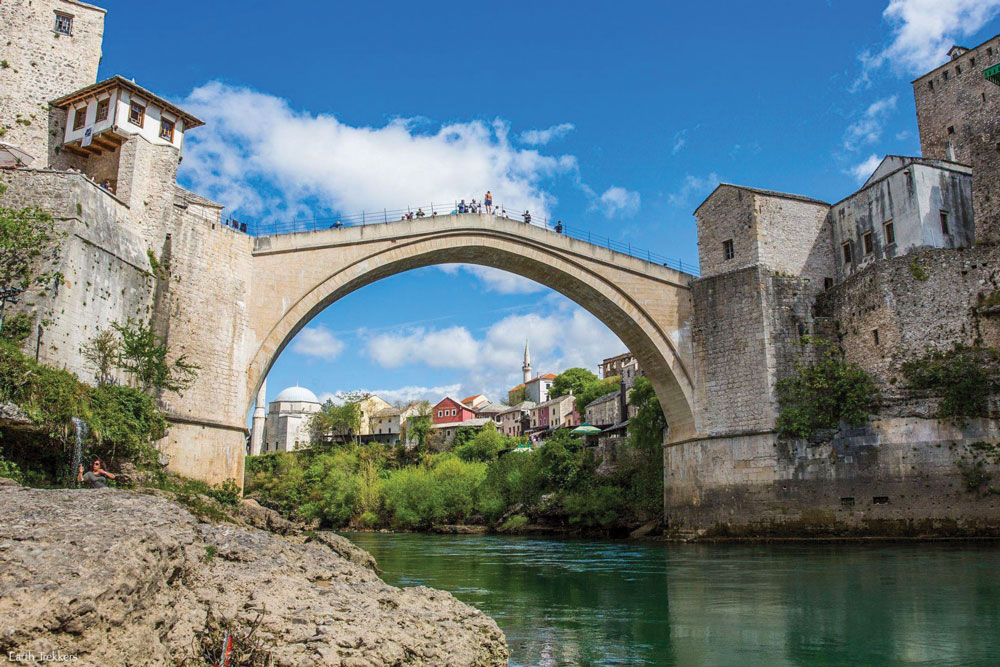
The most important facet of the city was the ‘Stari Most’ (the old bridge). Destroyed in 1993 as a consequence of shelling, the bridge represented a unique architectural example. It was a combination of viewing towers which added a scale contrast to the blue Neretva River. Although several bridges had been built during and after the Ottoman times, the focal importance of Stari Most had been paramount. The bridge was considered as a common asset of the people of Mostar. “During the war, all the citizens – irrespective of their religion or ethnicity – prayed for its survival. The enemies knew that the morals of Mostarians will never fall till the bridge remained. They targeted from hill tops, from lanes-near and far but could not succeed for several weeks. One enemy strategist advised the bombers to strike at the feet and arms of the bridge instead of the head! This time they succeeded to destroy. The people who seldom shed tears while burying their most beloved, wept bitterly”, told Zdenka – a restaurant worker who lived close to the bridge.
Conspicuous presence of UN peacekeepers all along the city edges was a visible phenomenon in Mostar. According to natives, the peace was simply an outcome of the presence of the ‘blue helmets’. If at all they were withdrawn at a pre-mature stage, the city would be ravaged again by civil war. Many local intellectuals and strategists also subscribed to the same viewpoint. People of Bosnia in general and Mostar in particular were locked in a strange dilemma. They had the great nostalgia of the times of peaceful co-existence. Such memories were soured by the atrocities of the genocide that almost all the citizens experienced with fellow communities of former Yugoslavia. The aftermaths of this devastation created deep impacts on the emerging scenario. While the majority Bosnians – by and large – were not strict practicing Muslims, more and more people can now be seen congregating at the masjid and the khanqahs of the sufi saints. The folks of other faiths were also following the same line. In some cases, this zeal over stepped the logical confines. For example, up on the city’s hill-top, a group of zealots, while re-constructing and repairing a church, erected a spire not less than 100 meters in height. This structure simply overpowered the entire skyline of the otherwise low-lying city. A huge cross was also put across the hill. The Muslims were said to be contemplating a suitable answer! One wondered where such futile race would stop!
Mostar became a divided city. One of the banks of Neretra River was inhabited by Bosnian Muslims. Across the river, edging the boulevard was the beginning of Croatian quarters. The Croatian Mostar had the newer development. It had less of historic quarters and was strategically gifted. The only airport of the town was also located in this part. Economic performance was on a lower ebb. The only visible activity observed in the form of restaurants, small-scale shops, night clubs, low scale discothèques etc. While Bosnian (convertible) mark was the currency, Deutch Mark (during the pre-Euro era) was openly used as the medium of exchange. Pace of daily life activities was also very slow. With the exception of nightlife, the day posed a dull picture. Many households of the town almost entirely survived on the remittances received from abroad sent by their family members.
The past was inseparable from the life of Mostar’s residents. There had been an open tradition of inter marriages between various communities of the region. These inter marriages gave rise to a completely inter twined socio-ethnic milieu which was the key reason for the peaceful co-existence of the people. Bosnia, by its very nature, war a common ground for Bosnian Croats, Bosnian, Serbs (who then controlled a large part of the country) and Bosnian Muslims. This plurality was the great advantage the people of Bosnian enjoyed. It was difficult to imagine that such a situation would arise back at all. However the young generation was living with painful memories of atrocities which were impossible to forget. Many observations can be drawn from the observed situation. Mostar, lied at a strategic location which could not be ignored by the local/regional power brokers. This strategic location was the key to the peaceful survival of the Balkans. If Bosnia and Mostar were ravaged by war again, the entire Balkans would remain at war. People, despite the utmost pain that they experienced, began returning to life with great courage. While the sufferings continued to exist, the attitude of working towards re-construction remained profound. Innate sense of discipline and a mature civilized attitude in the public life was a great advantage that they carried. Generally speaking, the moderate way of practicing the religion made the city an attractive point for tourists and expatriates. International agencies were also accustomed to such type of environment of working. An honest and enthusiastic professional approach was visible in almost every section of the society. In the words of Prof. Dr. Amir Pasic, renowned educator/academic and re-habilitation expert who was in charge of rebuilding Mostar, “the essence of a peaceful existence of Mostar lies in the creation and survival of a strong educational system. At all levels – beginning from kindergarten till the university – students have to be given a sound exposure about their heritage. The heritage not only means built heritage but also includes the social and cultural values on which the society was structured. Unless the citizens learn to respect the existence of each other and their heritage as a means for survival in the future, peace will never be achieved”!


