


By: Shaheer Masud
The people of Karachi, enthused about exploring artistic and cultural activities, seldom have the chance to immerse in experiences curated by passionate visionaries that transport us to a different world. Traffic, pollution, crime, and shrinking public spaces not only continue to add to the woes of this great city, but also leave its people with little time or energy to engage in our shared humanity.
The Karachi Biennale is one example of the antidote that is severely needed. A multi-venue, multi-artist, and multimedia series of art exhibitions, the third edition of this event started on October 31 and concluded on November 13. KB 22 is a brilliant confluence of creative storytelling, technological innovation, sensory immersion, and imperative advocacy. The themes of the many installations this year address pertinent issues affecting us, and remind everyone to embrace the past while staying true to a changing world.
The venues for the curations were deliberately chosen to bring Karachi’s heritage to the forefront. The major sites in Old Saddar included Narayan Jagannath Vaidya (NJV) School, Jamshed Memorial Hall, Hamid Market, and NED City Campus. Saddar is a place where the history of this city comes alive. The hustle and bustle, the crowds, the smells, the sounds, all reminding the passerby that this is still the heart of Karachi.
At Narayan Jagannath Vaidya (NJV) School, located on Old Bandar Road (now M.A. Jinnah Road), four installations represented different historical, environmental, and social themes. The historic building served as the original Sindh Assembly, also the place where Jinnah himself convened the first Pakistan Assembly. Varda Nisar, the Head of Educational Programming for Karachi Biennale, guided tours on the weekends. Among other things, she is responsible for engaging schools and students with the platform, inspiring the next generations of artists in the process.
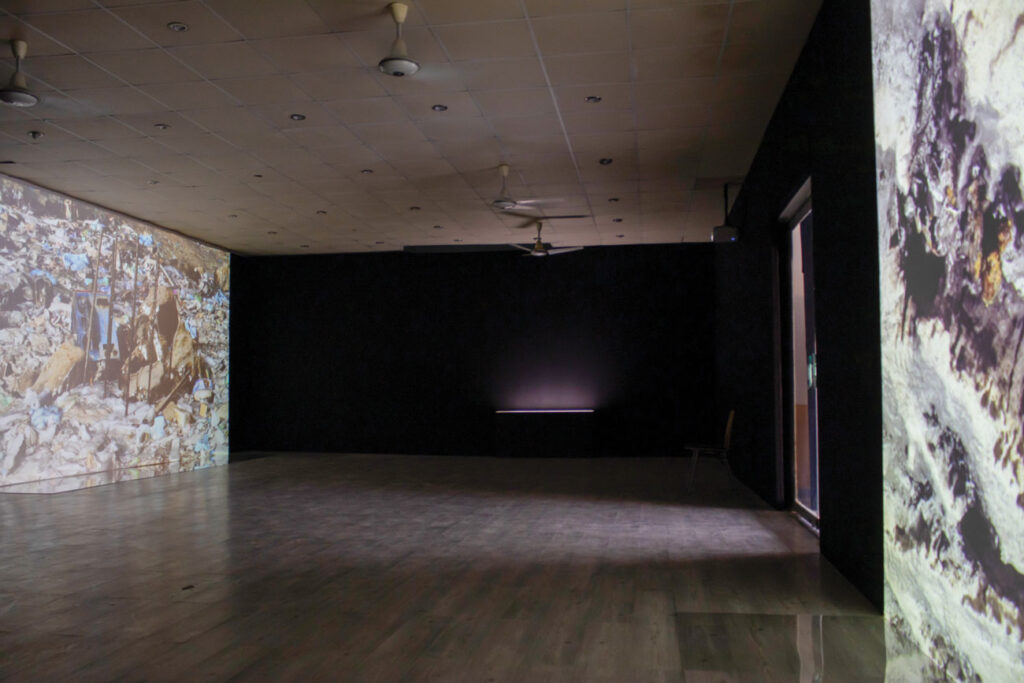
The large building with Greek columns is covered in desert sand hue, iconic of Saddar’s colonial era buildings, and serves as a generational educational institute for many of the area’s residents. The tour starts with ‘Saaz’, presented by Karachi Community Radio (KCR) Studio. Paying tribute to the sound and origins of the Chitrali sitar, while also showing visitors a world that is coming, the dark room floats with melodious notes as nebulous projections move like a river across the ground and walls. An incredible stripped-down robotic mechanism is seen pressing and strumming the strings of the sitar in a pre-programmed pattern that plays different compositions on a loop. The projections in the room are actually an AI-generated visualization of the sitar’s rhythms. The overlap of art and artificial intelligence has already started, and it raises many questions about the future of our musical traditions, performance arts, and audience perceptions. Sitting in the cool air, taking in the masterful installation with its sights and sounds, one feels as if they are somewhere in the Hindu Kush highlands.
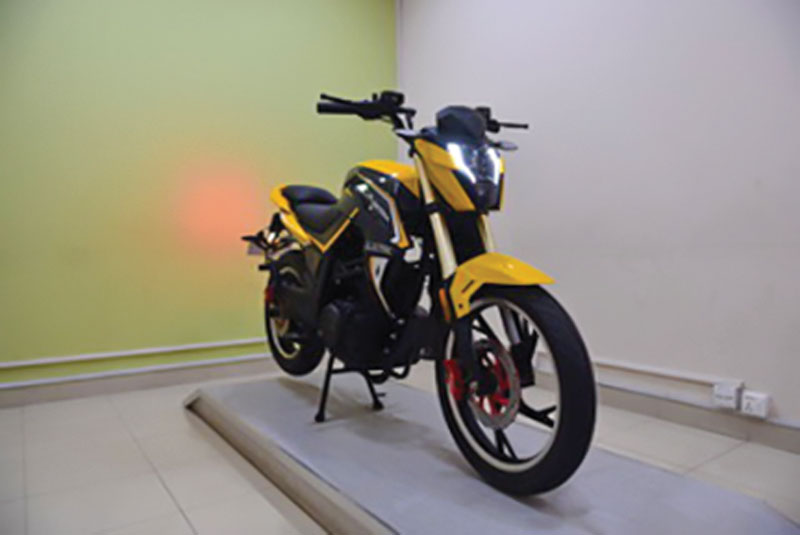
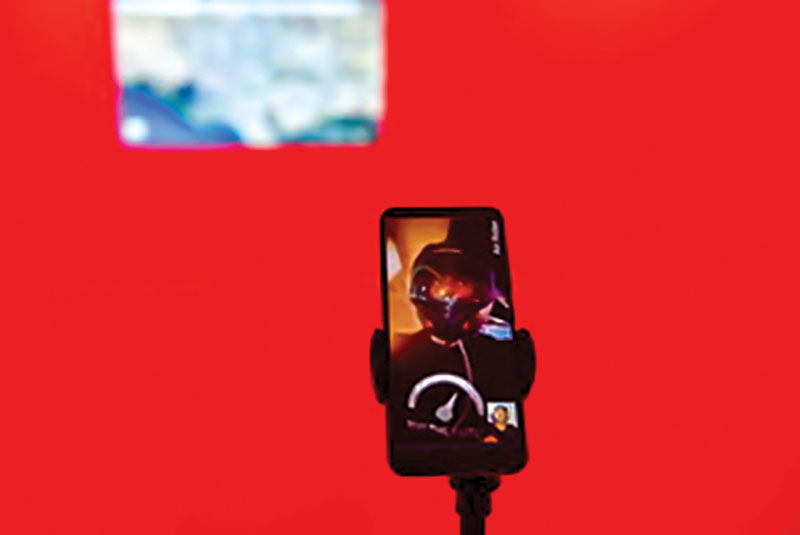
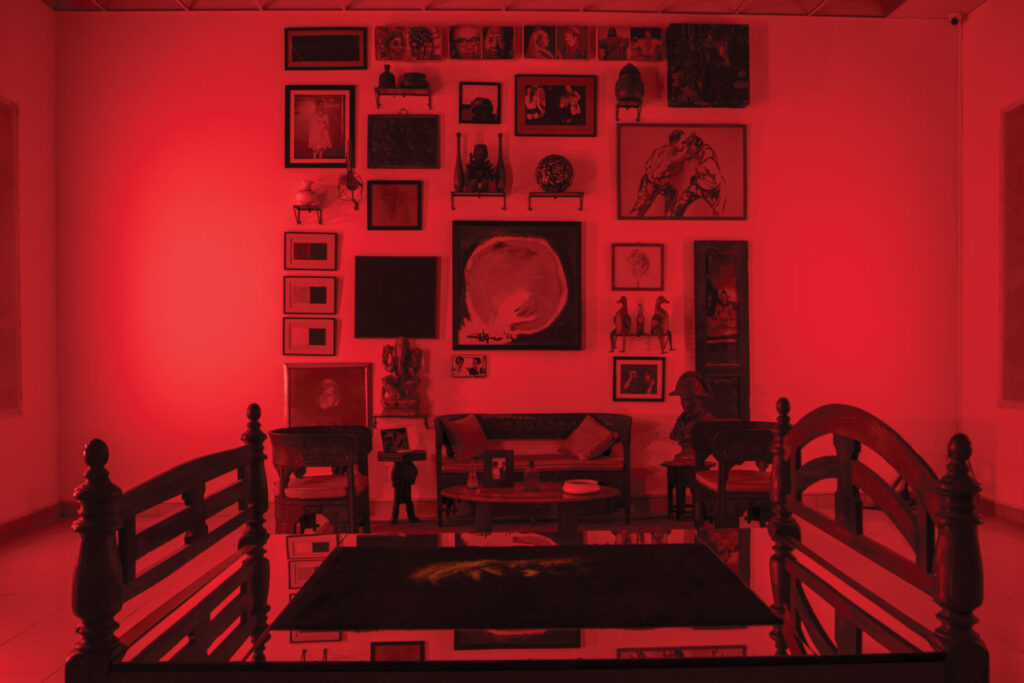
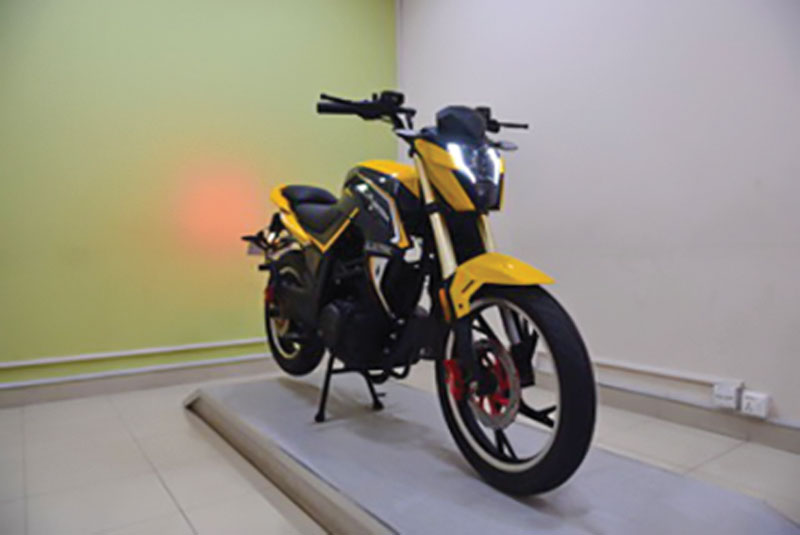
Yasir Darya’s ‘Air Rider’ highlights the issue of air quality deterioration in a truly modern way. As the winter sets in again, smog continues to make South Asian cities like Lahore and Delhi nearly unlivable. Multiple screens show a Google Maps overview of Karachi, the face of a rider on his bike as he makes his way through different parts of the city (recorded in real time), the biker’s vantage of the road, and a display of the air quality index (AQI) of the area he is currently riding in. This project makes an important point that satellite maps (as opposed to certain historical and political ones) present spaces with a certain agnosticism, and many of us that use them regularly fail to see the differences within our cities. As the rider moves from low-income areas to more affluent neighborhoods, the AQI improves (albeit slightly) with the lights in the room turning orange from red. The city is not the same for everyone. A potent reminder that we should not forget or ignore class and socioeconomic differences when pursuing climate and land justice.
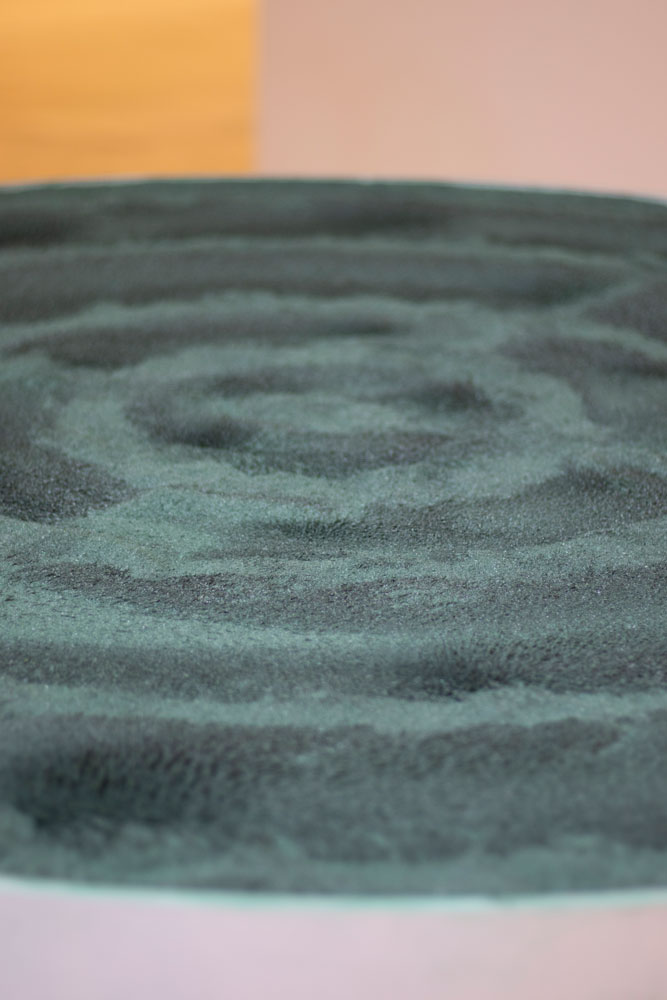
The other two were by Amin Gulgee and Dennis Rudolph. Gulgee’s ‘Memory Room’ created a space filled with aching nostalgia. This room moves on your senses from literally all sides. Shelves of cumin and chili powder aromatically induce the feeling of his childhood home, a wall full of pictures and paintings of opposing elements and family, a ceiling draped with his mother’s saris, and in the middle is a bed with mirrors and in the center of that a projection of Gulgee trying to breathe with his face blanketed with sand. The sound of Gulgee’s labored breaths fill the room with an ominous presence. He does not shy away from the brutality and senselessness of his loss and pain, while also showing what it means to be an artist in a society that buries free expression and those that stand for it.
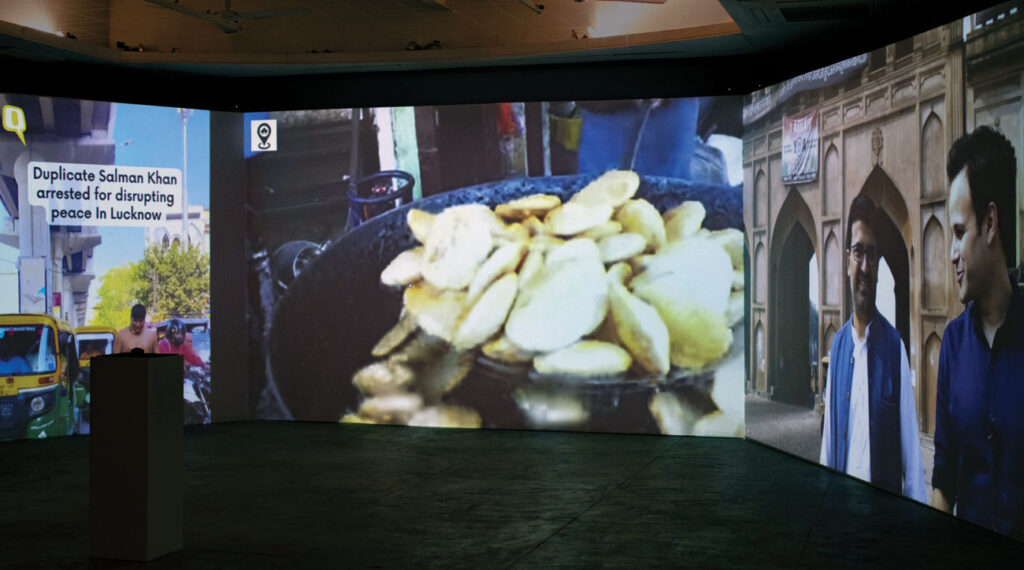
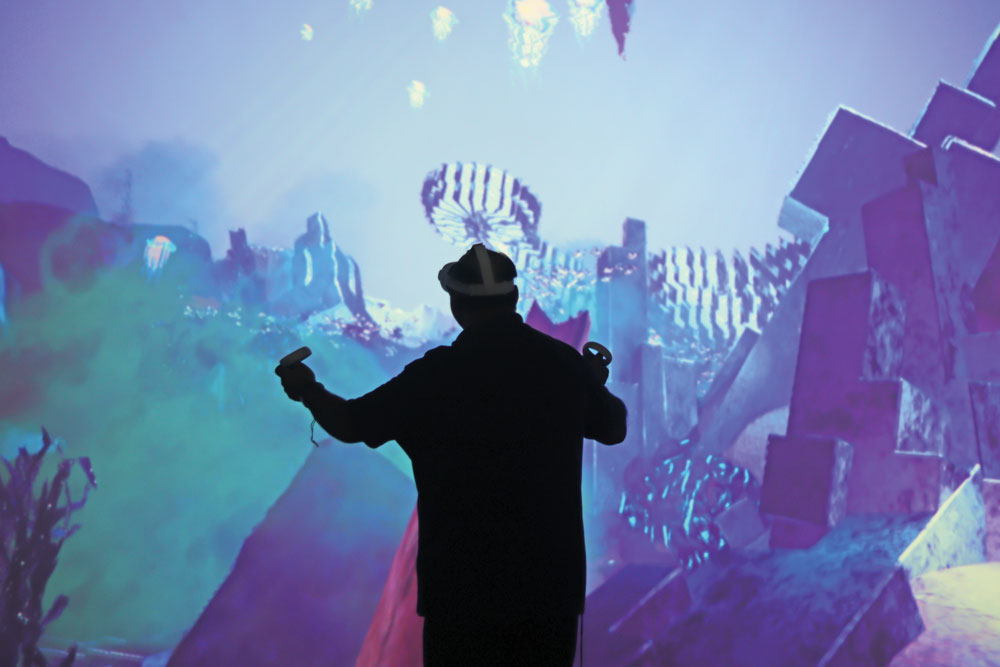
German artist Dennis Rudolph’s ‘Simurgh App’ is an app-based, augmented reality installation. Inspired by ancient Persian mythology, the piece incorporates modern technology and olden tales. Classic indigenous texts from the NJV school library, such as Mahabharta, Makli Nama, and Baloch Nama, are displayed. The downloadable app scans a text installation and three art pieces (3D paintings over enlarged pages from Ferdowsi’s Shahnameh) near the gate. Upon being scanned, these pieces reveal augmented mythological creatures.
A two-minute walk from the school is Jamshed Memorial Hall. Home to the Theosophical Society, the entrance is through an elegantly shaped white arch of Indo-Islamic style. Madhya Leghari presents ‘Speaking in Tongues’, a bi-lingual, interactive film project. In the film, the artist is seen in different places, especially her home (indoors) and in wild gardens (outdoors). There is an ever-presence of white clouds on the screen, with occasional black ones as a result of some explosives. The monologue voice-over by the artist plays out in a ‘stream of consciousness’ style prose, putting the audience in a dream-like state. Rabeeha Adnan also presents at Jamshed Hall, ‘Mukaalmah: We Can’t Both Be Right!’. A music and light show with old instruments and technology, the artist shows the interactions between different elements and compares it to Abrahamic religions, quite appropriate for the Theosophical Society.
The exhibition space at Hamid Market was created inside a part of a building wedged between Old Bandar Road and Rahguzar Walking Street. The family that owned this old construction, lost it during the uprooting caused by Partition. Presented on different levels within a narrow space, the highest room allows visitors to watch a colorful and changing heart with the help of a VR set in ‘My Heartbeats’ by Japanese artist Nobumichi Asai. The room also has a balcony view onto Old Bandar Road which gives an aerial perspective of Saddar’s buzzing activities.
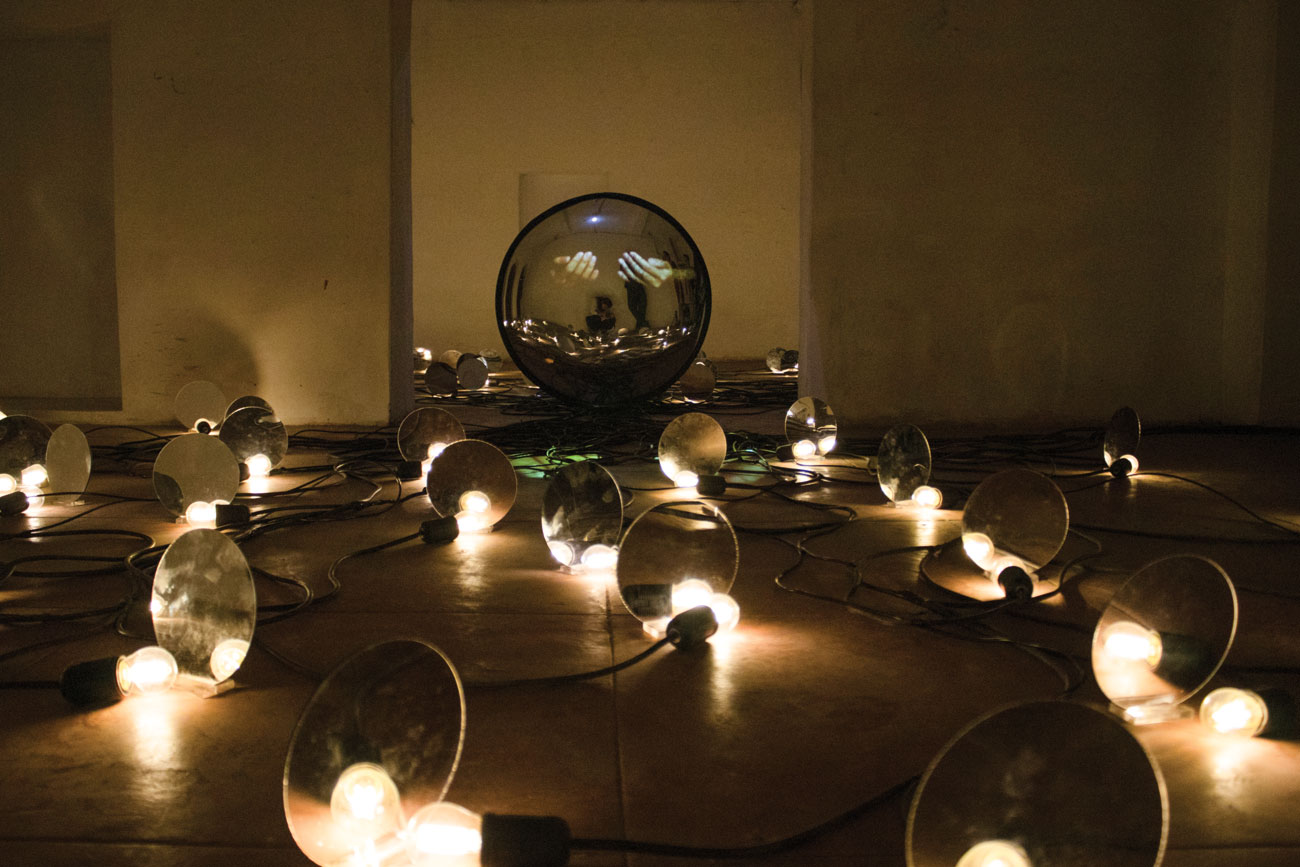
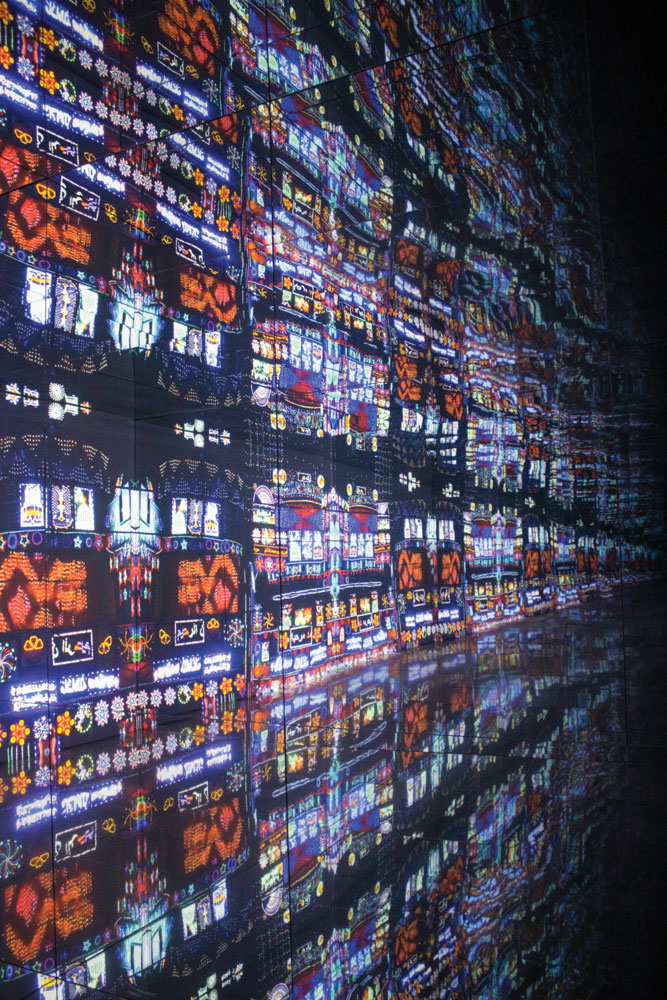
Imran Qureshi’s ‘Deen O Duniya’ and Alecia Neo’s ‘Power to the People’ were also at Hamid Market. Qureshi created a projection with reflective sides, showing the colorful and often chaotic mesh of lights and sounds (such as Qawwali music) that accompanies religious festivities. Neo’s work paid homage to the laborers of Saddar, whose hard work keeps the area going everyday. With two sides to represent the men and women, projections display hands engaged in prayer and gratitude while light bulbs scattered across the floor represent the ‘city of lights’ through its ups and downs. One can also look through the window to get a view of Rahguzar Walking Street, and its red-bricked flooring with the bricks provided by female workers from Makli. The Rahguzar Walking Street is an excellent restorative program by renowned architect and CEO of the Heritage Foundation of Pakistan, Yasmeen Lari. Spending time in Hamid Market, one can feel the presence of history and conjure up how people of old Karachi would have lived and moved around here.
The fourth venue in Saddar, NED University City Campus, is part of the same block as Burns Garden, People’s Square, and Dayaram Jethamal Sindh Government Science College (or DJ Science College). This area is an appealing collection of historic architecture and communal spaces for the people of Karachi. DJ Science College, founded in 1887, boasts the Indo-Saracenic style of British colonial architecture. Burns Garden (home to the National Museum of Pakistan) and the recently created People’s Square provide an area for recreational activities and cultural gatherings. The NED Campus also blends in stylistically with its surroundings.
Named after Nadirshaw Eduljee Dinshaw, a prominent member of Karachi’s once vibrant Parsi community, the university hosted four exhibitions. A large room covered end-to-end with small pictures that form a larger image of a sea surface, was presented by Rashid Rana and titled ‘It Lies Beyond’. The small images show the heaps of garbage dumped into the sea, some of which can be scanned to play a video within its frame. ‘Microtonal’ by Invisible Flock, brings the ancient borindo instrument to modernity through a sonically interactive piece. A mic hangs in the room to capture sound which is converted by an amplifier then played through the borindos.
The ‘Audio Placebo Plaza’ by Canadian artists Erin Gee, Julia E. Dyck, and Vivian Li, was a musical healing experience that allowed visitors to choose from different pre-set moods and have a unique piece of music curated for them. A local aesthetic and theme was emphasized with names like ‘Katakat Chat’ and ‘Lake Ansoo Dream’ for the categories of music. Amin Rehman’s ‘Water Wars’ was another exhibition that used augmented reality to highlight water-related issues, especially the plight of the affectees of recent floods.
Not only has each exhibition at this edition of the Karachi Biennale created another dimension, by pushing the boundaries of art through technology, but it has managed to leave an impression on its visitors. Entering the rooms by pushing black curtains apart, admiring and absorbing the visions and presentations, then upon exiting the installation it still continues to linger on in imagination. The transformation of space is a critical part of our collective thinking that needs more stimulus. As residents of a city where suffocation is the norm, to be able to escape to other worlds is a necessity not a luxury. Art is a necessity, not a luxury. Even traveling between the different venues of Saddar adds another experiential layer to the Biennale. As one moves to the next location after visiting the art installations at one, other heritage sights such as the Karachi Municipal Office, Sindh Muslim College (1943), and Kothari Building (1922) become unmissable. It becomes quite surreal seeing futuristic projects inside and around the historic town of Saddar. Inadvertently, the effect of the visual juxtaposition on the average Karachiite allows them to meditate on the story of the city. Where we came from, where we are, and perhaps most importantly, where are we headed?


